MICHIGAN NEWS
OWOSSO BARBER
STILL BATTLING $9K IN FINES FROM WHITMER LOCKDOWN
77-year-old was one of six hairdressers state
fined for cutting hair in 2020
By Jamie A. Hope, April 28, 2025
 Sarah
Huff, who owns a salon in Holland, cuts hair at Operation Haircut near the steps
of the Lansing Capitol on May 20, 2020, when Whitmer banned haircuts | Rodriguez
Photo Company
Sarah
Huff, who owns a salon in Holland, cuts hair at Operation Haircut near the steps
of the Lansing Capitol on May 20, 2020, when Whitmer banned haircuts | Rodriguez
Photo Company
Michigan residents and small business owners targeted by the Whitmer
administration got a long-delayed chance to speak on April 23 as the
Republican-controlled state House held its first hearings on government
overreach during the COVID lockdowns.
Two business owners and a lawyer described how they were targeted by Attorney
General Dana Nessel, the Whitmer administration, and local government at the
House's Weaponization of State Government hearing.
Gov. Whitmer declared barbers and hairdressers “nonessential” in 2020. Six
barbers and hairdressers defied the lockdown orders and were criminally charged
for cutting hair at the Michigan Capitol on May 20, 2020.
Five years later, Karl Manke, an Owosso barber, is awaiting a ruling in the
Shiawassee County Circuit Court to drop the fines, he said in the subcommittee
hearing. During the lockdown period, state government entities temporarily
suspended his barbershop and occupational license when he reopened his shop,
according to Kallman Legal.
The 77-year-old racked up $9,000 in fines, but Manke kept working to pay bills.
He believed Whitmer’s executive orders violated his rights, and the Michigan
Supreme Court ultimately agreed in October 2020.
Manke's fines included $1,500 for having hair and neck strips on his barbershop
floor and having a comb in his pocket during a televised media interview. He was
also fined $6,000 for cutting hair without a license on the steps of the
Michigan Capitol during Operation Haircut, a protest of Whitmer’s orders in May
2020. Though his license was later reinstated, the state refused to drop the
fines.
When the Michigan Supreme Court ruled in September 2020 that Whitmer’s orders
were unconstitutional, the charges against Manke were dropped.
Manke told the subcommittee he was never notified about the loss of his license.
Rep. Angela Rigas, R-Alto, chair of the Weaponization of State Government
subcommittee and a hairstylist for 25 years, said the $1,500 fine for having a
comb in a pocket was unusual.
Subcommittee member Laurie Pohutsky, D-Livonia, compared Manke to Michiganders
who are still in prison for marijuana violations that occurred before cannabis
became legal in Michigan.
Whitmer tapped emergency orders through the state health department after
reaching the limit of her executive-order powers.
Holland restaurant owner Marlena Pavlos-Hackney testified about Attorney General
Dana Nessel's determined effort to arrest her before she could appear on Tucker
Carlson's Fox News show to speak about reopening her business against pandemic
orders.
Emails obtained by Michigan Capitol Confidential in 2021 revealed that Nessel
explicitly stated her desire to have Hackney arrested before she could go on
Carlson's show. Hackney's testimony and present situation will be covered more
fully in an upcoming CapCon story.
Michigan Capitol Confidential is the news source produced by the Mackinac
Center for Public Policy. Michigan Capitol Confidential reports with a
free-market news perspective.
MICHIGAN REGULATORS
ORDER FAMILY FISHING SPOT FILLED
Lawmaker calls for funding cuts over pond
dispute
By Scott McClallen | March 27, 2025
 A
Michigan lawmaker wants to cut a state agency’s funding over disputes with
residents.
A
Michigan lawmaker wants to cut a state agency’s funding over disputes with
residents.
The new oversight committee fielded many complaints about the Michigan
Department of Environment, Great Lakes, and Energy, said Antrim Township
Republican Rep. Brian BeGole in a March 22 social media post.
“EGLE needs a lot of change and I have a feeling big budget cuts are coming for
them,” BeGole wrote.
The environmental agency is trying to force one Freeland man to fill in a pond
on his private property, Michigan Capitol Confidential reported in January. Two
months later, his brother Zach Wenzlick shared his story with Michigan lawmakers
via the House Oversight Committee on March 18. The state could fine Joshua up to
$1.7 million for expanding his pond from 2020-2023.
Joshua hired Schlicht Ponds of Montrose, a licensed contractor, to excavate the
pond to about 20 feet in one section. That depth is sufficient to sustain
wildlife when the pond freezes over in the winter, ensuring there is enough
oxygen.
Joshua stocked the pond with about 700 fish — a mix of bass, bluegill, crappie,
and perch. After stocking the pond, ducks, geese, and painted turtles moved into
the pond, Zach said.
But in March 2023, someone submitted an anonymous complaint about the property.
State employees visited the property without notice, Zach said.
Zach said Joshua gave the environmental agency a previous ruling that the pond
was a non-regulated wetland.
In June 2023, Joshua received a letter of a possible violation. The agency
referred the case to Michigan Attorney General Dana Nessel for enforcement, Zach
said.
In January 2024, Joshua received an order demanding that he restore most of the
one-acre pond to 18 inches or less of water, Zach told lawmakers.
That would kill all fish in the pond when it freezes during winter.
The environmental agency says it lawfully investigated an alleged violation of
Section 30314 of the Wetland Protection Act, as well as Part 301 Inland Lakes
and Streams, of the Natural Resources and Environmental Protection Act. The
agency is allowed, officials said, to enter premises suspected of causing an
“imminent threat to the public health or environment” or if it has reasonable
cause that the wetland “is a water of the United States as that term is used in
... the federal water pollution control act.”
The family flipped vacant mining land into a pond where they fish and enjoy
nature, Zach said.
“This is where we spend every 4th of July celebrating,” Zach said. “Where I wake
up on Saturday mornings with my son and we go fishing with my brother.”
“All my brother has done is take previous mining wasteland and turn it into a
thriving ecosystem,” Zach said.
The environmental agency hasn’t responded to a request for comment. Previously,
it denied any wrongdoing.
The family has been caught in a nightmare for over a year and treated like
criminals over a pond, Republican Rep. Matthew Bierlein of Vassar, said in a
March 18 social media post.
“My office has stood with Zach and his family since last year as they face a
situation no Michigander should ever have to endure,” Bierlein said. “This isn’t
just about a pond. It’s about property rights, government accountability, and
ensuring that no hardworking family is forced to defend themselves against this
kind of overreach.”
Michigan Capitol Confidential is the news source produced by the Mackinac
Center for Public Policy. Michigan Capitol Confidential reports with a
free-market news perspective.
MICHIGAN ELECTRIC
VEHICLE MAKER TO CLOSE TWO LOCATIONS AFTER POCKETING $900,000 SUBSIDY
Company
returning production to South Carolina
By Scott McClallen, February 24, 2025
 Receiving
$900,000 of taxpayer money won’t stop a Michigan electric vehicle maker from
shuttering two locations and taking 188 jobs out of state.
Receiving
$900,000 of taxpayer money won’t stop a Michigan electric vehicle maker from
shuttering two locations and taking 188 jobs out of state.
Auburn Hills-based automotive supplier BorgWarner will close two plants of its
subsidiary Akasol Inc., in Hazel Park and Warren. Layoffs will run from April 14
through July, according to a notice issued to the state under the federal WARN
Act.
The factories test products for electric vehicles, including battery modules and
packs, direct current fast charging equipment, and microgrid control and
operations, according to a 2023 news release.
In 2019, the Michigan Strategic Fund awarded the company $2.24 million in
taxpayer money for its Hazel Park plant, with the expectation it would create
224 jobs. The money would be paid out over five years as the company met
milestones for creating jobs.
But the state and the company amended the deal in 2022. Instead of being
promised $2.4 million over five years, the company received $900,000, according
to a Michigan Strategic Fund annual report. The company created 66 jobs,
according to the MSF report.
BorgWarner will close the plants as it pursues growth, the company told Michigan
Capitol Confidential.
“Consistent with those efforts, we have decided to shift all battery production
from our Hazel Park and Warren, Michigan, locations to our existing plant in
Seneca, South Carolina,” the company said in an email. “We believe in our
battery product portfolio and the opportunity for continued growth as customers
increasingly require innovative eMobility solutions."
Michigan officials have given various companies billions in taxpayer money in
return for jobs, but over a two-decade period, only one of every 11 jobs
promised actually got created, according to a new study by the Mackinac Center
for Public Policy. The study reviewed front-page news stories about government
grants to private businesses from 2000 to 2020, revealing that these deals
rarely meet job-creation goals.
When job deals made by the Michigan Economic Development Corporation fail, the
agency redefines success and declares victory, John Mozena, president of the
Center for Economic Accountability, told CapCon in an email.
“The MEDC is supposed to be guarding the interests of Michigan’s taxpayers and
holding companies accountable, but they act like their real allegiance is to the
companies that are getting the free money,” Mozena wrote. “That’s not
surprising, given that the MEDC’s board is made up of people who benefit from
these deals rather than anyone who might be a skeptic or whistleblower.”
Michigan can’t subsidize the auto industry to prosperity, according to Mozena.
“Whether it’s traditional cars and trucks, electric vehicles, so-called
‘mobility’ or whatever’s next, Michigan needs to tell the industry to stand on
its own feet, pay for its own factories and stop expecting Michigan’s taxpayers
to artificially inflate their balance sheets,” he wrote.
In 2023, Michigan lawmakers gave select private companies $4.6 billion in
subsidies.
“This deal is another reason lawmakers, taxpayers and voters should exercise
skepticism about corporate handouts,” Michael LaFaive, the Mackinac Center’s
senior director of fiscal policy, told CapCon in an email.
“State government confiscates taxpayer money to subsidize a company it thinks is
a real winner,” LaFaive wrote. “Then it issues a celebratory and
self-aggrandizing press release announcing alleged jobs that will be created.
The announcement is dutifully reported if not cheered in the press, only to see
that big corporate winner become a big loser in the marketplace.”
The company received a $900,000 MBDP grant. It was originally for $2.4 million,
however, through an amendment approved by the Michigan Strategic Fund Board, it
was reduced to $900,000, according to Otie McKinley, the media and
communications manager of the MEDC.
Michigan Capitol Confidential is the news source produced by the Mackinac
Center for Public Policy. Michigan Capitol Confidential reports with a
free-market news perspective.
SELECTIVE
SUBSIDIES ARE A LOSING STRATEGY FOR MICHIGAN
Corporate welfare does not fuel high-growth
states, and is not the answer for Michigan
By James M. Hohman, November 28, 2023
Politicians
are eager to take credit when companies like Ford Motor Company announce an
expansion that’s funded by taxpayer money. (Ford Motor Company press conference
announcing BlueOval Battery Park)
Michigan is falling behind. Jobs nationwide are up 3.0% from pre-pandemic
levels; Michigan has yet to recover all the jobs it lost in the pandemic. Its
0.7% decline is seventh-worst among states. The response from lawmakers was to
spend billions on selective business subsidies. It won’t work.
The states that have been growing the most are not the ones writing the biggest
checks to the biggest companies. They are Idaho and Utah, the states that spend
the least on selective business subsidies.
Handing out favors is no way to get ahead. The states leading the pack do the
least of it.
In contrast, Utah and Idaho score highly on what matters: economic freedom. The
Fraser Institute measures and ranks states based on their economic freedom, and
it puts the two states in the top 10.
Utah and Idaho protect property rights, only have regulations where they protect
the public, and keep taxes low. The formula works.
It works because basic rules affect everyone, while favoritism is only granted
to the few.
Most job creation happens without politicians getting involved. Michigan
businesses added 214,600 jobs in the first three months of 2023 and lost 187,400
jobs over that period. Businesses created one job for every 18 that were in the
state and lost one out of every 20 jobs.
The state’s economic development agency issued press releases that it had
awarded 18 businesses $293 million in taxpayer money to create 4,200 jobs during
the same period.
Job announcements are not the same thing as jobs — Ford Motor Co. already said
it’s scaling back a project that was part of the state’s releases — and the
state’s record of turning announcements into employment is pretty bad.
Still, even if things went according to plan, administrators would not be able
to replace 2% of the jobs lost in the economy.
Michigan is a leader in handing out special deals, but not at the scope
necessary to make a dent in the state’s job picture. Economic fundamentals
matter, as demonstrated in the states growing the most.
Favors exist because politicians love job announcements. It makes it seem like
they are doing something to create jobs.
Gov. Gretchen Whitmer adds a quote to all the press releases.
“Michigan is on the move, and we have an extraordinary opportunity right now to
create thousands of good-paying manufacturing jobs and bring supply chains
home,” Whitmer said in one.
It makes it sound like handing out money to companies will help grow the
economy.
But there is a difference between appearance and performance. In the ways that
matter, Michigan continues to fall behind.
Corporate welfare has three basic problems.
First, it’s an ineffective way to create jobs. Second, it’s unfair to the
businesses that don’t get handouts. Third, it is expensive to taxpayers.
There are several possible reasons why selective favors are ineffective. Many
companies that get cash could have done the same thing without deals from the
state. And there are real costs to the handouts, money that could be put to
productive uses elsewhere.
Time and again, economists find that handing out favors is no way to drive the
economic growth that politicians say they deliver with their deals. Michigan
won’t be “on the move” because Whitmer hands out subsidies to the right
companies.
Businesses only ask for favors when they think they can get politicians to
approve them. They’re happy to play states off each other to get more from cash
and tax breaks.
Instead of offering hundreds of millions to the next big company that asks for
favors, lawmakers should be working across state borders to agree to stop
handing out favors. They can agree to an interstate compact to drop their
favoritism, and such things have been introduced in the past, and there is a
bill to do so in Michigan at present.
Michigan should trash its selective subsidy programs. It’s a huge expense for a
failing strategy.
James M. Hohman is director of fiscal policy at the Mackinac Center. Email
him at hohman@mackinac.org.
Michigan Capitol Confidential is the news source produced by the Mackinac Center
for Public Policy. Michigan Capitol Confidential reports with a free-market news
perspective.
SO YOU WANT TO
MOVE TO MICHIGAN? HERE'S THE REALITY
$20M marketing blitz won’t mask Michigan’s
problems, but an engaged public can help
By James David Dickson, October 15, 2023
“You Can in Michigan” attempts to mask reality with
marketing. (State of Michigan)
The state of Michigan is spending $20 million on a multiyear campaign, called
“You Can in Michigan.” Between the new campaign and Gov. Gretchen Whitmer’s
“Make It In Michigan” effort, the state is spending about $60 million to tell
Michigan’s story beyond its boundaries.
The sales pitch is simple: “Career opportunity, quality of life and
affordability.”
It’s a nice thought, but it solves the wrong problem. The reason people leave
Michigan, or do not move here, does not owe to bad marketing or to a lack of
marketing. It owes to reality.
Between the roads, the electrical grid, and the schools — all poor — quality of
life is a struggle in Michigan, not a reason to move here. Yes, it’s pretty. But
what else?
Michigan is run as a 150-person club out of Lansing, not as a state of 10
million people. Lawmakers spend $82 billion of the public’s money. A billion of
that is on earmarks, pure pork, with only vague details about where the money is
going, and at whose behest. Lawmakers frequently don’t have access to current
information on bills, and the information available to the public is often
months old.
If you want to move to Michigan and be an involved citizen, transparency is a
battle you will fight, from local governments to the state government in
Lansing.
We have a state government whose tentacles extend into every aspect of your
life, either overriding local decision-makers or removing them from the process.
Should your private school administer medical marijuana? Should a farmer be able
to put wind turbines and solar panels on their property? Under current
leadership, the belief is that those decisions should be made in Lansing, not
locally.
We have leaders for whom the saying “character is destiny” augurs poorly.
We have government officials who go to great lengths to cancel income tax cuts
for the public. They then turn around to offer billions in corporate welfare to
Michigan’s biggest companies. Our leaders believe the answer to every problem,
even a state-created problem, is more bureaucracy.
We have a governor and attorney general who used the power of the administrative
state to crush — or attempt to crush — barbers or restaurant owners who dared to
earn a living during a pandemic. Not every business owner made it. Some people
lost everything.
Come to Michigan, if Tim Allen’s voice urges you. And you will find a state that
needs help.
You will find children left behind by Zoom schooling. You will find workers left
behind by the government-driven transition to electric vehicles. You will find
good people stunned by the difference between the Michigan they grew up in and
the Michigan they now occupy.
They’ll never leave, and they’ll always believe. They’re just not sure what to
do next.
Come to Michigan. You can call it the Fresh Coast, even.
But when you do come, ask not what Michigan can do for you. Ask for a bucket,
and start bailing water.
James David Dickson is managing editor of Michigan Capitol Confidential.
Email him at dickson@mackinac.org.
Michigan Capitol Confidential is the news source produced by the Mackinac Center
for Public Policy. Michigan Capitol Confidential reports with a free-market news
perspective.
WHITMER (AGAIN)
TOUTS THOUSANDS OF JOBS THAT DON'T EXIST
Governor misrepresents job announcements as
jobs
By Jamie A. Hope, August 4, 2023 Share on FacebookShare on Twitter
Gov. Whitmer boasts of thousands of new jobs to
make batteries for electric vehicles. None of those jobs have appeared.
Gov. Gretchen Whitmer boasted in an Aug. 2 tweet that she has been successful in
luring investments in battery manufacturing plants, claiming the subsidized
plants will add thousands of jobs. But the record shows a different story.
“If you’re keeping score, when I took office, we had 0 battery manufacturing
facilities. Soon we will have 5,” Whitmer wrote. “We’ve brought home more than
$16 billion in projects and secured over 16,000 jobs building EVs, batteries,
semiconductors and clean energy.”
The job numbers Whitmer cites in her tweet are potential future jobs that have
been announced, not positions that are currently filled, available, or in the
process of being created. Such misleading and sometimes false claims have been a
hallmark of Whitmer’s administration.
Politicians often hype tax-paid subsidies to corporations by describing jobs
projected as jobs themselves. In nearly all cases, the number of new jobs ends
up being far smaller than the number announced.
State officials gave $100 million to Ford Motor Co. in 2022 and announced that
the company was going to create 3,000 new jobs. Ford announced two months later
that it was laying off 3,000 workers.
None of the plants noted in Whitmer’s tweet exist yet. There are not 16,000 jobs
secured.
Whitmer’s tweet casts a negative light on one of her predecessors’ own
outlandish job-creation claims. Michigan had 2,521 battery manufacturing jobs in
2022. This was up from 763 such jobs in 2011. Gov. Jennifer Granholm spent
hundreds of millions of dollars in public funds trying to establish battery
manufacturing through her green energy program. Yet there were no battery
manufacturing facilities in the state when Whitmer took office, raising the
question of what Michigan taxpayers got for their money last time.
Granholm also boasted that her administration’s subsidies would create thousands
of new jobs and make Michigan the world hub of battery manufacturing. That never
happened. Now Whitmer is making the same promise.
Whitmer’s office did not respond to a request for comment.
Michigan Capitol Confidential is the news source produced by the Mackinac
Center for Public Policy. Michigan Capitol Confidential reports with a
free-market news perspective.
'SCAFFOLDING FOR PLUNDER'
Michigan Government Runs Roughshod
By Michael D. LaFaive,
April 27, 2023
Looking back on the first quarter
of 2023 it is not hard to be reminded of James Coffield’s famous description of
the British income tax system as “Scaffolding for Plunder.” Yet in Michigan
recently it feels broader, as if it is the whole government system working to
plunder us, not just the tax system.
Regardless of the political party in charge, many of us know or sense that we’re
shouting “stop” into a void. Michigan’s elites and elitists in government and
business are together running roughshod over the very people they force to pay
government’s bills. The only fixes may be constitutional.
One good example of this involves corporate handouts. In the last three months
alone, Lansing politicians have appropriated a staggering $3 billion in direct
subsidies for a handful of corporations. Not only is this unfair — forcing all
of us to underwrite the private interests of a favored few — but it is
ineffective. The majority of independent scholarship shows such programs don’t
create the jobs promised or at least not in a cost-effective way.
They can, however, result in windfall profits for powerful corporations who
would have likely created jobs without incentives. Their political handmaidens
also do well, increasing the likelihood of favorable headlines, ground-breaking
photo-ops and, in some cases, reelection. These subsidies are political tools
wearing the mask of economic development policy.
Companies that make political contributions are four times as likely to receive
government subsidies than those that do not. The subsidies are on average 63%
larger. One determinant of a large increase in state corporate handouts is
whether a state’s governor is up for reelection. Cities who have elected mayors
lavish larger subsidies on corporations than cities without an elected head. The
list goes on.
Corporations, politicians and their lieutenants in state agencies have a
symbiotic relationship, and together they’ve grown Michigan’s parasite economy.
Who pays? The rest of us, with slower growth, higher tax bills than would
otherwise be necessary and opaque, if not misleading governments. This group
works hard to protect its turf.
Michigan’s economic development agency has repeatedly bought questionable
studies to puff up its purported efficacy. It also aggressively blocks or
ignores attempts to acquire information that might illuminate its failures. It
even keeps its offers of taxpayer cash secret by using non-disclosure
agreements. Transparency might otherwise open it up to damning criticism and
threaten elites’ financial and political gravy trains.
And this is just in one area where politicians unfairly award the favored few
with special favors. There are others. A bill was recently introduced that would
swap out union members’ dues for taxpayer money. It’s likely the unions would
use a percentage of it to engage in politicking. In other words, your dollars,
their politics.
Another new bill would permit the creation of “solar energy districts” and would
be approved locally. It would require votes by those who own 50% of the assessed
property value. That is, one or two large property owners could theoretically
vote to create a solar district and drag others along with them. The same bill
would immediately grant tax exemptions for the districts. In addition to playing
favorites, the bill will promote the construction of far more solar energy
across the state.
But solar is already a heavily subsidized, unreliable, and expensive energy
resource that is gobbling up valuable farmland, at the same time as it relies on
questionable labor practices and threatens a massive increase in environmental
impacts.
If it seems like the “policymaking process” has been captured in a way “that
serves the well-off at the expense of the general welfare,” then join the club.
In their book, “The Captured Economy: How the Powerful Enrich Themselves, Slow
Down Growth, and Increase Inequality,” authors Steven Teles and Brink Lindsey
argue that it is government that is pushing markets and income equality in “an
inegalitarian direction.” Upward, that is.
What is the solution? There’s no panacea, but the authors recommend
constitutional prohibitions on the power of lawmakers. These could include a
Sustainable Michigan Budget amendment or a prohibition against granting fiscal
and other favors to specific corporations or industry.
Michigan state government suffers from too much favor seeking and granting. The
alliances between corporate and political classes result in harmful and
expensive policies. If thwarting those takes changes to our constitution then so
be it.
Permission to reprint this blog post in whole or in part is hereby granted,
provided that the author (or authors) and the Mackinac Center for Public Policy
are properly cited.
MICHIGAN TEACHERS UNION MAKES
FAKE CLAIM OF ATTACKS BY PARENTS
Seeking to silence school board opponents,
Michigan Education Association joins national effort to demonize dissent
By Jamie A. Hope | October 13, 2022
 The Michigan
Education Association attacks parents in an article on the union’s website,
calling for a campaign against a “loud minority of extremists” who dissent from
official policies during school board meetings.
The Michigan
Education Association attacks parents in an article on the union’s website,
calling for a campaign against a “loud minority of extremists” who dissent from
official policies during school board meetings.
“Parents, education advocates and several candidates for office came together
during a break in the monthly State Board of Education meeting on Tuesday to
speak out against organized right-wing attacks that are attempting to divide
parents and educators,” according to the Sept. 14 article at MEA.org.
The article makes no effort to substantiate its claims of “organized right-wing
attacks” — beyond a reference to public comment periods having been “flooded” by
input from groups such as Moms for Liberty. That particular 501(c)(4) group was
founded in 2021 by former school board members in Florida, and it has grown to
nearly 100,000 members. The MEA applauds union members who vow to “push back”
against the “vocal minority.”
The teacher union’s attack on parents follows massive failures in Michigan’s
public education system. Michigan students’ proficiency in English and math fell
32% and 36%, respectively, between 2018-19 and 2020-21, according to MI School
Data, and scores have only partly improved since the end of COVID restrictions.
Michigan ranks near the bottom of U.S. News & World Report’s current ranking of
states for education — in 38th place.
Dissenting opinions at school board meetings have become government and union
targets since 2020, when COVID-related restrictions and new school curricula
prompted many formerly quiet parents to begin speaking up. They started voicing
concerns about what they call racially divisive and hyper-sexualized content
that their children are exposed to at school.
Holt Public Schools called for affinity spaces where white students are not
allowed. Saline Area Schools provide graphic sexual images in its curriculum.
The Rochester Community Schools District uses ‘White Fragility’ by Robin
DiAngelo in its teacher training materials. “All white people are invested in
and collude with racism” DiAngelo writes, “socialized into a deeply internalized
sense of superiority that we either are unaware of or can never admit to
ourselves, we become highly fragile in conversations about race.”
Teacher unions in the United States are no stranger to partisan politics; they
gave $6.7 million to Democrats in 2020 and $147,600 to Republicans, according to
OpenSecrets.org. The MEA is endorsing and financially contributing to numerous
candidates for local school boards this year.
Kim Laforet, a candidate for the Grand Ledge Public Schools Board of Education,
is not one of those individuals.
“Labeling parents and some educators as ‘right-wing extremists’ for merely
having a different view of how and what to teach our children is the problem we
are facing,” Leforet told Michigan Capitol Confidential. “Teaching about the
failings of our country, along with its successes, is imperative so that our
children learn not to make the same mistakes when they are the ones governing
our country. However, if they don’t have a love for our country, what can we
expect in our future? A country that bans free speech?”
Laforet says that schools in the country are sexualizing children and dividing
them based on race. She hopes that school boards will listen to parents when
they voice concerns that children who can hardly read now have access to books
with graphic depictions of sexual acts.
She notes that the MEA has lost thousands of members in recent years, saying
this is because the union does not represent all teachers, despite it claims.
She wants the educational system to be a place where differences co-exist,
“everyone has a voice” and all are treated with respect.
The MEA did not respond to a request for comment.
Permission to
reprint in whole or in part is hereby granted, provided that the Mackinac Center
and the author are properly cited.
MICHIGAN DOESN'T NEED
ITS OWN COLLEGE ROI CALCULATOR
Cheaper tuition,
not bigger promises, would help bring students back
By Jennifer Majorana, May
17, 2022
State governments are taking what
seems to be a practical step toward understanding the actual value of a college
education: websites that purport to quantify the worth of a diploma in dollars
and cents. But Michigan shouldn’t feel the need to follow suit.
Higher education is in a bizarre place right now. Breakneck shifts to virtual
instruction in 2020, combined with rules about quarantining, social distancing,
testing, vaccinations and masking, have shifted the focus of higher education.
Even while responses to the pandemic have made the college experience less
engaging, policymakers have ramped up incentives for young people to attend
college with new programs, extra funding from the federal government and an
ongoing moratorium on required student loan payments. The result is a confusing
set of contradictions.
Fewer Michigan high school graduates are interested in attending college than
before COVID-19, despite the prodding of state and national officials.
Recruitment officers are having an especially tough time due to a long-term
trend of increasing college costs and a surge in inflation over the past year.
In response, school and state officials have developed return-on-investment
calculators to encourage more students to attend. Many states have started
websites that compare the expected salaries of new university graduates at
different institutions or majors.
Florida recently unveiled a website to help prospective college students and
parents to compare salary, employment prospects and the average loan burden at
Florida’s twelve public four-year institutions, broken out by field of study.
A variety of government, institutional, financial and informational websites
feature similar tools.
Choosing where and when to go to college, what to study and how much debt to
incur does matter for future success. But there are other factors to consider.
A degree doesn’t come with a salary guarantee. Many college graduates end up
working outside their fields. It should be no surprise: What you thought you
would do at age 18 or 22 doesn’t predict what you will do when you are 40 or 44.
Furthermore, the well-paying jobs of today might not exist in the future. And
the well-paying jobs of the future might not exist today.
The tools are not entirely valueless. Prospective students may want to see how
well-off graduates are, and compare the salaries earned by graduates from
different degree programs in different schools. College return-on-investment
calculators can help students make more informed decisions about their future
prospects for repaying education loans.
Should Michigan follow Florida’s lead in creating yet another college
return-on-investment calculator, specific to Michigan public universities?
Probably not. Lawmakers can insist colleges not mislead students, and high
school guidance counselors can incorporate existing calculators into their
advising process. But Michigan doesn’t need its own calculator. They’re already
widely available.
Instead of encouraging students to fixate on simplistic returns from degrees,
lawmakers should encourage schools to lower costs. The price tag of
postsecondary education is headed in the wrong direction, and higher government
spending tends to exacerbate the problem. An overpriced investment naturally
leads to lower returns for anyone, regardless of which college or major one
chooses.
Flooding the decision-making process with more calculators won’t increase the
return on investment that students make. Finding ways to reduce the cost of
college will.
Permission to reprint this blog post in whole or in part is hereby granted,
provided that the author (or authors) and the Mackinac Center for Public Policy
are properly cited.
GOVERNOR'S BUDGET
DOWNGRADES CHARTER SCHOOLS
Whitmer’s school
aid proposal picks winners and losers
By Ben DeGrow, February 15,
2022
Michigan’s governor wants another
major infusion of extra tax dollars into the state’s public schools. The
predictable approach has been rewarded with approving media headlines. But one
troubling aspect of her proposed spending has received little attention: the
extent to which it picks winners and losers.
Gov. Gretchen Whitmer’s new school aid budget comes in two parts. First, she
wants nearly $2 billion more to spend between now and September 30, primarily on
programs designed to fill classrooms. That includes money to defray college
tuition costs for prospective teachers, pay stipends to student teachers and
provide the first round of multi-year four-figure bonuses for instructors to
stay on the job.
Second, Whitmer put forward a 2023 proposal that would spend 8% more than this
year’s approved amount. Excluding federal funds, it would be the largest school
aid budget increase of the century. The $18.4 billion executive school aid
budget, made up of both state and federal funds, would continue a clear trend of
K-12 spending growth. It includes everything from a 5% per-pupil formula boost
to more state dollars for facilities, preschool and student mental health.
There’s a worthwhile discussion to be had about broad budget strokes and overall
price tags. But her request should not stand as introduced, because it
discriminates against certain educators, schools and students without sound
reasons.
Whitmer wants to provide a $2,000 retention bonus to teachers across the state,
but only to those who are directly “employed by” their districts. Most public
charter school teachers are paid as contractors and thus wouldn’t be eligible
for the bonus. But there’s no evidence that these schools are less affected by
staffing challenges. Nor are there data to support fears of a mass teacher
exodus generally.
Next, the governor’s 2023 budget calls for adding “$170 million annually over
the next 6 years” to a state fund intended to help local schools pay for
building and infrastructure projects. School buildings that are leased, rather
than owned, would not qualify for the financial aid. That excludes many charter
schools, which unlike conventional districts, lack the authority to raise local
taxes to help finance facility additions or upgrades.
Finally, Whitmer explicitly seeks to leave out students who select an online
charter school from the promised primary funding increase. Her budget would
raise base per-pupil funding from $8,700 to $9,135, but not for students
enrolled in online charter schools. This gratuitous decision would save just a
tiny portion of the overall budget – estimated between $5.7 and $7.7 million
based on recent enrollments – on the backs of select students. If she believes
that money is too much, it could come out of another part of the school aid
budget.
On the other hand, one could look at this last proposal as progress. The last
time Whitmer targeted students to deny them an across-the-board funding
increase, it affected students in all charter schools, or about 10% of the
state’s public school enrollment. And in 2021, she called for a 20% cut to cyber
school formula funding, even as these schools accepted a surge of incoming
students.
It’s difficult to take the governor’s budget proposals seriously when they treat
charter schools and their students as second-class citizens. The attempts to
placate interest groups at the expense of these students belies the praise of
state superintendent Michael Rice, who declared that Whitmer’s budget “puts
students first.”
Rice’s cheery rhetoric about “students” unfortunately leaves out many students
whose families have chosen different public education options. Time and again,
the governor has denied parents any say over education funds. Now, while
doubling down on attempts to enrich the system, her budget proposal is treating
some families’ choices as second-class.
To truly put children first, the Legislature should reject the Governor’s
preferential treatment of some students and pursue a different path.
Permission to reprint this blog post in whole or in part is hereby granted,
provided that the author (or authors) and the Mackinac Center for Public Policy
are properly cited.
MICHIGAN DEMOCRATIC PARTY:
'THE CLIENT OF THE PUBLIC SCHOOLS IS NOT THE PARENT'
Post on party’s Facebook page echoes view of
former Virginia Governor
By Tom Gantert, January 17, 2022
 Editor's note: After
this story was published, the Michigan Democratic Party retracted the post and
issued this statement:
Editor's note: After
this story was published, the Michigan Democratic Party retracted the post and
issued this statement:
“We have deleted a post that ignored the important role parents play—and should
play—in Michigan public schools. Parents need to have a say in their children’s
education, end of story. The post does not reflect the views of Michigan
Democrats and should not be misinterpreted as a statement of support from our
elected officials or candidates.”
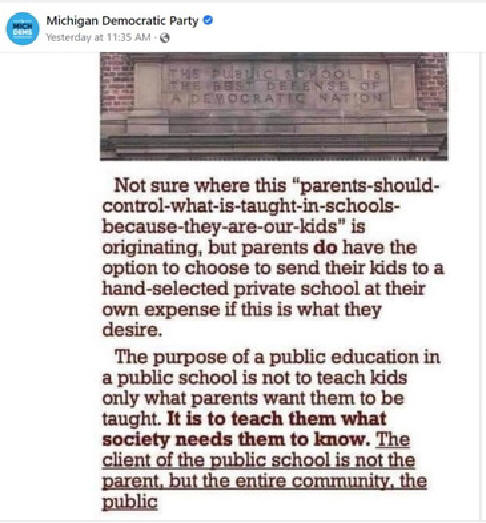
The Michigan Democratic Party posted a meme on its Facebook page Saturday,
questioning whether parents who send their children to public schools have any
right to control what is taught there.
“Not sure where this
‘parents-should-control-what-is-taught-in-schools-because-they-are-our-kids’ is
originating, but parents do have the option to choose to send their kids to a
hand-selected private school at their own expense if this is what they desire,”
read the post (emphasis in the original).
The post appeared on what is called “The Official Facebook Page of the Michigan
Democratic Party.” The page states it is under the control of the Michigan
Democratic State Central Committee.
The message continued: “The purpose of a public education in a public schools is
not to teach kids only what parents want them to be taught. It is to teach them
what society needs them to know. The client of the public schools is not the
parent, but the entire community, the public” (emphasis in the original).
Michigan law contains language suggesting something different, however, which
was pointed out in a user comment posted on the same Facebook page. Stephanie
Buikema, an employee of Rockford Public Schools, cited Section 380.10 of the
Michigan Revised School Code. It states:
“It is the natural, fundamental right of parents and legal guardians to
determine and direct the care, teaching, and education of their children. The
public schools of this state serve the needs of the pupils by cooperating with
the pupil’s parents and legal guardians to develop the pupil’s intellectual
capabilities and vocational skills in a safe and positive manner.”
“Michigan Democratic Party,” Buikema wrote, “you should familiarize yourselves
with the document.”
The Michigan Democratic Party’s Facebook post has similarities to the statement
made by former Virginia Democratic Gov. Terry McAuliffe, who was running for a
second nonconsecutive term in 2021. In a campaign debate, he made comments about
schools that many political insiders say cost him the election.
“I don’t think parents should be telling schools what they should teach,”
McAuliffe said. Republican Glenn Youngkin won the election.
Michigan Capitol Confidential is the news source produced by the Mackinac
Center for Public Policy. Michigan Capitol Confidential reports with a
free-market news perspective.
WHY THE STATE SHOULD
STOP SUBSIDIZING SELECT BUSINESSES
Corporate
handouts are unfair, ineffective and expensive
By James M. Hohman, June 30, 2021
Michigan’s business subsidies are unfair,
ineffective and expensive. Lawmakers should stop spending taxpayer dollars on
them.
They are unfair because they reward some businesses at others’ expense. The new
apartment complex in town gets a favor, while the old ones paying their share of
taxes do not. One auto supplier gets money while another doesn’t. They’re all
paying taxes, but some collect tax dollars, too, and state policymakers should
not be picking winners and losers like this.
Select subsidies are ineffective because they don’t do the job that lawmakers
created them to do: They don’t drive economic growth. They don’t help their
state add more jobs than others. A close look at the programs by economists
finds that they are a drain on growth rather than a cause of it. They can give
examples that look like state policymakers are doing something about jobs, but
they do not accomplish the objective they were created to achieve.
And they cost a lot of money that could be spent better elsewhere or used to
lower the state’s tax burdens. Michigan lawmakers will transfer $741.7 million
from taxpayers this year to the individual companies fortunate enough to get
state subsidies. That’s more than the state spends on environmental protection
and the Department of Natural Resources. And enough to cut the income tax rate
down to 3.95% without touching other state spending. Across the country, states
spend nearly twice as much on business subsidies as they do on fire protection.
Yet even reluctant lawmakers see that other states offer special deals to select
companies and think that they need to do so as well. That these other states
offer business subsidies is evidence enough for many lawmakers that their state
must have similar programs, too. Which is why, if states are going to continue
to offer business subsidies to compete with what other states provide, lawmakers
ought to sign on to an interstate compact to end the programs. States should not
compete based on unfair and ineffective tax favors, and they can agree to stop
together. Legislation to stop handing out new deals has been introduced in 15
states already, Michigan included.
Lawmakers ought to be skeptical of these programs and end them even if they
don’t want to sign on to an interstate compact. People of all political
persuasions ought to be uncomfortable with taking money from taxpayers and
handing it out to select businesses. These corporate handouts fail to grow the
economy, provide unfair advantages in the competition among firms and cost
taxpayers too much.
Permission to reprint this blog post in whole or in part is hereby granted,
provided that the author (or authors) and the Mackinac Center for Public Policy
are properly cited.
GRANHOLM GREEN ENERGY HANDOUT:
A GLOWING PROMISE AND CATTLE FEED
After getting millions from taxpayers, Alpena
biogas refinery now makes a livestock ingredient
By Jamie A. Hope, June 1, 2021
 At its
launch in 2009, an operation called the Alpena Prototype Biorefinery was lauded
by Gov. Jennifer Granholm, the federal government and managers in the corporate
welfare arm of Michigan’s state government as the future of green energy.
At its
launch in 2009, an operation called the Alpena Prototype Biorefinery was lauded
by Gov. Jennifer Granholm, the federal government and managers in the corporate
welfare arm of Michigan’s state government as the future of green energy.
The plant still existed as of February 2021, according to various reports, but
it appears nowhere close to helping Michigan become, in Granholm’s words, “the
alternative energy capital of the world.”
The plant has received millions of dollars in taxpayer subsidies to produce
energy from nonconventional sources. But it is instead making wood molasses to
feed livestock, according to the latest reports in 2021.
Understanding how a project born amid promises of a becoming an energy source
became a producer of an obscure agricultural product is not easy task.
Sporadic reports in local news media indicate the original company was sold to
new owners. And according to The Alpena News, the city is seeking back taxes
owed by the original owner, called American Process Inc. The company also
defaulted on a subsidy deal with the Michigan Economic Development Corporation,
the state’s corporate welfare arm.
One media report says that 33 jobs were created with the taxpayer grants, but by
2015, the company suspended operations and quit producing ethanol. The plant
reopened in March 2016 and began producing wood molasses. The company breached
its agreement with the state when it stopped producing ethanol, according to The
Alpena News, and thus lost its tax-exemption deal with the MEDC.
The local newspaper also reported that the Alpena refinery was bought by GranBio,
a Brazilian company. As of February 2021, the city of Alpena was still pursuing
over $800,000 in back taxes from the current and previous owners, going back to
2016.
Alpena City Manager Rachel Smolinski did not return an email asking about the
status of the biorefinery.
The Alpena biorefinery is not the only Michigan renewable energy scheme to be
launched on a wave of promises and publicity and then sink out of sight when the
promises went unfulfilled.
“We are continuing to diversify Michigan’s economy through the development of
green energy technologies,” Granholm said when announcing that the area around
the Alpena facility had been designated a tax-exempt Renewable Energy
Renaissance Zone. The designation allowed the company “to operate free of
virtually all state and local taxes for 15 years,” according to the MEDC.
Companies that receive the designation often received multiple subsidies, and
this project was no exception.
American Process, Inc., original owner of the refinery, was awarded $4 million
by the Michigan Economic Development Corporation in 2009, and $22 million by the
U.S. Department of Energy under the Obama administration stimulus program.
“This grant, in support of one of our Centers of Energy Excellence, will bring
160 jobs to the Alpena area and strengthen Michigan’s efforts to be a leader in
the development of the next generation of biofuels,” Granholm said in 2009.
Greg Main, president and CEO of MEDC, also stated in 2009, “Developing and
harnessing green energy sources in Michigan is critical to securing a strong
economic future.”
When Granholm attended a ribbon cutting ceremony at the plant, she said, “We are
here today celebrating that Alpena has become a center for clean energy
excellence. This plant is not just good for Alpena, it is good because it
provides great hope for the great future of waste-to-energy.”
The U.S. Department of Energy also touted the promises in a statement that read,
“In the future, the Alpena Biorefinery may also be hired by other innovators to
evaluate emerging conversion technologies for the growing U.S. bioindustry.” The
department has not updated information on its website to reflect on the
company’s current activities in producing a cattle feed input.
Michigan Capitol Confidential is the news source produced by the Mackinac Center for Public Policy. Michigan Capitol Confidential reports with a free-market news perspective. From the Mackinac Center for Public Policy, a research and educational institute headquartered in Midland, Michigan. Permission to reprint in whole or in part is hereby granted, provided that the author and the Mackinac Center are properly cited.
WIND,
SOLAR FIRMS PICKED FOR GRANHOLM'S GOVERNOR MANSION SOON WENT BROKE
Detroit Free Press
reported the installation meant she’s not kidding on renewables
By Tom Gantert, May 10, 2021
 A July 11, 2009, story in the
Detroit Free Press described then-Gov. Jennifer Granholm’s renewable energy
efforts.
A July 11, 2009, story in the
Detroit Free Press described then-Gov. Jennifer Granholm’s renewable energy
efforts.
“When Gov. Jennifer Granholm boasts that Michigan should be the renewable energy
capital of the nation, she’s not kidding,” the article stated.
“To prove her point, Granholm had a Michigan-made wind turbine installed at the
official residence in Lansing, and it started producing energy last week.”
The 1.2 kilowatt-per-hour turbine was made in Manistee by Mariah Power.
The 2009 article also reported that Granholm planned to install solar panels
made by United Solar Ovonic on the roof of the gubernatorial residence within
the next few months.
Mariah Power later became Windspire Energy. Both it and United Solar Ovonic
filed for bankruptcy in 2012, only three years later.
Both companies were subsidized through state tax credits delivered under the
Michigan Economic Development Corporation. United Solar Ovonic was awarded a
$17.3 million tax credit in 2008. Mariah Power was awarded a $400,000 grant by
the MEDC in 2008.
From the Mackinac Center for Public Policy, a research and educational institute headquartered in Midland, Michigan. Permission to reprint in whole or in part is hereby granted, provided that the author and the Mackinac Center are properly cited.
MICHIGAN BUREAUCRATS WANT PERMANENT COVID REGULATIONS
Michigan workplace regulators propose
permanent rules for temporary problem
By Michael Van Beek, April 19, 2021
 Gov. Gretchen Whitmer just
extended emergency COVID-19 rules that all Michigan employers must follow. Among
other things, they require businesses to conduct daily health screenings of
employees, require masks to be worn whenever anyone could be within six feet of
someone else and isolate employees who have a suspected case of COVID. Unless
rescinded, these rules will continue until October. But they could last even
longer, because the Michigan Occupational Safety and Health Administration wants
to transform these emergency rules into permanent ones.
Gov. Gretchen Whitmer just
extended emergency COVID-19 rules that all Michigan employers must follow. Among
other things, they require businesses to conduct daily health screenings of
employees, require masks to be worn whenever anyone could be within six feet of
someone else and isolate employees who have a suspected case of COVID. Unless
rescinded, these rules will continue until October. But they could last even
longer, because the Michigan Occupational Safety and Health Administration wants
to transform these emergency rules into permanent ones.
In the department’s filings, required by state law to create new administrative
rules, MIOSHA admits that only one other state in the country has created
permanent COVID-19 regulations like these — Virginia. But the Virginia rules
MIOSHA references are labeled “emergency temporary standards,” so it is not
clear that this is the case. Either way, Michigan is one of the first states
where unelected bureaucrats are seeking permanent COVID regulations on
businesses.
The department says in its filings with the state’s Office of Administrative
Hearings and Rules that these regulations are needed because “Michigan’s
experience with COVID-19 demonstrates that the disease can spread rapidly
without protective measures and standards in place.” But that rationale doesn’t
hold much water, considering identical emergency rules have been in place since
last October, and Michigan has experienced two separate COVID-19 waves since
then.
Regardless of whether the state should impose permanent regulations in response to a temporary emergency, the proposed rules raise concerns for several other reasons. Here are some of them:
They do not automatically expire when the COVID-19 pandemic is over. Even after the state health department rescinds its “epidemic orders” and no other emergency declarations are active, these rules can stay on the books. They only require state bureaucrats to “examine the continued need for these COVID-19 rules” after the state’s other emergency controls are lifted.
The rules do not mention the word “vaccine” and could remain in place regardless of how many people are vaccinated. This means that employers would still have to require their employees to wear masks, work from home and socially distance even if the entire workplace is fully vaccinated.
Some of the proposed rules originate from mandates issued by Gov. Whitmer through executive orders last spring and are based on an outdated understanding of the coronavirus. For instance, they prohibit employees from sharing equipment and require employers to “increase facility cleaning and disinfection.” That’s because last spring it was thought that virus could easily spread on surfaces. That’s no longer supported by the science, and the Centers for Disease Control and Prevention recently estimated that the chance of catching COVID from surface contact is one in 10,000.
Some mandates are ill-defined and poorly written, making it difficult for employers to know if they are complying. For example, they require businesses to “create a policy promoting remote work for employees to the extent that their work activities can feasibly be completed remotely.” But what counts as “feasible” or “promoting” is not defined, so employers will have to make a guess of it.
The rules turn businesses into mask police; it mandates that they require customers to wear face coverings. Current epidemic orders — mandates from the state health department distinct from MIOSHA rules — obligate everyone two and older to wear masks in public. But even after those orders are lifted, these rules would obligate employers to force customers to mask up nevertheless. Businesses will be stuck between turning away customers who don’t want to wear masks (even fully vaccinated ones) or risk state penalties.
As part of the rulemaking process,
the department must submit a form called a “regulatory impact statement and
cost-benefit analysis,” which requires it to consider the compliance costs these
rules will impose on Michigan businesses. Amazingly, and somewhat
disingenuously, MIOSHA claims these rules will impose “no additional burdens.”
Its reasoning is that identical mandates are already in place, so businesses
won’t face any new costs if these rules are made permanent. That’s akin to
knocking a guy to the ground and then claiming that pinning him there won’t do
him any harm because he’s already lying down.
Given an inch, MIOSHA stands poised to take a mile. Unfortunately, this has been
the typical approach by the Whitmer administration, perhaps the only consistent
aspect of her COVID-19 strategy.
Permission to reprint this blog post in whole or in part is hereby granted, provided that the author (or authors) and the Mackinac Center for Public Policy are properly cited.
CITING THE
AMERICAN REVOLUTION . . . BARAGA COUNTY OFFICIALS REVOLT AGAINST STATE COVID
ORDERS
Upper Peninsula community’s leaders point to their oath
By Tom Gantert,| January 12, 2021
 Several Baraga County commissioners, plus the sheriff, prosecuting attorney,
clerk, and treasurer of the Upper Peninsula county, have all signed a manifesto
that places the state on notice that they will no longer enforce the state's
COVID-19 mandates and restrictions.
Several Baraga County commissioners, plus the sheriff, prosecuting attorney,
clerk, and treasurer of the Upper Peninsula county, have all signed a manifesto
that places the state on notice that they will no longer enforce the state's
COVID-19 mandates and restrictions.
The declaration reads: “Since March 10, 2020, the People of the State of
Michigan have endured restrictions on their freedom which have not been seen in
North America since the days of King George III and the American Revolution. In
the face of a worldwide pandemic our political leadership in Lansing has ignored
the protections guaranteed to all America citizens by the Bill of Rights in
favor of the medical models designed to predict the course of a still, for the
most part, unknown virus. The result has been the unilateral adoption of clearly
unconstitutional measures which treat human beings like herd animals and which
arbitrarily pick economic winners and losers. Our citizens’ rights to assemble,
to freely practice their religion, to travel, to keep their property, businesses
and jobs, even to dress as they please have all been swept aside, and to what
end? The pandemic rages on and Lansing’s failed efforts to control the spread of
the virus is blamed on the people themselves rather than the scientific
community’s admitted lack of data and understanding of COVID-19.”
The manifesto continued: “Enough is enough. We have taken an oath to uphold and
defend the Constitution of the United States of America, an oath we take very
seriously. Accordingly, we hereby put the State of Michigan on NOTICE that we
have no intention of participating in the unconstitutional destruction of our
citizens’ economic security and Liberty. We further declare our intention to
take no action whatsoever in furtherance of this terribly misguided agenda.
Finally, we call upon the Michigan Legislature to exercise their co-equal
authority by adopting constitutionally sound measures which limit the unchecked
exercise of executive power, which restore individual responsibility and
accountability, and which return Michigan to the ranks of freedom-loving
governments everywhere.”
The Baraga County elected officials who signed the declaration include Sheriff
Joe Brogan, Clerk Wendy Goodreau, Treasurer Jill Tollefson, Prosecuting Attorney
Joseph O’Leary and Commissioners Gale Eilola, Dan Robillard, Will Wiggins,
William Rolof and Lyle Olsen.
Michigan Capitol Confidential is the news source produced by the Mackinac Center
for Public Policy. Michigan Capitol Confidential reports with a free-market news
perspective.
From the Mackinac Center for Public Policy,
a research and educational institute headquartered in Midland,
Michigan. Permission to reprint in whole or in part is hereby
granted, provided that the author and the Mackinac Center are
properly cited.
GOP STATE LEGISLATURES:
COWARDICE UNDER FIRE
Republican lawmakers in the
battleground states surrender without a fight.
By David Catron, December 7, 2020
 Despite
the mendacious claims of the legacy “news” media, there is clear evidence that
egregious violence was done to election laws in at least five states during the
recent presidential contest. Sworn testimony from dozens of eyewitnesses,
well-documented breaches of statutory ballot counting protocol, and damning
security camera videos have been presented to legislators in these states.
Republican lawmakers in Arizona, Georgia, Pennsylvania, Michigan, and Wisconsin
have the constitutional power and the moral duty to rectify the resultant
fraudulent outcomes. The only obstacle to reestablishing voter sovereignty in
these five states is the inaction of the spineless GOP majorities that control
their legislatures.
Despite
the mendacious claims of the legacy “news” media, there is clear evidence that
egregious violence was done to election laws in at least five states during the
recent presidential contest. Sworn testimony from dozens of eyewitnesses,
well-documented breaches of statutory ballot counting protocol, and damning
security camera videos have been presented to legislators in these states.
Republican lawmakers in Arizona, Georgia, Pennsylvania, Michigan, and Wisconsin
have the constitutional power and the moral duty to rectify the resultant
fraudulent outcomes. The only obstacle to reestablishing voter sovereignty in
these five states is the inaction of the spineless GOP majorities that control
their legislatures.
As I and others have previously noted, the Constitution reserves the sole power
to select presidential electors and the method by which they are chosen to the
state legislatures: “Each State shall appoint, in such Manner as the Legislature
thereof may direct, a Number of Electors, equal to the whole Number of Senators
and Representatives to which the State may be entitled in the Congress.” No
other state official or judge can make this call without legislative consent.
The pathetic excuses of the lawmakers themselves notwithstanding, they can
restore election integrity in their states. Instead, they take positions similar
to the “leaders” of the Michigan legislature, who offered this pusillanimous
statement:
The Senate and House Oversight Committees are actively engaged in a thorough
review of Michigan’s elections process and we have faith in the committee
process to provide greater transparency and accountability to our citizens. We
have not yet been made aware of any information that would change the outcome of
the election in Michigan and as legislative leaders, we will follow the law and
follow the normal process regarding Michigan’s electors, just as we have said
throughout this election.
They are evidently “not aware” of clear violations of state law by Michigan
Secretary of State Jocelyn Benson, who illegally gave private activist
organizations access to voter rolls. Among the recipients of Benson’s disregard
for this statute was the Center for Tech and Civic Life (CTCL), an organization
controlled by Facebook founder Mark Zuckerberg. They also failed to notice that
Zuckerberg’s organization donated $350 million that paid for “election workers”
whose activities were largely carried out in the very counties in which election
canvassers at first refused to certify the election results due to serious
irregularities. At length the latter acquiesced after being physically
threatened, accused of racism, and doxxed.
The Amistad Project has filed a lawsuit with the Michigan Supreme Court asking
the judges to direct the state legislature to conduct an investigation into the
above-described violations as well as many others. As the director of the
Amistad Project phrased it, “The pattern of lawlessness was so pervasive and
widespread that it deprived the people of Michigan of a free and fair election,
throwing the integrity of the entire process into question.” This lawsuit
wouldn’t be necessary, of course, if the GOP legislature showed any inclination
to conduct a serious inquiry. Unfortunately, their inertia is all too typical,
as the following statement by the Republican Speaker of the Arizona House of
Representatives makes clear:
Rudy Giuliani, Jenna Ellis, and others representing President Donald Trump came
to Arizona with a breathtaking request: that the Arizona Legislature overturn
the certified results of last month’s election and deliver the state’s electoral
college votes to President Trump…. Giuliani and Ellis made their case during a
closed-door meeting at the State Capitol with Republican leaders from both
chambers of the Legislature … the Trump team made claims that the election was
tainted by fraud but presented only theories, not proof.
This claim will immediately be recognized by anyone who watched Arizona’s
November 30 public hearings as an evasion of their constitutional oath and a
betrayal of the numerous election workers who gave eyewitness testimony to
Arizona legislators. Moreover, the closed-door meeting mentioned above almost
certainly included information that was too sensitive to be revealed in public.
Yet the GOP leadership of the Arizona legislature merely parrots the Democrat
Party line promulgated in the media — that there was no proof. To mollify the
angry GOP voters who helped them maintain the undeserved legislative majority,
they will conduct a superficial audit of ballot counting and voting machines in
Maricopa County.
Meanwhile, as the major lawsuit rendered inevitable by the transparent election
skullduggery that occurred in Pennsylvania escapes the Democrat-controlled court
system and awaits a ruling by the U.S. Supreme Court, the Keystone State’s
legislators are showing some signs of life. A group of 64 Pennsylvania
Republican lawmakers have signed a letter asking their congressional
representatives not to certify the commonwealth’s electoral votes for Joe Biden.
The seven-page letter lays out several instances in which the state’s Democrat
Gov. Tom Wolf and various election officials “set about undermining the many
protections” provided by a bipartisan election law passed three years ago,
including the following:
The Pennsylvania Election Code requires that all mail-in ballots be received by
8 p.m. on Election Day; Governor Wolf ordered that this statutory deadline be
waived.… The Pennsylvania Election Code prohibits counties from inspecting
ballots prior to 7 a.m. on Election Day; Pennsylvania’s Secretary of State
issued guidance encouraging counties to ignore this prohibition … The
Pennsylvania Election Code prohibits the counting of defective absentee or
mail-in ballots; the Department of State and some county boards of elections
ignored this prohibition.
In the Supreme Court, Justice Samuel Alito is awaiting Pennsylvania’s response
to the Trump administration’s petition pursuant to these violations, and Alito
moved the deadline for their answer to the December 8 safe harbor date, when all
election disputes in the states are to have been resolved. Regardless of what is
decided in that case, Pennsylvania’s 20 votes are not enough to flip the
election. Moreover, despite Georgia Gov. Brian Kemp’s refusal to call a joint
session of the legislature to consider the state’s electoral votes, new
testimony seen by legislators increases the possibility that representatives of
the Peach State may visit SCOTUS. On Sunday, Attorney Alan Dershowitz raised the
issue:
Clearly state legislators have the power before the voters vote to pick the
electors. The unanswered constitutional question is do they have the powers, the
legislatures, to pick electors after the voters vote if they conclude that the
voters’ count has been in some way fraudulent or wrong. That is a constitutional
question we don’t know the answer to, and the Supreme Court may get to decide
that question if a state legislature decides to determine who the electors
should be, and changes the electors from Biden to Trump.
Finally, according Trump attorney Rudolph Giuliani, Wisconsin is among the
states whose election losses he hopes to reverse. During a Sunday interview he
said, “I think our best chance is in Wisconsin, Georgia, Michigan, and Arizona.
I would say Wisconsin in the courts … Georgia, Michigan, and Arizona in the
legislature.” But late Friday the Wisconsin Supreme Court rejected another
appeal. In the end, it must come down to the legislatures. As Giuliani said to
Arizona lawmakers last week, “Your political career is worth losing if you can
save the right to vote in America.” It isn’t clear that our state Republican
legislatures have the courage to make that choice. Ironically, that means
they’re guaranteed goners.
Reprinted with permission from The American Spectator:
https://spectator.org/gop-state-legislatures-2020-election/
David Catron is a recovering health care consultant and frequent contributor to
The American Spectator. You can follow him on Twitter at @Catronicus.
Drawing of David Catron (above), courtesy of The American Spectator.
GRETA WITCHMER HAS RECEIVED A RESOUNDING "F" AS HER GRADE FROM THE CATO INSTITUTE
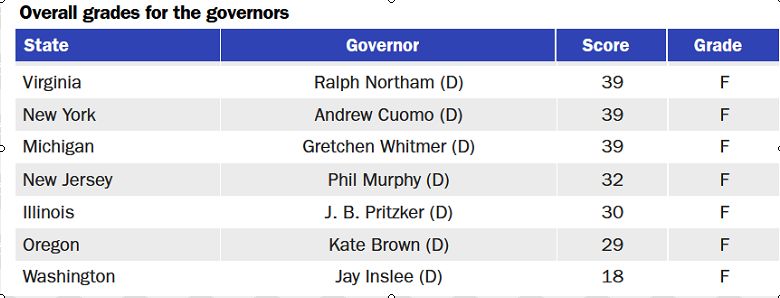
Michigan
Gretchen Whitmer, Democrat
Legislature: Republican
Grade: F
Took office: January 2019
Gretchen Whitmer served in the Michigan House and the Michigan Senate before being elected governor in 2018. Whitmer scores poorly on this report because of her support for large tax increases.
When campaigning in 2018, Whitmer “scoffed at the idea” that she supported a gas tax hike in a televised debate, calling the accusation “ridiculous.”140 Despite that dismissal, Whitmer pushed hard for a gas tax increase her first year in office. Her plan would have increased the 26 cents per gallon tax by 45 cents over time to raise $2 billion annually. Polls found large‐scale public opposition, and the plan did not pass the legislature.141
It is not clear why Michigan would need higher road funding. In 2015, lawmakers approved a huge tax‐increase package to fund roads, and Michigan’s population has been static at 10 million people for two decades. A Reason Foundation study ranked Michigan in the bottom half of states in highway spending efficiency, so Whitmer should focus on using current highway funds more efficiently.142
Whitmer approved an increase in online sales taxes and she proposed increasing taxes on passthrough businesses. In a flip‐flop that is angering retirees in the state, Whitmer campaigned in 2018 on repealing a pension tax imposed by the prior governor, but now she seems to have dropped the idea.143
Reprinted with permission from the Cato Institute. This article is a small portion of a larger article dealing with the whole country. For further information, see: https://www.cato.org/publications/white-paper/fiscal-policy-report-card-americas-governors-2020#michigan
30% OF STATE WORKERS FLEE
THEIR UNIONS
More than 9,000 in Michigan have canceled
memberships and dues payments
By Dawson Bell, Oct. 7, 2020
More than 9,000
state workers — or nearly 30% of those covered by a collective bargaining
agreement — have now withdrawn from or not renewed their union membership. These
numbers come days after a new rule went into effect that prohibits state
employee unions from collecting dues from workers who do not authorize it on an
annual basis.
Unions representing nearly 32,000 state employees had sought an injunction to
prevent the rule from going into effect this month. They claimed that the rule
adopted by the Michigan Civil Service Commission in July would impair
contractual agreements and deny workers the right to express themselves through
their unions. The rule represents the state government’s response to a 2018 U.S.
Supreme Court ruling that bars government employee unions from collecting dues
without affirmative consent from individual employees. The high court had
suggested that a rule calling for annual reauthorizations of paycheck deductions
by employees would likely not violate constitutional rights to free speech and
contract.
U.S. District Court Judge George Steeh denied the request for an injunction on
Oct. 1. The state can no now longer deduct union dues from the paychecks of
employees who have not specifically authorized it for the 2020-21 fiscal year.
According to figures supplied to the Mackinac Center for Public Policy by civil
service commission staff, 3,275 employees (about 10.3% of employees represented
by the five unions which brought the lawsuit) did not submit a reauthorization
notice by Oct. 4. Additionally, the commission said only 22,406 had filed
authorizations for dues or fee collection in 2020-21, out of 31,680 state
workers covered by union contracts. Consequently, nearly 30% of covered state
employees have opted out of union membership since the state’s 2013
right-to-work law made payments to unions optional.
The unions issued a joint statement when the federal lawsuit was filed, decrying
the July change. The commission’s requirement, it said, was “part of a long
running campaign against working families in Michigan and across the country,
pushed by billionaire-backed anti-worker groups.”
But as Steeh noted in his decision to deny the injunction, appellate courts have
found that government employers don’t have a constitutional duty to collect
union dues in the first place.
The unions “do not explain ... why union members should have a First Amendment
right to pay dues through payroll deduction, when the unions do not have a First
Amendment right to collect dues in the same manner,” he wrote.
Steeh also rejected the unions’ claim that the process for reauthorization
placed an undue burden on would-be dues payers.
The fact that a majority of covered employees had reauthorized payments, and
that the option to submit a renewal is open-ended, shows that the requirement is
not “so burdensome as to rise to the level of irreparable harm,” he wrote.
In adopting the new rule, the Civil Service Commission said it was compelled by
the U.S. Supreme Court ruling in Janus v. AFSCME, strengthening the rights of
public employees to opt out of union membership. The commission said the rule
was needed to ensure that authorization for dues deduction were “not stale,
(but) current, knowing and voluntary.”
Representatives of UAW Local 6000, the lead plaintiff in the case, could not be
reached Tuesday. The UAW’s attorney did not respond to a request for comment.
There are six unions representing state unions. The information here does not
include the 1,751 troops and sergeants in the Michigan State Police, which was
treated differently by Michigan's right-to-work law.
Permission to reprint this blog post in whole or in part is hereby granted, provided that the author (or authors) and the Mackinac Center for Public Policy are properly cited.
112 OUTBREAKS IN NURSING
HOMES, 5 IN BARS - SO LOCK DOWN THE BARS?
Michigan governor defended placing virus
patients in nursing homes, and just closed inside service at bars
Michigan Capitol Confidential, Aug. 11, 2020
 Long Term Care and
Skilled Nursing Facilities have accounted for 112 virus outbreaks being tracked
by the state while bars were involved in just five.
Long Term Care and
Skilled Nursing Facilities have accounted for 112 virus outbreaks being tracked
by the state while bars were involved in just five.
That is according to data on ongoing and new outbreaks reported by MIRS News,
which requested the information from the state.
There were no outbreaks that were linked to bar customers, according to the
data. The five epidemic-related outbreaks in bars involved staff not customers.
Gov. Gretchen Whitmer has placed COVID-19 patients in nursing homes with healthy
residents, according to news reports.
She has also closed all bars in the state to inside service in a recent
executive order.
Reprinted with permission by the Mackinaw Center: https://www.michigancapitolconfidential.com
STATE SUPREME COURT
SETS SEPT. 2 FOR ORAL ARGUMENTS ON WHITMER EMERGENCY POWERS
June 30, 2020
The Michigan Supreme Court ordered a
hearing and oral arguments on a case that could strip Gov. Gretchen Whitmer of
the extraordinary emergency powers she has assumed in response to the the
COVID-19 epidemic.
The Michigan Supreme Court said it would hear the case on Sept. 2.
The Mackinac Center Legal Foundation and Miller Johnson law firm are
representing three medical practices and one patient that were unable to
schedule medical procedures due to Whitmer’s executive orders restricting
non-essential medical procedures. While Whitmer has eased some of her
restrictions on medical procedures, others are still restricted.
If the state Supreme Court rules against Whitmer, then the governor would not
have the power to issue any more executive orders and would have to work with
the state Legislature to get new restrictions in place.
From the Mackinac Center for Public Policy, a research and educational institute headquartered in Midland, Michigan. Permission to reprint in whole or in part is hereby granted, provided that the author and the Mackinac Center are properly cited.
GRETCHEN
WHITMER SLIPS STATE MONEY TO LEFTIST POLITICAL OPERATIVES
TO SPY ON MICHIGANDERS. THEN LIES ABOUT IT.
By Monica Showalter, May 28, 2020
It's pretty amazing how many negative activities gather around Michigan's hard-faced and ambitious Democratic governor, Gretchen Whitmer.
Besides her outrageous performance on the coronavirus crisis — banning sales of garden seeds, seeding nursing homes with COVID-19 patients, forcing private dam operators to overfill their reservoir for greenie purposes, causing two of them to burst — she's also a liar.
We saw that clearly enough when her husband tried to put himself at the front of the boating queue by citing his marriage to her — cronyism at its worst — and she claimed that it was a joke. It was a story so egregiously bad that the only reason we didn't comment about it here at American Thinker earlier is that we mistakenly thought the story was fake. Now there's the matter of Whitmer's political corruption — succoring her political cronies at state expense to spy on Michiganders to beef up the Democratic Party operation, which she's also lying about.
According to the Daily Wire: Newly released emails show that Michigan Democrat Governor Gretchen Whitmer's office gave the "green light" for taxpayer money to be awarded to Democrat groups as part of the state's coronavirus tracing program.
"Whitmer's office gave the 'green light' for a COVID-19 contact tracing 'arrangement' she denied knowledge of and canceled amid outcry over a contractor with Democratic ties," Bridge Magazine, a local Michigan publication, reported. "Emails obtained through a public records request appear to show Michigan officials tried to avoid controversy by shifting work to apolitical subsidiaries of firms with known partisan leanings."
It would be bad no matter what the sneaky money was for, but in this case, the awfulness is multiplied because it's state money for leftists to spy on Michiganders — and not just spy on them, but use that information to benefit one political party's campaign operations. Guess which:
In late April, The Washington Free Beacon reported that Whitmer had given control of the state's contact tracing program to "one of the left's biggest technology firms" and that the move was seen as potential way of her "using the coronavirus to strengthen the Democratic Party's data operation."
The Washington Post reported that the group that hundreds of thousands of taxpayer dollars were going to go "would be managed in coordination with EveryAction, a firm that is closely linked to NGP VAN, a technology provider that boasts that it powers 'nearly every major Democratic campaign in America.'"
That's handing leftists an illegal campaign contribution at taxpayer expense, amounting to naked political corruption.
Now she's lying about the whole thing. According to the Wire: Whitmer struggled to respond and had to resort to reading prepared notes when pressed during a news conference in April about why she awarded the contracts to partisan left-wing groups.
"When it was brought to my attention, I told them to cancel it," Whitmer claimed. "This was an unnecessary distraction. Leadership is about solving problems. The correct process was not followed."
Whitmer refused to answer who was responsible for making the decision to use those companies. This sounds like her bizarre response to the boat dock scandal, or her strange intransigence on keeping Michigan's economy closed, or her insistence on all mail-in ballots. She claims to be the good guy when it's clear as day that her hands are filthy with scandal. She seems to recognize it, too, which is why she keeps lying.
She's already under investigation by the state Legislature for her nursing home scandal. She ought to be under a big-time federal probe for this one. Something is way off about this woman, who will do anything to advance her own political prospects and those of her cronies. Her supposed popularity in her state is astounding, given the scale of her scandals. I suspect it's fake.
It's time for the feds to step in. This isn't normal politics.
Reprinted with permission from the American Thinker: https://www.americanthinker.com
SHE COULD HAVE SAID. . .
She could have said:
Stay home longer and continue to be safe.
If you’ve quarantined for 3 weeks and are symptom free go visit your lake
house. Buy groceries from the local small business grocery and liquor
store. Fish from the dock. They have been waiting all season for your
return but exercise social distancing.
But she didn’t.
She could have said:
Plant a garden! Michiganders get outside and work in your yard. Order
supplies to be delivered from your local nursery and spend some money
there. They are stocked and ready for you!
But she didn’t.
She could have said:
Take this time to work on a home project. Call your local hardware store
and have them mix a gallon of paint. Pay over the phone, use social
distance to pick it up.
But she didn’t.
She could have said:
Restaurant owners, reopen but at half capacity. You can only seat every
other table and wait staff must wear masks. We want you to survive so
let’s use common sense and appropriate social measures.
But she didn’t.
She could have said:
Landscapers who starved all winter for lack of snow - get to work! Book
your jobs over the phone. Accept payment via cash apps. Work single crew
jobs or small crews where you can keep your distance. Let’s work with
local box stores to have supplies delivered or waiting for you to pick up.
We know you’re cash based and aid hasn’t come yet. Be safe but work!
But she didn’t.
She could have said:
Go back to your place of worship! Sit one family per pew, and use every
other pew. Practice social distancing but go celebrate Passover and
Easter.
But she didn’t.
Walmart gonna Walmart. Costco gonna Costco. Target gonna Target, but our
small business owners are drowning and she tossed them a cement block
instead of a lifeline.
When will people realize she doesn’t want to help us. She wants us so
broke and so hungry and so desperate and so afraid that we turn in our own
neighbors, we hide in fear, we stay glued to the fear mongering news, we
deplete anything we have saved and when it’s all gone and we are desperate
and broken and depressed we turn to the government to save us.
She could have said and done a lot, but she didn’t. Do not ignore the
message that woman from Michigan delivered last night, because where she
stands and what she’s about was loud and clear.
 The happiest news to
emerge in recent coronavirus weeks come courtesy of videos from online
news sources showing the good citizens of Michigan, fed up with their
tyrannical governor, taking to the streets in mass — and maskless! — to
demand an end to the tyranny.
The happiest news to
emerge in recent coronavirus weeks come courtesy of videos from online
news sources showing the good citizens of Michigan, fed up with their
tyrannical governor, taking to the streets in mass — and maskless! — to
demand an end to the tyranny.
The saddest news? The realization that it took so long for these types of
protests to occur.
And for reason for that, we can turn to the Declaration of Independence.
“Prudence, indeed, will dictate that Governments long established should
not be changed for light and transient causes; and accordingly all
experience hath shewn, that mankind are more disposed to suffer, while
evils are sufferable, than to right themselves by abolishing the forms to
which they are accustomed,” the opening lines state.
Most Americans, when first informed of the coronavirus, wanted to simply
do the right thing and help their neighbors, help their communities and
families, help their country. They willingly stayed home; out of love for
neighbor — or at least, concern for neighbor — abided by the government’s
recommendations and mandates to protect against the spread of the virus.
Business owners shelved their dreams of entrepreneurial freedom for the
good of the country. School administrators closed their buildings;
government service officers shut their doors. Church pastors, even, sent
their congregations online.
Then things got stupid. Really stupid.
Then government ran amok.
The Americans saw tyrannical types, up close and personal, up close and in
their own communities, seize powers the Constitution doesn’t grant and run
roughshod over the rights of individuals and business owners. And
Americans saw how these tyrannies were taking place in the face of failed
computer modeling that showed wildly inaccurate coronavirus numbers.
“Michigan cracks down on seed purchases and tiny gatherings,” The Post
Millennial reported, of Democrat Gov. Gretchen Whitmer’s ridiculous
executive-issued prohibitions against the purchase of plant seeds and
grains in the state — and against neighbors from visiting their next-door
neighbors.
Police state, anyone?
Seriously: How does buying plant seeds cause — or even correlate to — a
spread of the coronavirus?
Then there was this, in the aftermath of an eye-opening Fox News interview
between host Tucker Carlson and guest, Gov. Phil Murphy of New Jersey.
“By what authority did you nullify the Bill of Rights in issuing this
order [prohibiting church gatherings and free assembly of the people]?”
Carlson asked.
“That’s above my pay grade,” Tucker,” Murphy said, as the National Review
noted. “I wasn’t thinking of the Bill of Rights when we did this.”
Come again?
It’s the job of a governor — of any public servant who takes the oath of
office, for that matter — to first and foremost, above all else, uphold
the provisions of both state and U.S. constitutions.
To admit to not “thinking” of those documents, as a governor, is to admit
a failure of job performance.
It’s a fireable offense. And in these coronavirus times, there are a lot
of fireable offenses being perpetrated on the people by government
officials, from police to politicians. Are we to stand idly by and watch,
sheeplike, doing nothing forever?
This is where the rights of the individual to control and curb the
government should blare forth.
President Donald Trump says he’s got a plan to open America’s economy and
jumpstart U.S. businesses again, and that states ought to abide by his
White House guidelines. Some states say they won’t.
Some states say the heck with reopening the country, the heck with freeing
citizens from their house arrest, er, suggested stay-at-home, syndromes —
the heck with all that until each and every last case of the coronavirus
has been driven from humanity, until it’s safe and secure out there for
all.
Well, what right does government have to decide that in the first place?
American citizens are well-equipped to determine how best to protect
themselves and their families from looming health threats.
Americans do it every day, as a matter of fact.
Those who feel sick — stay home.
Those who worry about getting sick — stay home.
Those who can’t stay home but worry about getting sick — go ahead and wear
a mask, social distance, stay in the car, do whatever seems logical and
proper to keep from getting sick.
Just don’t expect all of America to suffer a police state existence for
the next, well, forever — as a matter of possible protection for the
relatively few citizens in the country who may or may not catch the
coronavirus.
It’s time for more civil disobedience. It’s time for the protests of
Michigan residents against their power mad governor to spread to the rest
of the states — if only to send a message to the government that says:
We’re watching. We’re watching, and we’re fed up.
If not now, when?
Americans aren’t going to go quietly into that good despotic night. Nor
should they.
After all, it’s in America’s founding to fight for freedom.
“[W]hen a long train of abuses and usurpations [occur] … it is [citizens’]
right, it is their duty, to throw off such Government, and to provide new
Guards for their future security,” the Declaration of Independence reads.
It’s not just a right to Americans to strive for freedom. It’s not just a
right enshrined in the Constitution, in the Bill of Rights, in the First
and Second amendments in particular.
It’s a duty. An actual duty. It’s a duty and responsibility for Americans
to demand government obey. And how do Americans typically go about
exercising that duty? With civil disobedience. Peaceful — but purposeful,
persistent and powerful civil disobedience.
• Cheryl Chumley can be reached at cchumley@washingtontimes.com or on
Twitter, @ckchumley. Listen to her podcast “Bold and Blunt” by clicking
HERE.
And never miss her column; subscribe to her newsletter by clicking
HERE.
Copyright © 2020 The Washington Times, LLC. Reprinted with
permission.
GIVING A FRIEND A
MANICURE OR HAIRCUT IS ILLEGAL IN MICHIGAN
And getting the
license takes more training than homebuilders or EMTs
By Sandy Malone, March 3, 2020
 You’re breaking the law if you
cut the hair of another person in Michigan without the government’s permission,
even if it’s for a friend or family member, and even if there’s no charge. An
aunt cutting her nephew’s hair? Illegal. A girlfriend giving her boyfriend a
trim? Not allowed. And teenage girls giving each other manicures? They’re all
committing misdemeanor crimes under Michigan law.
You’re breaking the law if you
cut the hair of another person in Michigan without the government’s permission,
even if it’s for a friend or family member, and even if there’s no charge. An
aunt cutting her nephew’s hair? Illegal. A girlfriend giving her boyfriend a
trim? Not allowed. And teenage girls giving each other manicures? They’re all
committing misdemeanor crimes under Michigan law.
That’s according the state statutes imposing licensure requirements on barbers
and cosmetologists. The law states, “An individual shall not perform any form of
cosmetology services, with or without compensation, on any individual other than
a member of his or her immediate family without a license under this article.”
Barbers were one of the first professions on which the state of Michigan imposed
licensing restrictions. The requirements are stringent: Getting a barber’s
license here requires an individual to take 1,800 hours of classroom and
practical training – and that’s down from the 2,000 hours required a few years
ago. These are among the nation’s most restrictive occupational licensure
mandates in terms of the number of training hours required. It is nearly eight
times the number required to get a New York license, to cite one example.
And that’s after the would-be practitioner has paid in the neighborhood of
$12,000 to $20,000 in tuition to a barber school, according to Damon Dorsey,
president of the American Barber Association.
Dorsey told Michigan Capitol Confidential the amount of time and debt associated
with becoming a licensed barber has led to more unlicensed people providing the
service illegally in their homes. The facts back this up. In 2018, there were 83
complaints filed with the state against barbers, and most of them were
complaints about someone operating without a license.
“The ABA has gotten countless complaints from students on the cost of barbering
school and time it takes to get a barber’s license,” Dorsey said. “As it is,
many people forgo getting a barber’s license and just cut hair in their kitchen
and basement, as they refuse to be strapped down by debt and spend two years of
their lives qualifying for a barber’s license.”
Dorsey said that it takes the average person one-and-a-half to three years to
become a barber; and he called the classroom requirements out-of-date.
“Most barbers will agree that it should not take [1,800] hours of practice to
become a barber,” he said. “Forty to 80 hours should be sufficient, especially
if continuing education is available. Also, technology makes it possible for
students to take classes online, which should make it much easier to speed up
the process.”
To put those numbers in context, the training hours to be a barber are several
times more than the number required to become a licensed homebuilder, auto
mechanic or emergency medical technician.
In 2013, Alabama became the last state to require a license for barbers. A 2018
study by Edward Timmons found that this increased profits for licensees, caused
fewer shops to open and drove prices higher for consumers. “This comparison
produces evidence consistent with the economic theory that occupational
licensing restricts competition and harms consumers by limiting choice and
increasing prices,” said the report.
Several bills have been recently introduced to cut back on the barbering
mandates. Senate Bill 691, introduced by Sen. Wayne Schmidt, R-Traverse City,
and Sen. Ken Horn, R-Frankenmuth, would allow apprenticeship hours to cover the
training requirements. State Rep. Steven Johnson, R-Wayland, introduced House
Bill 5438, which would eliminate the state requirement that individuals get a
license before being able to become a barber.
“Quite simply, state government has a thousand better things to do than tell
barbers how to cut hair,” Johnson said in a press release. “This license is an
unnecessary regulation and does nothing to protect public safety.”
From the Mackinac Center for Public Policy,
a research and educational institute headquartered in Midland,
Michigan. Permission to reprint in whole or in part is hereby
granted, provided that the author and the Mackinac Center are
properly cited.
GREAT LAKES
WATER LEVELS TOO HIGH? TOO LOW? FOR 60 YEARS NEWSPAPERS ANSWER: YES
Variation appears the norm
By Tom Gantert, Feb. 8, 2020
 A recent Detroit Free Press
story highlighted the focus on the Great Lakes in Gov. Gretchen Whitmer’s
state budget plan for the fiscal year starting Oct. 1.
A recent Detroit Free Press
story highlighted the focus on the Great Lakes in Gov. Gretchen Whitmer’s
state budget plan for the fiscal year starting Oct. 1.
“Between the high water levels gobbling up beaches, roadways and homes along the Great Lakes ... the environment was sure to be a big-ticket item,” the Free Press reported.
The newspaper describes Whitmer’s proposal to spend $40 million on what the budget calls “Local Climate Resilient Infrastructure Grants” as a response to “the negative impacts of Michigan’s changing climate conditions.”
The Free Press adds that this is what has caused record high water levels.
Around the region, newspapers are reporting that water levels are high and are causing damage. Over the past six decades, regional newspapers have had a lot to stay about Great Lakes’ water levels. Here are some examples:
July 29, 1964
Alton Evening Telegraph (Alton, Illinois)
Headline: Great Lakes Water Levels Big Problem
“The conference was prompted by record low levels of the lakes which have been falling steadily since 1960 – due primarily to a lack of rainfall in the Great Lakes basin.”
May 21, 1975
Lansing State Journal
Headline: After 10 Years, Joint Lakes Study Incomplete
“When the IJC [International Joint Commission, US – Canada] study began nearly a decade ago, he noted, the Great Lakes were plagued by low-water levels and as it comes to a completion, high waters have become the chief concern.”
Dec 16, 1986
Petoskey News-Review
Headline: High Water May Be The Norm, Not Exception
“We would all do better to learn a lesson from this increasing tide, a lesson teaching that Mother Nature is consistently inconsistent. Today’s extreme may be tomorrow’s norm and the reverse is certainly true, also.”
Jan. 26, 1987
News Herald (Port Clinton, Ohio)
Headline: Michigan Wants Lake Level Controls
“All the Great Lakes are either at or near their highest levels on record, with erosion and flooding causing millions of dollars in damage to coastal properties and erasing huge sections of the shoreline.”
“The Great Lakes began reaching record highs in 1984, with the rising levels blamed on a 15-year period of unusually high precipitation in the Great Lakes basin.”
April 11, 1996
The Windsor Star (Windsor, Ontario, Canada)
Headline: Great Lakes Water Levels Continue 10-Year Decline
“Water levels in the Great Lakes and Lake St. Clair have declined steadily over the last decade, Environment Canada statistics indicate.”
May 17, 2000
Battle Creek Enquirer
Headline: Great Lakes Water Levels Drop To Record Low
“What makes the dropoff particularly remarkable is that it comes only three years after lake levels reached near-record highs. Then, beaches and even houses were swept away.”
July 19, 2009
The Dispatch (Moline, Illinois)
Headline: Great Lakes Water Levels Rebound After Long Slump
“During the mid-1980s, levels got so high that houses, businesses and even sections of roads were swept away along Lake Michigan’s southeastern shoreline.
Then a sudden deep dropoff began in the late 1990s. ... But if grim computer modeling proves accurate, global warming will cause the lakes to recede up to 3 feet this century.
“‘Climate projections say the lakes will go up and down around a decreasing average,’ said Don Scavia, director of the University of Michigan’s Graham Environmental Sustainability Institute. ‘The lows will be lower than in the past and the highs will be lower than in the past.’”
Oct. 13, 2019
The Times Herald
Headline: Great Lakes Water Levels Could Be Even Higher In 2020
“It appears 2020 won’t bring relief from high Great Lakes water levels – and they could be even higher than this past record-shattering spring and summer.”
Permission to reprint this blog post in whole or in part is hereby granted, provided that the author (or authors) and the Mackinac Center for Public Policy are properly cited.
SOME BASIS FOR VOTERS'
SUSPICION NO TAX HIKE NEEDED TO FIX ROADS
53.3% say state has enough to fix roads;
fiscal agency says $897 million is available
Jan. 29, 2020
 A majority of likely
voters in Michigan believe the state has enough money to fix the roads without
imposing a new tax increase. That’s according to a recent survey commissioned by
the Detroit Regional Chamber of Commerce and conducted Jan. 14 to 18. A majority
of respondents — 53.3% — said there is enough money to fix roads without a tax
hike, 33.7% said there isn’t, and 13% gave no response.
A majority of likely
voters in Michigan believe the state has enough money to fix the roads without
imposing a new tax increase. That’s according to a recent survey commissioned by
the Detroit Regional Chamber of Commerce and conducted Jan. 14 to 18. A majority
of respondents — 53.3% — said there is enough money to fix roads without a tax
hike, 33.7% said there isn’t, and 13% gave no response.
The head of the firm that conducted the poll disagreed.
“Michigan’s elected leaders continue to lose the PR battle on additional road
funding. By a margin of 53%-33%, Michigan voters continue to believe that the
state already has enough money to fix the roads as compared to needing
additional revenues. As far back as 2012, we talked about how voters did not
understand why Michigan needed more road money. And eight years later, voters
still don’t understand why Michigan needs more money for roads,” said Richard
Czuba, founder of Glengariff Group Inc., in a news release put out by the
Detroit Regional Chamber of Commerce.
But voters’ intuition has some support from official budget projections.
The Senate Fiscal Agency estimates that the state will have $897 million in
unspent dollars when the current fiscal year ends on Sept. 30, 2020. Lawmakers
could decide at any time to use all or some of that money to pay for more roar
repairs.
In addition, budget officials and analysts who convened earlier this month say
that total state revenue in the 2020-21 fiscal year, which begins Oct. 1, could
rise another $574 million above their last estimate.
In 2015, the Legislature increased vehicle registration taxes, effective 2017.
That tax increase was projected to add at least $226 million to the state
treasury in 2020.
The same legislative package included a motor fuel tax increase that was
projected to bring in another $298 million for state transportation spending in
2020. Based on other recent state revenue increases generated by a growing state
and national economy, the actual amounts are likely to be even higher.
Permission to reprint this blog post in whole or in part is hereby granted, provided that the author (or authors) and the Mackinac Center for Public Policy are properly cited.
WHITMER RAN ON ROAD REPAIR
PROMISE, BUT WILL SPEND LESS TO FIX THEM THAN LAST YEAR
$40 million less; her one suggestion was a
steep gas tax hike
By Tom Gantert, Dec. 6, 2019
Michigan Gov. Gretchen
Whitmer ran for office on a promise to fix Michigan’s roads. During her first
several months as governor, she talked a lot about the issue.
According to WXYZ, the governor said in May, “People want our roads fixed. That
is the No. 1 issue, and there is crickets at the Capitol right now on that
front.”
A Michigan Radio report from May quoted Whitmer describing the condition of
roads in the state as “very dangerous.”
But as of Wednesday, $40 million less in state transportation spending will have
been authorized this year when compared to 2018-19.
Here’s how that happened.
Whitmer's one proposal to fix Michigan’s roads was a 45-cent per gallon hike in
the gas tax, which would have nearly tripled the current level of 26.3 cents per
gallon. The governor tweeted in June, “Michigan's roads are more than an
embarrassment, they’re downright dangerous. I have a real plan to get Michigan’s
roads back into shape.”
But no legislator of either party ever introduced a bill to enact her idea, and
no one asked for a roll call vote on it. Instead, legislators found an
additional $338 million for transportation without a tax hike, mostly by
allocating increases in various state revenue streams to road funding.
At the end of September, the Republican House and Senate adopted and sent
Whitmer an annual budget bill that contained the $338 million increase. The
governor’s response was to veto 147 items in the budget, representing $947
million in spending across state government.
Many of the vetoes were intended to pressure Republican lawmakers, such as a $35
million cut to new money for charter schools. But the reaction of the GOP House
and Senate caucuses was summed up a few days later when both the Senate majority
leader and the House Speaker stated separately, “The budget is done.”
On Wednesday, however, the House and Senate approved $573.5 million in
additional state spending, including much of the money Whitmer had vetoed. Not
included, however, were any additional dollars to fix the roads.
The only transportation-related spending approved then was $13 million for
municipal bus agencies.
Whitmer’s actions actually removed $375.1 million in transportation spending,
not just the $338 million that had been added from rising state revenue. In
addition to the line item vetoes, the governor also approved controversial
fund-shifts. Among other things, one favored mass transit over fixing roads by
moving $25 million originally targeted for roads but was moved to pay for
transit (buses) costs.
The additional spending authorized this week represents a compromise between the
Democratic governor and Republican Legislature, and it is expected to be
finalized next week. Despite the governor having campaigned on a fix-the-roads
platform, less money has been budgeted in 2020 to fix Michigan roads than during
the fiscal year that ended Sept. 30.
Specifically, $3.64 billion in state revenue was budgeted for transportation in
2018-19. The budget passed by the Legislature in September increased that amount
to $3.98 billion in 2019-20. But after the governor’s vetoes and fund shifts,
and this week’s approval of added spending, the transportation budget will
receive $3.60 billion state dollars this year, or about $40 million less than
the amount spent last year.
Whitmer’s office didn’t respond to an email seeking comment.
From the Mackinac Center for Public Policy, a research and educational institute headquartered in Midland, Michigan. Permission to reprint in whole or in part is hereby granted, provided that the author and the Mackinac Center are properly cited.
OLYMPIC POOL HOLDS 12 TIMES ANNUAL ROAD RUNOFF SAVED BY $475K GREAT LAKES GRANT
Total Great
Lakes Restoration Initiative spending at $300 million a year
By Tom Gantert | Nov. 5, 2019
The U.S. Environmental
Protection Agency’s Great Lakes Restoration Initiative (GLRI) spent $474,916 to
prevent rainwater that lands on a Detroit highway from getting into Lake Erie.
The GLRI estimates the project will prevent 51,187 gallons of rainwater runoff
each year from reaching Lake Erie. By comparison, an Olympic-sized swimming pool
holds 660,253 gallons, 12 times more water than the project will collect. Lake
Erie contains 127.6 trillion gallons of water — 127,600,000,000,000 – which
comes to 2.49 billion gallons of lake water for every gallon of rainwater
prevented from reaching the lake.
The project was completed in September, according to the GLRI’s description of
the grant.
A nonprofit called Greening of Detroit received the $474,916 grant for roadway
rainwater collection. The organization’s last financial filing with the federal
government was in 2016, when it listed Rebecca Salminen Witt as the president,
with a salary of $137,396.
Greening of Detroit didn’t respond to an email seeking comment.
Congress has appropriated $300 million for GLRI in 2020, and it has authorized
the same for 2021.
Permission to reprint this blog post in whole or in part is hereby granted, provided that the author (or authors) and the Mackinac Center for Public Policy are properly cited.
POWER OUTAGES? UTILITY RENEWABLES
SCHEMES MAY MEAN 'GET USED TO IT'
Michigan’s big utilities also plan for you to just have
less to use
By Madeline Peltzer, July 26, 2019
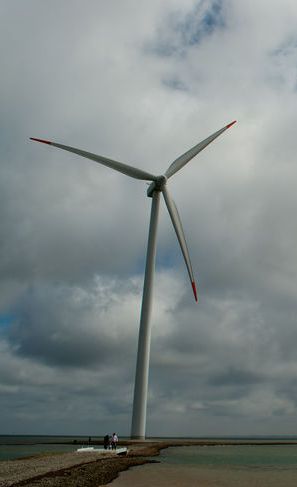 Severe
storms last weekend left some 600,000 DTE Energy and 250,000 Consumers Energy
customers without power. As of Tuesday morning, 91,000 DTE customers and almost
4,900 Consumers customers were still waiting, according to The Detroit News.
Those who have been without power for at least five days are eligible for $25
credits from the utility companies.
Severe
storms last weekend left some 600,000 DTE Energy and 250,000 Consumers Energy
customers without power. As of Tuesday morning, 91,000 DTE customers and almost
4,900 Consumers customers were still waiting, according to The Detroit News.
Those who have been without power for at least five days are eligible for $25
credits from the utility companies.
“We understand your frustration as you try to go about your daily activities
without power,” DTE said on Twitter.
Heather Rivard, DTE’s senior vice president of electric distribution, called the
situation “unacceptable.”
Likewise, Michigan Attorney General Dana Nessel said in a press release, “It’s
important we continue working together to ensure better reliability for our
residents.”
But as DTE and Consumers Energy implement their ideas for generating electricity
in the future — called integrated resource plans — customers can likely expect
lower levels of power reliability.
In 2017, 37% of energy in Michigan was generated by coal, but DTE is planning to
retire 11 of its 17 coal-fired generation units by 2022. The electricity these
plants provide will be replaced by a mix of renewable sources, including more
industrial wind turbines. The company will also import power from utilities in
other states and Canada when the renewables can’t handle the demand.
Similarly, Consumers Energy recently announced a goal of getting 56% of its
electric capacity through renewable sources. It plans to do that by buying power
from elsewhere and by requiring Michigan household and business customers to use
less through demand response programs. These may include voluntary incentives to
use less power, but they can also involve mandatory reductions in energy usage,
especially for commercial and industrial users.
As Consumers Energy anticipated last week’s heat wave, the company asked
customers to keep their thermostats at 78 degrees to conserve its limited
resources. That’s a prime example of a voluntary demand response.
The focus on backup energy sources in these plans highlights the
weather-dependent nature of wind and solar generators, which are far less
dependable than traditional power generation methods. That’s the assessment of
Jason Hayes, director of environmental policy at the Mackinac Center for Public
Policy.
“What’s happening is the utilities are shutting down the reliable, affordable
generation, so when they shut that down, the plan is to replace it with less
reliable, more expensive generation technologies,” Hayes said. “You can’t help
but have your electricity system become less reliable when it relies on less
reliable technologies. It’s not a slight against wind and solar to say that;
it’s just a simple reality. The physics that goes into powering this generation
technology means they’re ephemeral because the sun doesn’t always shine and the
wind doesn’t always blow.”
As a result, utility companies end up building generators that run on natural
gas as a backup for fickle energy sources.
“You could just build gas and have the exact same system and ability to produce
electricity but at far less cost,” Hayes said. “That’s the challenge that you’re
facing with these technologies. You end up building the system two or three
times when you could just build gas or coal and get reliable, affordable
generation the first time.”
DTE did not respond to a request for comment on how it plans to deliver reliable
energy while phasing out traditional methods for making electricity.
From the Mackinac Center for Public Policy, a research and educational institute headquartered in Midland, Michigan. Permission to reprint in whole or in part is hereby granted, provided that the author and the Mackinac Center are properly cited.
MICHIGAN POLICE KEPT $15 MILLION TAKEN MOSTLY FROM 'LITTLE GUYS' IN 2018
‘Police do use it to raise revenue’
By Dawson Bell, July 10, 2019
Over 6,000 persons had more than
$15 million worth of property and cash seized and kept by Michigan law
enforcement agencies in 2018. Many of them were never convicted of a crime or
even prosecuted. Those are some of the findings of a report released June 30 by
the Michigan State Police on the practice of civil asset forfeiture.
Most of the seized property was cash ($13,481,835), according to the report, was
then used by police agencies to supplement their own budgets.
Michigan’s civil asset forfeiture law was adopted in 1978 with the intent of
depriving criminals, especially drug dealers, of the proceeds from illegal
activity. But critics say the the practice too often tramples on the property
rights of low-level drug users, some of whom are never prosecuted for the
underlying alleged crime. In April, the Michigan Legislature enacted reforms to
the law. Starting in August, there must be a criminal conviction, in most
situations, before officials can retain seized assets.
According to the report, property was seized from more than 6,000 persons in
Michigan in 2018. Of these individuals, only 2,810 were convicted of the crime
for which the property was seized, and 514 were never charged at all.
Jarrett Skorup, the director of marketing and communications for the Mackinac
Center for Public Policy, has written extensively on civil asset forfeiture. He
said of the report, “It’s disturbing ... that hundreds of people never charged
with illegal activity are losing their property. Forfeiture should be used only
on those convicted of a crime in which someone actually gained money or property
from that illegal activity.”
Skorup said research by advocates for reform found many instances in which the
target of forfeiture was not a drug kingpin. Instead, it was a low-income petty
drug user whose $2,500 car was seized by police. Many such individuals are never
charged, and they surrender ownership rather than contest the seizure in court,
Skorup said.
To address the concerns of law enforcement officials, the new law requiring a
conviction for forfeiture does not apply to property worth more than $50,000 if
it may be associated with illegal drug trafficking. This property will still be
subject to forfeiture even if its owner is not convicted of a crime.
In June, the Institute for Justice, a leading national advocate for forfeiture
reform, released a study analyzing the effects of federal forfeiture practices
on crime and drug use. It found them to be negligible. The study added that
civil asset forfeiture is most intensely used in communities in financial
duress.
“Forfeiture doesn’t help police to fight crime,” said Lee McGrath, IJ’s lead
legislative counsel, “but police do use it to raise revenue.”
McGrath said Michigan’s new forfeiture law “is an important step in reform ...
but the important question is how it will affect state law enforcement and
property owners (targeted by forfeitures) in the future.”
IF YOU SEEK A
PLEASANT ROAD FUNDING PLAN, LOOK ABOUT YOU
Lawmakers
can spend more on roads without a tax hike
By James M. Hohman, May 17, 2019
Gov. Gretchen Whitmer has criticized
the people who oppose her plan to raise fuel taxes for not coming up with an
alternative. But lawmakers are required to pass annual budgets, so she won’t
have to wait long.
The governor’s plan for the upcoming budget calls for $1.3 billion in new taxes
for $800 million in additional road spending. No legislation has yet been
introduced to do this.
Perhaps that’s because the idea looks unappealing to state senators, who already
voted on a budget without it. They included $93 million more in road funding,
though. That’s 12% of what the governor called for in extra money for the year,
without raising taxes.
Lawmakers in the House may find more, or they may not.
But the roads have already been a priority that gets more taxpayer money. In
2010, the state spent $2 billion of its revenue on the roads. Lawmakers found
$600 million in the budget, then raised taxes by $600 million, then found even
more money for the roads. When that plan is fully implemented, we will have
doubled state road funding.
Maybe it is more a matter of what roads cost and less of how much funding
lawmakers find. It takes time for the markets to adjust to the extra money
available for road funding — to dig more gravel pits, to buy more equipment, to
entice more road builders to enter our market and to train more qualified
people.
Even when more money buys fewer roads than it used to, there is money in the
budget for priorities if roads are a priority. The state ought, for example, to
reconsider its policy of flying planes over state universities to drop crates of
taxpayer dollars and asking little in return. Lawmakers ought to agree that
roads are a higher priority for at least some of that cash. And there are plenty
of other line items they should reconsider.
In addition, state revenue continues to grow. Lawmakers have already used that
growth to boost road funding and can continue to do so.
So, road funding has already doubled since 2010. Road builders are still
adjusting to the influx of cash. And lawmakers are already finding more money
for the roads without a tax hike. Looks like there is already a better plan than
a tax hike, especially one that purports to go toward roads but ends up
directing 37% elsewhere.
Permission to reprint this blog post in whole or in part is hereby granted,
provided that the author (or authors) and the Mackinac Center for Public Policy
are properly cited.Permission to reprint any comments below is granted only for
those comments written by Mackinac Center policy staff.
40 PERCENT OF
WHITMER'S GAS TAX HIKE WON'T SUPPORT ROADS
It backfills
money governor would remove from transportation budget to pay for other state
spending
By Tom Ganter, March 6, 2019
A large portion of the 45-cent
increase in the state gas tax proposed by Michigan Gov. Gretchen Whitmer will
not go to the state’s transportation budget, according to an analysis by the
Mackinac Center for Public Policy.
If approved by the Republican-controlled House and Senate, Whitmer’s proposed
45-cent motor fuel tax increase would occur in three separate 15 cent tax hikes
on Oct. 1, 2019, April 1, 2020, and Oct. 1, 2020.
The first two tax hikes would increase the tax by 30 cents and bring in an
additional $1.26 billion during the 2019-20 fiscal year. But documents submitted
by Whitmer as part of her executive budget recommendation on Tuesday indicate
that the net increase to transportation funding will be just $764 million in
2019-20 fiscal year.
In other words, $499.2 million — an estimated 40 percent of the $1.26 billion
gas tax increase in 2020 — would not go to roads. Instead, it would replace
current transportation budget dollars that would be redirected to pay for other
state government spending.
Some $325 million of the difference comes from removing income tax revenue from
the 2020 road repair budget, an amount that under current law will increase to
$600 million in the 2020-21 and successive road budgets. This money was
earmarked to roads as part of a road funding package enacted in late 2015 after
another all-tax road repair measure that was placed on the ballot by a previous
legislature was defeated by voters earlier that year. The income tax earmarked
for road repairs represented a commitment by then-Speaker of the House Kevin
Cotter and House Republicans to not approve another all-tax road fix proposal,
and instead reprioritize some other non-transportation state resources to roads.
Other than ending the $325 million income tax earmark, the budget documents
released by Whitmer on Tuesday are not clear on where the rest of the $499.2
million coming out of the Transportation budget is coming from. The difference
between how much the tax increase will bring in and the overall increase in
transportation spending appears in those executive budget documents.
Whitmer called Michigan's roads “downright dangerous,” according to WJRT-TV.
Despite this characterization, $499.2 million of the gas tax increases she
proposes will not end up in the state’s transportation fund.
The analysis was done by James Hohman, director of fiscal policy at the Mackinac
Center for Public Policy.
Whitmer’s office didn’t respond to an email seeking comment.
“The governor’s budget is a political wish list funded by much higher taxes on
the people of Michigan,” said Sen. Aric Nesbitt, R-Porter Township. “Road
funding has increased to a record level, and a solid boost would have been to
direct all taxes on fuel to fixing our roads.”
From the Mackinac Center for Public Policy, a research and educational institute headquartered in Midland, Michigan. Permission to reprint in whole or in part is hereby granted, provided that the author and the Mackinac Center are properly cited.
MICHIGAN'S SUPREME COURT IS
TAKING ON PREDATORY PROPERTY TAXES
By Larry G. Salzman Senior Attorney, Pacific Legal Foundation
Originally published by The Daily Caller, December 5, 2018.
 In 2013, Uri
Rafaeli learned that he underpaid the 2011 property tax bill on his modest home
in a Detroit suburb. He attempted to pay the difference but miscalculated the
interest due, unknowingly paying it $8.41 short. What came next was a shock:
Oakland County seized his property for the deficiency, which had grown to $285
with penalties and interest. It then quickly auctioned his home off to someone
else for $24,500—and kept every dime for itself.
In 2013, Uri
Rafaeli learned that he underpaid the 2011 property tax bill on his modest home
in a Detroit suburb. He attempted to pay the difference but miscalculated the
interest due, unknowingly paying it $8.41 short. What came next was a shock:
Oakland County seized his property for the deficiency, which had grown to $285
with penalties and interest. It then quickly auctioned his home off to someone
else for $24,500—and kept every dime for itself.
Rafaeli has been in court—and losing—ever since, trying to get some relief. He
doesn’t dispute that he made a mistake. He knows the county can’t let people
default on their tax bills with impunity. But he can’t conceive of any principle
of justice that would allow the government to take his entire home and all its
equity—nearly 3,000 times the debt he originally owed—without returning the
surplus cash to him.
In good news for Rafaeli and property owners throughout Michigan, the state’s
supreme court announced that it will hear his case. The court will decide
whether the county violated property rights protections in the U.S. or Michigan
constitutions by keeping more of the proceeds from the tax sale than needed to
satisfy Rafaeli’s debt.
Any reasonable government official could have recognized that Rafaeli’s tax
deficiency was a simple mistake. While he underpaid those 2011 taxes by $8.41,
he paid in full his taxes for 2012, 2013, and the period in 2014 before the home
was seized. He plainly intended to—and in every subsequent year did—pay his full
tax bill.
On those facts, one might be tempted to think this is an exceptional case of
government incompetence, but Rafaeli is only one of tens of thousands of victims
of Michigan’s predatory tax foreclosure machine.
A blockbuster piece of investigative journalism by Detroit’s public radio
station WDET and Bridge Magazine documented the same abusive tax foreclosures in
counties throughout Michigan, netting hundreds of millions of dollars in
“surplus” revenue over the past decade to fill holes in local budgets. For
instance, neighboring Wayne County seized more than 25,000 properties in 2017
alone, leading the report’s authors to conclude that “the county now relies on
property owners’ misfortune to balance its budget.”
Courts have taken notice, but until now Rafaeli and similarly aggrieved property
owners have been left without a remedy.
Shortly after Rafaeli lost his home, he sued in federal court but was told he
had to go to state court instead. The federal trial judge noted in passing,
however, that Rafaeli suffered “a manifest injustice that should find redress
under the law.” In another similar case involving the seizure of a church
property, a federal appellate court called Michigan’s behavior a “gross
injustice” likened to “theft.” In yet another federal case, also dismissed, the
judge declared Michigan’s abusive tax regime an “unconscionable” system while
lamenting that no relief is available in federal court.
Taking the advice of the federal courts, Rafaeli sought relief in state court.
He has fared no better up to now. In an appeal from his loss in state trial
court, the panel of appellate judges determined that they could not return to
him the excess funds collected by county because Rafaeli “acted contrary to the
welfare of the state by failing to pay [his] taxes.” That result moved one of
the appellate judges to write a separate opinion, agreeing that the decision was
correct as a matter of precedent but calling it a “gross injustice.”
Only Michigan’s high court now has the power to declare this “gross injustice”
unconstitutional. It must do so, putting an end to an “unconscionable” system
now.
Larry Salzman is a senior attorney at the nonprofit Pacific Legal Foundation,
which represents Mr. Rafaeli in the Michigan Supreme Court.
TOWNSHIP HITS BROTHERS WITH
FINE FOR REMOVING TREES
Wayne County property owners could face
$450,000 fine
By Tyler Arnold,| Oct. 12, 2018
 Gary and Matt Percy,
brothers and business owners in Canton Township, Michigan, face nearly a half a
million dollars in fines after they removed trees from their own property
without the township's permission.
Gary and Matt Percy,
brothers and business owners in Canton Township, Michigan, face nearly a half a
million dollars in fines after they removed trees from their own property
without the township's permission.
Many of the plants the Wayne County township is classifying as trees are
actually invasive species, according to the brothers’ attorney. The Percys hope
to start a Christmas tree farm on the land, which would involve planting 2,500
conifers, such as balsams, firs, and spruce trees.
“It is a shockingly high fine for allegedly clearing a retired grazing pasture
in an industrial area,” said their lawyer, Michael J. Pattwell.
Township officials claim the brothers violated a local ordinance that requires
landowners to get government permission before removing trees.
The township does not know the exact number of trees the brothers removed.
Instead, it hired an arborist to examine the trees on an adjacent property to
estimate what trees had been removed from the Percy’s land. The township
proposed a settlement of fines totaling about $450,000 for the removal of what
it says is about 1,500 trees, including 100 landmark or historic trees.
The fine can be reduced by about $70,000 if the brothers pay into the township’s
tree fund and plant new trees, according to the settlement offer.
Pattwell objected both to the fine and the arborist’s method for estimating the
number of trees cut down. He also said the brothers thought they qualified for
an agricultural exemption from the township. The trees they removed, he said,
were mostly invasive plants, including phragmites, buckthorn, and autumn olive.
The land, which is located in an industrial part of the township, included a
number of dead ash trees as well.
“Nobody argues with the stated goals of local ordinances to protect true
heritage trees in communities or promote neighborhood trees to beautify
neighborhoods,” Pattwell said. “But in this case, we believe strongly the
township has abused its authority in order to punish a landowner unreasonably.”
Pattwell also said the adjacent property has a different, unique history, making
the comparison with the Percy’s land problematic.
Pattwell added that the conflict between the brothers and the township is not an
isolated problem.
“There are many communities around Michigan that have established local tree
removal ordinances that put municipalities in the business of harassing local
business and property owners unfairly, certainly,” he said.
Kristin Kolb, the township’s attorney, said that she was not at liberty to
discuss the specific amount of the fines because of a confidentiality agreement.
Pattwell said that no confidentiality agreement exists.
Kolb said citations for illegally removing trees are rare in Canton Township,
and she defended the township’s decision to enforce the ordinance in this case.
She also said the method the arborist used, examining an adjacent property that
is part of the “same forest,” is recognized in the arborist field.
The township has not received a response from Pattwell about the settlement,
Kolb said. Patwell said the Percy brothers will defend themselves against Canton
Township’s fine and threatened legal action.
RECENT CORRUPTION SCANDALS INVOLVING SOME OF MICHIGAN'S LARGEST UNIONS
Embezzlement, financial malpractice plague
unions
By Jarrett Skorup, April 21, 2018
In the five years since Michigan
became a right-to-work state, most of its largest unions have seen a significant
hit to their membership, revenues and political spending. On average, since
2012, they have lost 85,000 members (11 percent) and are spending $26 million
less (57 percent) on politics and lobbying.
If you take out the United Auto Workers, a national union that has rebounded
strongly with the auto industry, the 10 largest unions in Michigan that file
federal transparency reports have had a net loss of 137,000 members, or 33
percent of their total.
A loss of members and revenue isn’t the only problem for many unions, however.
Several of the major unions have had corruption scandals in the past two years,
further restricting their growth and power going forward.
In 2017 and 2018, six people, most of them officials with the United Auto
Workers union, have been charged in a single multimillion-dollar corruption
scandal. The union leaders allegedly took millions that the automaker FCA
provided for worker training and instead spent it lavishly on trips, shoes,
restaurants and other goods.
Last year, the former leader of the Operating Engineers Local 324 pleaded guilty
to forcing businesses and employees to pay kickbacks, which he spent on alcohol,
meals and a wedding for his daughter. Two other officials — the then-current
president and financial secretary — also pleaded guilty to taking funds.
Also in 2017, the former comptroller of the Michigan Regional Council of
Carpenters and Millwrights pleaded guilty to embezzling nearly $500,000 from the
union.
Last year, a former office manager with the International Brotherhood of
Electrical Workers Local 876 was convicted of embezzling more than $300,000 from
the union. She was sentenced to four years in federal prison.
SEIU Healthcare Michigan was placed under an emergency trusteeship in 2017 by
its parent organization after allegations of financial malpractice came to
light.
The recent leader of AFSCME Local 640, a hospital workers union, was charged
with stealing $600,000 from the union over a two-year period. The charges were
announced in 2018.
An investigation by the Detroit Free Press found that embezzlement plagues union
offices around the country. In the past two years, about 300 union offices have
discovered theft, often through audits of union finances.
From the Mackinac Center for Public Policy, a research and educational institute headquartered in Midland, Michigan. Permission to reprint in whole or in part is hereby granted, provided that the author and the Mackinac Center are properly cited.
MONEY FOR ROADS DOESN'T GO
WHERE IT'S NEEDED THE MOST
Roads in the worst condition are not a priority
By Tom Gantert, April 11, 2018
 In a recent social
media post, state Sen. Jim Ananich, D-Flint, indirectly pointed to one of the
challenges to improving the condition of Michigan roads.
In a recent social
media post, state Sen. Jim Ananich, D-Flint, indirectly pointed to one of the
challenges to improving the condition of Michigan roads.
Ananich, who is the Michigan Senate’s minority leader, said in a March 20
Twitter post: “MI Republicans: tossing a few pennies in a pothole and making a
wish won’t fix our roads. I tried it just to see. Now let’s work together to
find a real solution.”
Ananich also posted a short video in which he throws a handful of pennies into a
pothole.
Michigan roads are funded through Public Act 51 of 1951 (PA 51), which governs
how money gets allocated between state, county and local road agencies. Enacted
in 1951, the law represented a compromise between rural and urban lawmakers. The
Citizens Research Council of Michigan calls it the “third rail” of highway
funding.
“The antiquated and inefficient formula used for sharing road funds with state
and local road agencies guarantees that much of this funding will not go to
those roads experiencing the most traffic or those in the worst condition,” the
council stated in a report it released last month.
The law has not been changed in 67 years, mainly because in a big state there
has never been a consensus on how to strike a balance between connecting
far-flung communities and having smooth roads within them.
Under existing law, 39 percent of the money available for Michigan roads each
year goes to the state Department of Transportation, 39 percent goes to county
road commissions and 22 percent goes to cities and villages.
The formula also applies to $175 million in general state tax dollars that
legislators have earmarked to fix roads this year, on top of gas tax and vehicle
registration tax revenue. Of that $175 million, $68 million will go to state
roads, $68 million to county projects and $38 million to cities. The money not
spent by the state is divided among 83 counties and 533 cities and villages.
The Citizens Research Council said the state's system of divvying up the money
doesn’t take into consideration which roads need repairs the most.
“Given the current PA 51 funding distribution system, it is nearly impossible to
address the funding needs of heavily traveled roads or roads in greater need of
repair without significantly increasing the allocation of revenues to those
roads with less traffic or that have relatively lesser needs,” Craig Thiel, the
council’s research director, said in an email. “Under this system, an increase
in funding, regardless if it is one-time or ongoing in nature, will result in
the same percentage increase for each road agency. This is inefficient."
From the Mackinac Center for Public Policy, a research and educational institute headquartered in Midland, Michigan. Permission to reprint in whole or in part is hereby granted, provided that the author and the Mackinac Center are properly cited.
DEBATE HEATED ON ENDING POLICE KEEPING PROPERTY WITH NO CONVICTION
In Michigan, more than 500 people lost
property in 2016 with no criminal charges
By Evan Carter, Feb. 6, 2018
State legislators
are getting strong reactions on both sides over a bill to require prosecutors
and police to get a conviction before they can keep money and property seized in
connection with an alleged crime. Under current law, people can lose their
property even if they are never prosecuted.
The House Judiciary Committee is holding a hearing Tuesday to consider House
Bill 4158, which may be the first bill in a broader package aimed at reforming
Michigan’s civil asset forfeiture law.
Civil asset forfeiture means transferring ownership of assets seized by police –
typically, cash and vehicles – from citizens to the government, including the
law enforcement agencies that execute the seizures.
In Michigan, a person does not have to be convicted, prosecuted, or even charged
for civil asset forfeiture to take place. It is a legal process that happens
after police seize property, either as part of an investigation or on suspicions
that it may be the ill-gotten gains of an alleged crime.
For example, in May 2016 the Michigan State Police seized $2,035 from someone
during a traffic stop, based on a suspicion that the man had just completed a
drug transaction. The police searched his SUV and found no drugs or drug-related
materials, but still seized the cash.
During 2016, one out of every 10 Michigan residents whose property was taken by
law enforcement using civil asset forfeiture was never charged with a crime.
Statewide, more than $15.3 million in cash and other property was forfeited in
2016, according to a Michigan State Police report. Since 2000, the state has
retained forfeited property worth $20-$25 million every year.
The bill under consideration this week is sponsored by Shelby Township
Republican Peter Lucido, who said that he believes civil asset forfeiture is
terrible “optically” and “morally” for law enforcement.
“If you don’t get this passed, if you don’t get the core passed, you don’t have
substance to pass the other bills on,” Lucido said. “It’s going to bring a
playing field that’s more just and fair for our constituents.”
The bill has some Democratic supporters.
Rep. Adam Zemke, D-Ann Arbor, believes requiring government to obtain a
conviction before it keeps the property it has seized protects residents with
lower incomes.
“Unfortunately with some this becomes a revenue issue. And I fundamentally
believe that the reason you seize property is not to make money, but I don’t
want to generalize,” Zemke said. “It disproportionally hits those with low
income because they can’t fight these seizures.”
In many cases, the legal expenses of challenging a forfeiture are greater than
the value of the seized property.
State law enforcement interests have come out strongly against the legislation.
As with past reform proposals, the Michigan State Police has officially come out
against the legislation. But according to spokesperson Shanon Banner, the
department is willing to work with Lucido. Other law enforcement agencies from
across the state are also opposing the bill.
If the measure advances all the way and is signed by Gov. Rick Snyder, Michigan
will join 14 states (and the District of Columbia) in requiring a conviction
before the government can keep the property of a person who may never have done
anything wrong.
Permission to reprint this blog post in whole or in part is hereby granted, provided that the author (or authors) and the Mackinac Center for Public Policy are properly cited.
MICHIGAN LEGISLATURE'S 10 MOST REVEALING VOTES OF 2017
Which side were
your lawmakers on?
By Jack McHugh, Jan. 3, 2018
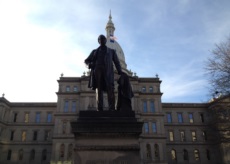 Supporters of free markets
had little to cheer for based on what Michigan’s 99th Legislature did in 2017.
There were certainly positives – such as public school pension reform – but
lawmakers also indulged in a corporate-welfare potlatch party. Here’s a
round-up.
Supporters of free markets
had little to cheer for based on what Michigan’s 99th Legislature did in 2017.
There were certainly positives – such as public school pension reform – but
lawmakers also indulged in a corporate-welfare potlatch party. Here’s a
round-up.
House Bill 4001, (Don’t) cut the state income tax rate by 0.2 percentage
points
Twelve Republican members of the Michigan House set the tone by defeating a
modest income tax cut that would have reduced the current rate of 4.25 percent
to 4.05 percent. The damage was compounded when Republican Gov. Rick Snyder
chose to publically thank these 12 members for their votes to prevent a tax cut.
With this action, the prospect of achieving any significant pro-growth reforms
in this 99th Michigan Legislature largely evaporated, to be replaced by an
explosion of cronyism and corporate welfare.
Senate Bill 111,
Redistribute $1.0 billion from state taxpayers to Dan Gilbert and other big
developers
With income tax cuts off the table, lawmakers reverted to giving handouts to a
privileged few. Detroit developer Dan Gilbert lobbied hard for his share and
scored big. As introduced, the bill would have let Gilbert and possibly a few
other developers simply pocket the income tax they withhold from their own
employees (plus some other revenues). This was bit too transparent, so the final
bill shuffles the money through Lansing first before handing it back to the
developers. A few weeks after the vote, Forbes Magazine declared Gilbert the
richest man in Michigan.
Senate Bill 242, Redistribute $200 million from state taxpayers to iPhone
maker
Michigan lawmakers joined colleagues in other states in bending over backward to
offer handouts to a Taiwan-based company that makes iPhones. Taking a page from
SB 111, this one would let Foxconn essentially pocket up to $200 million worth
of income taxes paid by its employees. The bill was also worded in a way that
potentially would allow more firms to get in on the scheme.
Senate Bill 469, Give some developers tax breaks for rehabbing “historic”
structures
When he ran for governor in 2010, Rick Snyder’s top priority was reforming
Michigan’s economically destructive business tax. In 2011 the Legislature passed
and Snyder signed a sweeping overhaul of Michigan’s income tax for both
businesses and individuals. Among many changes, this eliminated a variety of
special income tax exemptions and deductions benefitting certain developers,
nonprofits and individuals.
But like water flowing downhill, cronyism tends to expand in legislative bodies,
as illustrated by a number of bill introductions and at least one vote to bring
back the special privileges repealed in 2011. The vote was by the Senate on a
bill to grant certain developers tax breaks and outright cash subsidies for
rehab projects deemed by local and state corporate welfare officials to involve
a “historic” structure – a form of handout that had been scotched by Snyder’s
2011 reform.
House Bill 4207, Subsidize some grocery stores in cities
This one was promoted as misguided social engineering, not “economic
development,” but it’s no more likely to achieve its purported goals than the
big corporate welfare bills. To address alleged food deserts in urban areas, the
bill would earmark between $1 and $2 million annually to be divvied among a few
urban grocery store and delicatessen owners. Specifically, stores that sell
unprocessed or fresh meat, fruits and vegetables or dairy products would
qualify. In fine cronyist fashion, protectionist language was added prohibiting
subsidies for new stores opening within a mile of a competitor.
Coincidentally, in the same month the bill was signed into law, a study
published by the National Bureau of Economic Research found that such measures
are unlikely to have any impact on nutrition. The poor dietary habits of
low-income households are, it said, largely explained by differences in
“education, nutrition knowledge, and regional preferences” – not the supposed
unavailability of fresh food.
House Bill 5013, Auto insurance reform
Michigan House Republicans took yet another run at reforming the state’s
no-fault auto insurance system, which forces motorists here to purchase the most
expensive coverage in the nation and makes insurance unaffordable for far too
many.
The proposed bill would have given vehicle owners the option of purchasing
less-than-unlimited personal injury protection benefits. It also would restrict
the power of hospitals to gouge insurers – and through them, every vehicle owner
– for the cost of treating crash victims.
Never mind the demagoguery
about making the currently unlimited personal injury coverage optional (and
still the nation’s most generous coverage), the real force against this bill was
state’s hospital lobby. Big Hospital perhaps became the state’s most powerful
special interest after the 2013 Legislature voted to accept the Obamacare
Medicaid expansion. That move brought approximately $4 billion in annual “free”
federal dollars that now flow to Michigan hospitals.
Senate Bill 335, Accommodate “Citizens United” ruling; authorize “super-PACs”
Finally, some good stuff actually passed. In 2010 the U.S. Supreme Court ruled
that politicians may not restrict political free speech if the speaker is a
corporation, a category that includes many nonprofits organized by individuals
motivated by political beliefs. One consequence of the ruling was an explosion
at the federal level of so-called “super-PACs,” which can engage in political
speech that is not “express advocacy.” These organizations are not subject to
spending limits or compelled to disclose the names of contributors. In 2017
Michigan lawmakers accepted the premise by inserting essentially the same
provision into this state’s complex campaign finance regulatory regime.
House Bill 4999, Ban local food and beverage taxes
Former New York Mayor Michael Bloomberg made headlines by banning sugary soft
drinks served in containers larger than 16 ounces. Subsequently, some
communities around the country enacted local soft drink taxes. Some local
politicians in Michigan apparently liked the idea, and it seemed just a matter
of time before nanny-state local governments here followed suit. In a notably
expeditious process, legislation preempting local taxes on food and beverages
was introduced in late September and signed into law by Halloween.
Senate Bill 401, Reform School Pension System
By the start of 2017, unfunded taxpayer liabilities in Michigan’s state-run
school pension system had soared $4.3 billion higher than when the Legislature
enacted a faux-reform in 2012. This development undercut the credibility of
those insisting that the status quo system was sound and sustainable, and
strengthened the hand of legislative leaders who felt misled by some reform
opponents inside state government.
Last year’s legislative product was messy and more complicated than it should
have been, but it nevertheless appears to get the pension-reform job done.
Starting next month, 401(k) accounts (with generous employer contributions) will
be the default for new school employees. New hires who select a traditional
defined benefit version will be on the hook themselves for future underfunding,
which makes it unlikely that many will choose this option.
Permission to reprint this blog post in whole or in part is hereby granted,
provided that the author (or authors) and the Mackinac Center for Public Policy
are properly cited. Permission to reprint any comments below is granted only for
those comments written by Mackinac Center policy staff.
MICHIGAN COUNTY STEALS HOUSE
FOR $8 DEBT
Pacific Legal Foundation
By Christina M. Martin, December 7, 2017
 In 2014, Oakland County, Michigan foreclosed on a home owned by
Uri Rafaeli’s business—Rafaeli, LLC—over an $8.41 tax debt. The County sold the
property for $24,500, and kept profits. Ditto for Andre Ohanessian, when the
County seized and sold his property for $82,000, and pocketed every penny left
over from the $6,000 tax debt. While most states refund the surplus, Michigan is
among a handful of states that allow property theft to fill government coffers.
PLF has asked the Michigan Supreme Court to strike down this bureaucratic theft
and restore our clients’ constitutional rights.
In 2014, Oakland County, Michigan foreclosed on a home owned by
Uri Rafaeli’s business—Rafaeli, LLC—over an $8.41 tax debt. The County sold the
property for $24,500, and kept profits. Ditto for Andre Ohanessian, when the
County seized and sold his property for $82,000, and pocketed every penny left
over from the $6,000 tax debt. While most states refund the surplus, Michigan is
among a handful of states that allow property theft to fill government coffers.
PLF has asked the Michigan Supreme Court to strike down this bureaucratic theft
and restore our clients’ constitutional rights.
Rafaeli, LLC v. Oakland County
In 2011, Uri Rafaeli’s business—Rafaeli, LLC—purchased a modest rental property
in Southfield, Michigan for $60,000. Rafaeli inadvertently underpaid the
property’s 2011 taxes. He paid his 2012, 2013 taxes in full. After learning he
owed money for 2011, Rafaeli tried to pay the full 2011 tax debt in January,
2013. But he mistakenly did not factor in interest growing on the debt, and
underpaid by $8.41. The County foreclosed on the property, sold it for $24,500,
and pocket the massive windfall at Rafaeli’s expense.
Similarly, Andre Ohanessian owed $6,000 in taxes, penalties, interest, and fees
when the County foreclosed and sold his property for $82,000. As with Rafaeli,
the County kept all profits from the sale, rather than reimbursing Ohanessian.
Rafaeli and Ohanessian are not alone. Unlike most states which refund such
surplus, Michigan is among a handful of states that allow property theft to fill
government coffers. In fact, thousands of property owners across Michigan have
lost valuable property to pay debts, even very small ones. This predatory
government foreclosure process is a particular threat to the elderly, sick, and
economically distressed.
Rafaeli and Ohanessian sued, saying that the government unconstitutionally took
their property without just compensation when it kept the proceeds from the
sales. PLF filed an amicus brief in their support in the Michigan Court of
Appeals. That court ruled against them, dangerously expanding civil asset
forfeiture law to include non-criminal activities, and upholding this
bureaucratic theft.
PLF now represents Rafaeli and Ohanessian, and asked the Michigan Supreme Court
to vindicate their constitutional property rights, and set a precedent that will
protect thousands more property owners from bureaucratic theft.
THE PROBLEMS WITH THE PENSION AND RETIREE
HEALTH INSURANCE BILLS
Recent legislation confuses legal obligations
between benefits
By James M. Hohman, Dec. 12, 2017
Legislation that creates funding requirements for local government
pensions and retiree health insurance benefits recently passed both Michigan
chambers. This package is an attempt to address the billions in retirement debt
faced by local governments. But the law is problematic because it conflates
pension and retiree health care benefits — two things that should not be lumped
together — and opens the door to tax hikes in local governments.
Pensions and retiree health care are fundamentally different things to
governments in Michigan. The state constitution requires pensions to be paid for
as they are earned; they are legally binding debt. Retiree health insurance
benefits are not. Local government managers can change their eligibility
requirements, trim the generosity of benefits or otherwise alter the insurance
benefits they offer to employees and retirees.
Local governments can make sure that employees trust that retirement insurance
benefits will be available by setting aside money today to pay for them. But few
have done so.
The legislative package, however, creates similar funding requirements for both
pensions and retiree health insurance benefits. It recognizes only weakly the
very different legal status each benefit has: The state will now consider
retiree medical insurance benefits to be underfunded when a local unit of
government has less than 40 percent of the cost saved. It will consider pension
benefits well-funded when governments have saved enough to pay 60 percent of the
liability.
In addition, governments will also be considered “underfunded” when they spend
12 percent of their budget on retiree health care or 10 percent on pensions,
even if they exceed the legislation’s funding requirements.
The primary effect of the proposed law is to encourage local governments to fund
both benefits. Fund, not cut. And that is a problem. While pensions need to be
funded, retiree health care does not. The costs for retiree health care should
be lowered, and there is a lot that can be done without making already-retired
employees ineligible for insurance. Only after being cutting down to a bare
minimum should retiree insurance be prefunded.
The current policy where government officials pledge benefits, kick the costs to
future taxpayers, and reserve the option to reduce them later implies that
governments need to cut benefits. But that, and prefunding health benefits,
should be done only after clearing the mismanagement surrounding the current
benefits being provided.
Some local governments may choose to use the funding requirements as a reason to
reduce retiree health insurance benefits. For one thing, the 12 percent cap
makes it harder to tax their way out of the problem. Yet it’s not impossible,
for local government officials are often tempted to see a tax increase as the
solution.
If a local government does not meet state funding standards, the state can
declare that its benefits are “underfunded” and create a plan to address the
underfunding. The plan can be approved or rejected by a state board of political
appointees. And that may mean pressure to increase taxes to avoid state
involvement.
It is unclear how governments will react to this legislation. Will they be
interested in trimming costs, increasing taxes and revenues or will they do
something else? The larger problem with the legislative package is that it
provides little encouragement in state policy to address these optional retiree
health care benefits. Local officials have refused to acknowledge their problems
in retirement benefits and instead insist that fiscal issues are entirely the
fault of revenue. So it’s likely they will use this process to raise revenue
rather than reduce costs for optional benefits.
Legislators can encourage local governments to take steps to lower the costs of
retiree health insurance. They can prohibit governments from kicking the costs
of new employee service onto future taxpayers and make retiree health insurance
prefunding a higher priority than wage increases. They can offer state
incentives to lower the costs of these benefits or other kinds of direct
encouragement. By not taking steps to move local governments this way,
legislators made mismanagement more likely.
Permission to reprint this blog post in whole or in part is hereby granted,
provided that the author (or authors) and the Mackinac Center for Public Policy
are properly cited. Permission to reprint any comments below is granted only for
those comments written by Mackinac Center policy staff.
POLICE SET UP CRIME,
ENTRAP COLLEGE STUDENT'S CELLPHONE AND $100
Though none were
arrested, 523 in Michigan still lost property forfeited to police last year
By Tom Gantert, Nov. 20, 2017
In 2016, police officials from two Michigan cities teamed up to place an advertisement soliciting sex on a website commonly used for prostitution.
The Kalamazoo Valley
Enforcement Team, which is a joint operation of police officers from the cities
of Kalamazoo and Portage created to run drug investigations, then used an
informant to agree to be a prostitute for the sting operation.
On March 31, 2016, a Western Michigan University student answered the fake
advertisement. When he paid the informant $100, police were listening from an
adjoining hotel room and through the door. The student was not arrested but
admitted to paying for sex.
The WMU student was never charged with a committing a crime because this would have required the police to name the informant. Yet police seized his cellphone and $100 anyway and kept it through a process known as civil asset forfeiture.
In Michigan, one in 10
people whose property is taken and kept by police in forfeiture actions is never
charged with a crime. A state report shows that more than $15.3 million in cash
and property was forfeited last year.
That WMU student was one of 523 people who had seized property forfeited without
being charged with a crime. In this case, police created the circumstances for
the crime to be committed and then did not charge the individual they lured. But
they did keep his money and cell phone.
Michigan Capitol Confidential has sent Freedom of Information Act requests to dozens of local and state agencies asking for the reports involving cases in which property was seized and then forfeited to police. The information for this story came from the public records received from a FOIA request.
The Kalamazoo Department of Public Safety and City Manager Jim Ritsema didn’t respond to emails seeking comment.
Permission to reprint this blog post in whole or in part is hereby granted, provided that the author (or authors) and the Mackinac Center for Public Policy are properly cited.
IRON MOUNTAIN
SCHOOLS DRAWS FLAK FOR NOVEL HOMESCHOOL CO-OP
'I don’t think
it’s a fair way of doing it,' says neighboring superintendent
By Evan Carter, Nov. 15, 2017
A school district near the
Michigan-Wisconsin border in the Upper Peninsula is getting pushback over the
structure and funding of a co-op it runs with some homeschool families in the
area.
The resistance is coming from other schools in its area. The co-op offers
virtual courses on subjects like Spanish, cooking and gymnastics, but also
offers regular off-campus activities that allow local experts, who aren’t
necessarily licensed teachers, to give hands-on instruction.
The homeschool co-op not only provides classes to homeschool families, but Iron
Mountain also receives partial per pupil funding from the state for each student
who takes an online course. It is currently working to reduce more than $427,000
in debt.
Allowing homeschool students to take noncore classes at public schools –
subjects other than science, math, language arts and social studies classes – is
not new for Michigan public schools. But the practice of offering regular
off-campus activities that are connected to the class differs from what has
typically been offered before.
Ben DeGrow, director of
education policy at the Mackinac Center for Public Policy, said he sees these
types of partnerships as a positive development that provides families a wider
range of options to help children succeed.
“More and more Michigan parents are being drawn to these homeschool partnerships
as a way to enhance their ability to customize their children’s learning,”
DeGrow said. “Districts that embrace the partnership model get the opportunity
to learn innovative approaches that help them serve all students better.”
Opponents of this type of homeschool co-op claim Iron Mountain is skirting the
rules set up to govern programs offered by school districts to nontraditional
students. Since the Iron Mountain school district offers off-campus activities
connected to the classes during the school day, some opponents, like Craig
Allen, superintendent of Breitung Township Schools, say the programs aren’t
truly available to all students.
Allen said he isn’t opposed to public school co-ops with homeschool families in
general. But he doesn’t agree with how Iron Mountain’s co-op is set up.
“This new-wave homeschool partnership is to offer classes for homeschool
students and to offer classes in a segregated way. I don’t think it’s a fair way
of doing it and traditionally not what shared time was about,” Allen said.
In an interview with Michigan Capitol Confidential, Iron Mountain Superintendent
Raphael Rittenhouse defended his school district’s program, saying that
conventional public school students can set up their schedules so they can
attend the off-campus activities.
According to Rittenhouse, the real disagreement between his school district and
the surrounding ones is Iron Mountain’s frequent use of off-campus activities,
which he believes have made them popular with homeschool families.
Offering online courses or even allowing homeschool students to take noncore
classes at their local public school is not uncommon.
“Everybody is using the same resources that are available to run school
districts,” Rittenhouse said. “There’s nothing being done here in Iron Mountain
that isn’t being done somewhere else. This is a question of scale.”
Emelie Fairchild has six children who range from kindergarten to high school in
the co-op program, where she helps teach Spanish. Fairchild appreciates the
extra hands-on learning experiences the co-op provides for her children, not
only for the educational value but also because her children can make friends
with other kids their age.
“My kids would probably tell you that, that is the most fun part of the class,”
Fairchild said. “The [hands-on activities] are the bonus and that’s the most fun
part of the class.”
Permission to reprint this blog post in whole or in part is hereby granted, provided that the author (or authors) and the Mackinac Center for Public Policy are properly cited.
TAXPAYERS DESERVE TO KNOW
DETAILS OF BUSINESS SUBSIDY DEALS
State officials are hiding what should be
public information
By James M. Hohman, Oct. 5, 2017
 Businesses that
inked special deals with the state are going to collect $681 million from
taxpayers this year. But residents cannot be told which businesses are cashing
in and how much each gets. This is a failure of basic government transparency.
Businesses that
inked special deals with the state are going to collect $681 million from
taxpayers this year. But residents cannot be told which businesses are cashing
in and how much each gets. This is a failure of basic government transparency.
As a citizen, you are entitled to know how your government is spending your
money. The state and local governments put a lot of effort into this — for
instance, posting every annual financial report of every government and every
contract the state agrees to.
And, with few exceptions, people can access any government document available
with a Freedom of Information Act request. That includes detailed records of
spending by governments, even checkbook registers and credit card statements. A
simple FOIA request is all that is needed, for instance, to find out how much
your school district spends on paper clips.
All of this shows how abnormal it is that the state does not disclose the
recipients of a large number of business subsidy programs. Some of this
information is available: There’s a report on the recipients of certain programs
here, but not all of them. The subsidies that are delivered through tax credit
programs are deemed to be confidential information.
They shouldn’t be. These deals allow select companies to collect dollars — in
the form of refundable tax credits — from other taxpayers and have contracts
with the state that determine the size of the subsidy. These are subsidies
administered through the tax code.
There are some obvious reasons why this information should be public. Economists
can use it to determine the full costs and benefits of the program. It can be
used to compare the alleged benefits of this spending to that of other state
programs or government services. And it can be used to hold politicians
accountable.
But there is a more important reason: Citizens should be entitled to it. This is
their money that is being spent and they deserve to know who is getting it and
what they are getting in return.
Thankfully, some lawmakers also think that the public has a right to know where
all their taxpayer dollars are going. Rep. John Reilly, R-Oakland Township,
introduced bills that would allow this information to be disclosed. It’s a
simple bill that would clarify that payments through these programs are
disclosable.
And that’s the kind of thing that both Republicans and Democrats should support.
It’s bad enough that subsidy programs put select businesses ahead of the
taxpaying public and businesses that don’t find favor with politicians. These
groups ought not have to foot these bills under a veil of secrecy.
Permission to reprint this blog post in whole or in part is hereby granted,
provided that the author (or authors) and the Mackinac Center for Public Policy
are properly cited.
THE QUIET GOOD NEWS:
US ECONOMY IS DOING REALLY WELL
Middle-class
incomes are setting new highs, poverty is down, yet no one’s talking about it
By Tom Gantert, Sept. 13, 2017
The median household income of
Americans grew to an all-time high of $59,039 in 2016 according to a U.S. Census
Bureau report released Sept. 12. That’s a 3.2 percent increase from the 2015
median of $57,230.
The nation’s poverty rate, meanwhile, is down, falling to 12.7 percent in 2016.
This is very close to the 12.5 percent rate that prevailed in 2007, before the
Great Recession of 2008-09 and the slow-growth recovery that followed. In 2010
the national poverty rate was 15.1 percent.
While 40.6 million Americans still lived in poverty in 2016, that was 2.5
million fewer than the previous year, according to the Census Bureau.
“Has anyone noticed how well the economy is doing?” said University of Michigan
economist Don Grimes. “Middle-class income at the highest level ever and the
poverty rate back to where it was before the recession. Where is the champagne?”
Data on Michigan median household income and poverty rates will be released
later this month.
Permission to reprint this blog post in whole or in part is hereby granted, provided that the author (or authors) and the Mackinac Center for Public Policy are properly cited.
STATE OF MICHIGAN'S GREAT
LAKES INVASIVE CARP CHALLENGE
Crowdsourcing the state’s carp strategy
By Jason Hayes, Aug. 9, 2017
On Aug. 1, the state of Michigan posted its Great Lakes Invasive Carp challenge on the Innocentive.com website. The announcement began:
The State of Michigan has appropriated 1 million dollars for a Challenge seeking to prevent the movement of invasive carp species into Lake Michigan from the Illinois River through the Chicago Area Waterway System (CAWS). The Seeker is looking for new and novel ideas to function independently or in conjunction with those deterrents already in place to prevent carp movement into the Great Lakes or other locations.
Reading through the challenge can be initially unsettling for two
distinct reasons.
 First, the threat of Asian carp
becoming established in the Great Lakes should bother all of us. Two of the
species grouped under the umbrella of “Asian carp” – bighead and silver carp –
can grow up to 100 pounds and four feet long, and can eat as much as 40 percent
of their body weight each day. Both species are so effectively intrusive that
researchers compare them to cancer cells. When introduced into a lake or river
system, their populations can grow so rapidly that they take up most of the
available nutrients and space. Eventually, they push the native fish species
out. Missouri’s Department of Conservation estimates that these carp species
make up 95 percent of the biomass in some Missouri rivers.
First, the threat of Asian carp
becoming established in the Great Lakes should bother all of us. Two of the
species grouped under the umbrella of “Asian carp” – bighead and silver carp –
can grow up to 100 pounds and four feet long, and can eat as much as 40 percent
of their body weight each day. Both species are so effectively intrusive that
researchers compare them to cancer cells. When introduced into a lake or river
system, their populations can grow so rapidly that they take up most of the
available nutrients and space. Eventually, they push the native fish species
out. Missouri’s Department of Conservation estimates that these carp species
make up 95 percent of the biomass in some Missouri rivers.
If Asian carp become established in the Great Lakes, they could decimate
Michigan’s fisheries and would have a significant negative impact on Michigan’s
$2.43 billion fishing industry.
Second, the announcement suggests government may not be up to the task of
stopping invasive species. While the Department of Natural Resources does have
an invasive species plan, it doesn’t appear to provide an answer to the problem.
That can be unsettling for those who believe that government should have answers
to difficult management questions.
The economist Friedrich Hayek provides a word of caution and hope here. In his
1945 paper, The Use of Knowledge in Society, Hayek provides an interesting look
at the idea that government can always have answers to important questions.
Knowledge of the circumstances of which we must make use never exists in
concentrated or integrated form but solely as the dispersed bits of incomplete
and frequently contradictory knowledge which all the separate individuals
possess. … The ‘data’ from which the economic calculus starts are never for the
whole society ‘given’ to a single mind which could work out the implications and
can never be so given.
He was saying that one person or group can’t possibly be the source of all
wisdom on a given topic. And although we must admit that the knowledge dispersed
throughout our population may not have the answer to the invasive species
challenge, when pulled together in a coherent form, it is far more likely to
contain an answer.
Faced with the reality that they have a legal and financial responsibility to
tackle the issue, but have not yet solved it, DNR officials have reached out for
help. They should be applauded for their willingness to crowdsource novel ideas
for this challenge. Applying an economic incentive – in the form of a financial
reward – may also help to encourage creative responses.
Using incentives to gather dispersed knowledge on an important issue is a far
superior option to hunkering down and relying on a single entity – in this case
the DNR – to possess all knowledge on invasive species. This $1 million expense
appears imminently reasonable when weighed against the potential losses to
Michigan’s fisheries if Asian carp do become established in the Great Lakes.
Permission to reprint this blog post in whole or in part is hereby granted,
provided that the author (or authors) and the Mackinac Center for Public Policy
are properly cited. Permission to reprint any comments below is granted only for
those comments written by Mackinac Center policy staff.
HOW MUCH ARE
GOLDFISH WORTH? $4.3M IF CALLED 'GREAT LAKES RESTORATION'
Legislator wanted
Michigan taxpayers to replace federal spending cuts
Michigan Capitol Confidential, May 8, 2017
When President Donald Trump proposed
eliminating $300 million in annual spending labeled the Great Lakes Restoration
Initiative, many politicians and media voices warned of catastrophic
consequences for the nation’s largest bodies of fresh water.
The money is disbursed through hundreds of grants to state and local
governments, universities, Indian tribes and others, often for activities that
have little to do with the lakes. Previous stories here have described it being
spent on better moose management in Minnesota, training Mohawks to write fish
advisories and reverting an Ottawa County golf course to a “more natural state.”
Yet a Democratic member of the Michigan House of Representatives recently tried
to backfill any reductions to this spending with money collected exclusively
from Michigan taxpayers. State Rep. Kristy Pagan, D-Canton, proposed an
amendment to next year’s state budget on May 2 that would have allocated $37.5
million for this, mostly from state income tax collections. Pagan’s amendment
failed on a voice vote.
A $4.3 million project in Chicago shows the tenuous relationship between these
federal grants and the stated intention of restoring the Great Lakes. Approved
in 2013 and scheduled to be completed by 2019, it would replace 162 acres of
pond and marsh on the city’s south side with savanna and grassland riparian
habitats.
One benefit of the $4.3 million project, as stated by Jackson Park Advisory
Council President Louise McCurry, would be exposing city children to a native
habitat. McCurry also said in a local newspaper that the money could control
goldfish and carp, considered invasive species, that were in the park’s lagoon.
Jackson Park is along the shore of Lake Michigan. The original park was designed
by Frederick Law Olmstead as part of the 1893 world’s fair called the World’s
Columbian Exposition. It is also the intended site of the Barack Obama
presidential library.
Spiffing up a Chicago park may have value for the city, but that project shows
how far this spending veers from the goal of “cleaning up and maintaining” the
Great Lakes, which many media stories and politicians claim is the purpose.
Permission to reprint this blog post in whole or in part is hereby granted,
provided that the author (or authors) and the Mackinac Center for Public Policy
are properly cited.
PLANTING TREES IN VACANT LOTS TO SAVE GREAT LAKES
Michigan Capitol Confidential, April 4, 2017
The city of Detroit received $1
million from a federal spending program called the Great Lakes Restoration
Initiative in 2014 for two projects.
The city would turn 40 publicly owned vacant lots into green space consisting of
meadows, trees and other vegetation. And it would also install drainage ditches
and porous pavement on roadways and developed sites near the Recovery Park area,
about 3 miles north of downtown. Both federally-funded projects were intended to
deal with rainwater runoff.
President Donald Trump's budget proposes cutting most Great Lakes Restoration
Initiative spending, which has prompted critics to say the funding is critical
to protecting the Great Lakes.
Permission to reprint this blog post in whole or in part is hereby granted, provided that the author (or authors) and the Mackinac Center for Public Policy are properly cited.
HOW LANSING DODGES TAX CUTS
Never admit state government is taking more
Michigan Capitol Confidential, March 31, 2017
In a March
29 newspaper story about Gov. Rick Snyder’s proposed budget, Democratic
politicians warned about “de-investment” in the state.
“In my opinion, Michigan has been a state where we’ve de-invested in so many
things, that I’m not looking for de-investment now,” said Sen. Curtis Hertel
Jr., D-Meridian Township, in a report out of The Detroit News. “If we want to
give tax relief to the middle class, we can do it by actually making sure that
corporations pay some part of their fair share.”
State Rep. Yousef Rahbi, D-Ann Arbor, echoed Hertel’s comments about more
investment needed in the state.
ForTheRecord says: Most of the political establishment in Lansing appears
determined never to acknowledge that the amount of taxpayer money flowing into
the Michigan Department of Treasury has risen every year since 2010-11. They
instead try to create a perception of continual belt-tightening.
This bipartisan party line makes it harder to pass even a modest tax cut, as the
Speaker of the House and most of the Republican caucus discovered in a failed
Feb. 23 roll call vote on a 0.2 percent income tax cut.
State spending from state taxes and fees — not including federal money — has
risen for seven consecutive years and is projected to rise again for an eighth
time in the 2016-17 fiscal year.
The state spent $25.2 billion in 2009-10 and its spending in the current fiscal
year will reach $31.1 billion. Snyder’s budget proposes to make state spending
climb to $31.9 billion next year. These figures do not include federal dollars
in the budget.
Permission to reprint this blog post in whole or in part is hereby granted, provided that the author (or authors) and the Mackinac Center for Public Policy are properly cited.
$581K IN GREAT LAKES
RESTORATION MONEY FOR MOHAWK TRIBE TO TALK FISH, TRIBAL BELIEFS
Michigan Capitol Confidential, March 20, 2017
Opponents have loudly
criticized President Trump’s proposal to stop spending $300 million annually on
a Great Lakes Restoration Initiative, some calling it “critical.”
One of the program's line items was $581,851 in 2010 to help the St. Regis
Mohawk Tribe write advisories for members and “communicate benefits and risks of
consuming fish caught from the St. Lawrence River Basin.” The project would also
“engage the community in the design and development of new fish advisory
communications, increase awareness and understanding of advisory messages, and
maintain and respect traditional tribal customs and beliefs.”
Permission to reprint this blog post in whole or in part is hereby granted, provided that the author (or authors) and the Mackinac Center for Public Policy are properly cited.
$135K TO STUDY
INSECTS CALLED 'GREAT LAKES RESTORATION'
Michigan Capitol Confidential, March 14, 2017
Michigan State University
was given a $135,668 grant from the Environmental Protection Agency in 2010 via
the Great Lakes Restoration Initiative. The money was to be used to study the
Mitchell’s Satyr butterfly and the Hine’s Emerald dragonfly in the Great Lakes
region.
A document from a White House budget office suggested possible reductions in
Great Lakes Restoration Initiative spending. In an editorial, the Detroit Free
Press called reductions to the initiative “irresponsible.”
Permission to reprint this blog post in whole or in part is hereby granted, provided that the author (or authors) and the Mackinac Center for Public Policy are properly cited.
APRIL 2017
$750K 'GREAT
LAKES' GRANT INCLUDED REVERTING GOLF COURSE TO NATURAL STATE
Michigan Capitol Confidential, March 10, 2017
Ottawa County's parks
department bought the 122-acre Holland Country Club in 2008. The county then
received a $750,000 Great Lakes Restoration Initiative grant from the U.S.
Environmental Protection Agency in 2010. Part of that money was used to restore
62 acres of golf course turf grass to a more natural state.
According to a White House budget document reported by different media outlets,
the president’s budget will include large cuts in the ongoing Great Lakes
Restoration Initiative.
Permission to reprint this blog post in whole or in part is hereby granted, provided that the author (or authors) and the Mackinac Center for Public Policy are properly cited.
GREAT
LAKES CASH 'CRITICAL' -- REALLY?
Michigan Capitol Confidential, March 6, 2017
In 2010, Michigan State University
received $1.5 million in taxpayer dollars from the “Great Lakes Restoration
Initiative,” a federal initiative. According to MSU, the money paid for
researchers to “work with physicians and other health care providers in Michigan
to provide them with the tools and information they need to identify at-risk
patients and inform them of the benefits and potential dangers of eating fish.”
President Donald Trump has been criticized in the media for proposing cuts to
the Environmental Protection Agency’s budget. These include money for the
programs and grants covered under the GLRI rubric. One newspaper headline read:
“Trump to Great Lakes: Drop dead.” U.S. Sen. Debbie Stabenow said the spending
was critical and the cuts outrageous.
Permission to reprint this blog post in whole or in part is hereby granted, provided that the author (or authors) and the Mackinac Center for Public Policy are properly cited.
WHAT HAPPENS WHEN THE ECONOMIC DEVELOP
CORPORATION ENDS?
State Could Save Millions by Stopping
Ineffective Subsidies
By James M. Hohman, Jan. 24, 2017
In April 2019, the administrator for the state’s economic
development programs, the Michigan Economic Development Corporation, will
officially close. The closing ought to force lawmakers to reassess the state’s
economic development policies.
The MEDC is an “interlocal agency,” created by an agreement between the state’s
Strategic Fund Authority and a number of local government economic development
agencies. This agreement has a 10-year term and, by agreement, can be renewed
for two five-year terms.
Its partners renewed the organization by default in 2009 and in 2014, and the
agreement creating the agency will dissolve in 2019.
Even if the state wants to keep administering its economic development programs,
the MEDC ought to go away. There is no point to having a quasi-state agency do
it.
The MEDC is not a third party entity since the state has direct control over its
operations. It makes economic development activities more complex, with no
benefit. The state still runs its own economic development agency, the Michigan
Strategic Fund, but currently has to have an agreement with the MEDC to
delineate each party’s responsibilities.
But the state’s economic development activities do little good in the first
place. As we’ve argued before, these programs are more about press releases than
job creation, they invite corruption and they do not justify their costs. Taking
money from some people and giving it others through a political process in the
name of job creation has been a losing policy.
The state is spending $181 million a year on economic development programs. The
MEDC gets additional income from the state Indian Gaming Compacts, and the state
would need to agree on what to do with that money if the MEDC is eliminated.
But that money is only a portion of the savings Michigan would reap from
eliminating the state’s economic development apparatus. The MEDC’s financial
statements report that the organization has $98 million in unrestricted
non-capital assets — money lawmakers can direct elsewhere. If the state is out
of the selective subsidy game, it should also reconsider the fund balance of the
21st Century Jobs Fund, which stands at $81.6 million, and it should consider
selling any of its speculative financial investments. Financial reports indicate
a $147 million fair market value for its investment programs, for instance.
Exactly how much can be directed elsewhere if the MEDC and its programs end is a
good question for legislators to ask.
All told, there is likely more than half a billion that can be saved and spent
elsewhere if the MEDC closes and the state stops its business subsidies.
Permission to reprint this blog post in whole or in part is hereby granted,
provided that the author (or authors) and the Mackinac Center for Public Policy
are properly cited.
MICHIGAN'S PENSION BUREAUCRATS
MISLEAD POLICYMAKERS AND THE PUBLIC
Friday, Dec. 2, 2016
Midland
— Pension managers who oversee Michigan’s school pension system testified
Wednesday in a Michigan Senate committee that a reform bill lawmakers are
considering would cost the state billions in upfront costs. Their analysis of
Senate Bill 102 is inaccurate as the bills explicitly prohibit the state from
incurring these added expenses, as they are entirely optional.
Legislators are considering offering new school employees 401(k)-style
retirement plans instead of adding them to Michigan’s school employee pension
system, which carries $26.7 billion of unfunded liabilities. The move would keep
Michigan from making pension promises to future teachers that it may be unable
to keep. But representatives of Michigan’s Office of Retirement Services
misleadingly claimed in testimony that this would lead to massive “transition
costs,” arguing that the state needs to follow so-called “best practices” of
public pension finance.
ORS’s claims are false and should be disregarded. So-called “transition costs”
had been the main objections to previous attempts to reform the pension system,
so the legislation currently under consideration in the Senate was written to
specifically prohibit the state from incurring these optional costs. ORS’s own
testimony showed they had not taken that language into account and were instead
analyzing previous versions of legislation no longer on the table.
Additionally, ORS’s sudden commitment to “best practices” flies in the face of
the department’s repeated willingness to ignore prudent pension funding
practices.
“ORS presides over a retirement system that has been underfunded for 33 of the
past 34 years,” said James Hohman, assistant director of fiscal policy at the
Mackinac Center. “They’ve used far-from-best practices to shortchange the
dollars going into the system and their mismanagement has made retirees the
largest creditors to the state.”
Additionally, examples of ORS’s failure to maintain or ignore other
pension-funding “best practices” include:
•Continuing to assume that school payroll will grow 3.5 percent annually when it has steadily decreased. From 2008 to 2014, school payroll fell 15 percent — ORS assumed it would increase by 23 percent and has not changed this assumption moving forward.
•Pledging retirement assets to guarantee the bonds on a speculative movie studio.
•Failing to pay the annual required contributions of the pension system 14 out of last 20 years.
•Rejecting state auditors’ recommendations to lower payroll growth assumptions and warnings about optimistic investment return assumptions.
ORS representatives claimed SB 102 would trigger
five different additional costs and only one of those is legitimate. That
additional cost comes from offering new employees benefits that would be more
generous than are offered under the current "hybrid" retirement plan. The other
costs are optional or prohibited by SB 102. It’s clear that ORS did not read,
did not understand or did not tell the truth about the legislation.
“Lawmakers and workers who depend on state systems for their retirements should
be outraged that ORS seems more interested in protecting the status quo and
their jobs than accurately analyzing and representing the legislation under
consideration,” Hohman added. “The current state of affairs is bad for teachers,
bad for kids in schools being shortchanged by pension funding requirements and
bad for taxpayers who are stuck with the bill.”
Permission to reprint this blog post in whole or in part is hereby granted, provided that the author (or authors) and the Mackinac Center for Public Policy are properly cited.
MICHIGAN HOUSE PASSES BILLS ROLLING BACK ARBITRARY 'HANDYMAN' LICENSING
Projects costing less than $4,000 would face fewer restrictions
By Jarrett Skorup, Sept. 24, 2016
Some contractors, like roofers,
would see fewer requirements.
If you want to earn some cash in Michigan painting a barn, be prepared to take
60 hours of educational courses and pass a state-mandated test. It will set you
back hundreds of dollars in total. But to obtain an amateur pilot’s license, the
Federal Aviation Authority mandates only a book and flight test with 40 hours of
flight instruction.
The state of Michigan licenses nearly 200 occupations, including more than dozen
“maintenance and alternations” contractors. But a review of who is required to
be licensed and who is able to work legally without state permission is
seemingly arbitrary. A new bill lessens restrictions on many contractors while
preventing mandates on those doing limited amounts of work.
If you put up siding in Michigan, you are required to have a license — but if
you build a fence you are exempt. Laying down wood food floors is subject to
extra mandates; laying down carpet or vinyl is not. Putting up drywall is no
problem, but painting that wall requires a license. Siding means extra hours and
fees, but constructing a fence does not. Paving with asphalt requires no
license, laying down concrete does. Moving a house can be done unregulated;
wrecking a house requires a license.
Most contractors have to take 60 hours of licensing classes, pass a $160 test
and pay $125 worth of state fees. The continuing education classes mandated by
the state cost hundreds of dollars.
House Bill 4282 is sponsored by Rep. Ray Franz, R-Onekama and was recently
passed by the Michigan House. The bill would drop the number of class hours for
residential maintenance and alteration contractors down to five. It would also
exempt from stringent licensure any person who worked on projects that cost less
than $4,000. The current limit is $600.
Michigan licenses many different types of contractors that other states do not.
The proposed law would allow people the ability to choose from a larger pool of
contractors, while the burdens on people trying to work would be lessened.
“It can quickly become overly burdensome to be required to hire a licensed
residential builder or contractor to perform everyday projects or improvements
to your house,” said Franz in a statement. “Even simple projects can get very
expensive. There needs to be a system in place to make sure people aren’t
charged an arm and leg for a small job.”
A companion bill, House Bill 4281, would eliminate the fees for the deregulated
jobs. It also passed.
“Hiring a family friend or neighbor to complete a project on your house is much
easier,” Franz added. “In some cases, it can make a person feel more comfortable
hiring someone they know. Requiring a licensed residential builder for something
a friend or relative could do with ease seems unnecessary.”
The bill was approved 66-40, with all Republicans and some Democrats in favor.
Over the past few years, the Michigan Legislature has been the most active in
the nation when it comes to licensing reform. The state has eliminated hundreds
of work rules and repealed seven licenses. But most of those have been
relatively minor — like ocularists and community planners — affecting only a
small number of people. If the bill overseeing trades workers passes the Senate,
it would be a major government obstacle removed from in front of workers.
“By raising the threshold for minor home repair projects, the bill would provide
welcome relief to handymen across the state,” said Lee McGrath, the legislative
counsel for the Institute for Justice, which works to lessen licensing
requirements. “Homeowners shouldn’t have to fear Michigan’s array of arbitrary
and costly contractor licenses to fix up their own homes.”
The licensing for larger scale residential builders, who build homes from the
ground up, would not be significantly changed. The bill mostly affects the
following occupations: carpentry, concrete, excavation, insulation work,
masonry, painting and decorating, siding, roofing, screen and storm sash,
gutters, tile and marble, house wrecking, swimming pools and basement
waterproofing.
Permission to reprint this blog post in whole or in part
is hereby granted, provided that the author (or authors) and the Mackinac Center
for Public Policy are properly cited.
STATE'S '21st
CENTURY FUND' SPENT $100 MILLION FOR JUST 1,052 JOBS
'. . . You're going
to be blown away' promised previous governor about these subsidies
By Derek Draplin, Sept. 16, 2016
The state’s 21st Century
Investment Fund (CIF) has spent nearly $100 million on various types of
subsidies and other forms of involvement in businesses since 2006, yet only
1,052 jobs have been created or retained because of it, according to the fund’s
2015 report. In addition, some investment groups received millions through the
fund but created zero jobs and no proceeds.
The state describes the fund as a program that “encourages the growth of
emerging Michigan companies, diversifies the state’s economy by creating and
retaining knowledge-based jobs and grows a community of investors to create a
long-term, sustainable capital ecosystem within Michigan.”
According to the report, $98.5 million in so-called “capital called for
investments,” or money spent by the state, has been used for investments.
"In 2005, policymakers deluded themselves into putting tax money into high-risk
investments to pump up the economy," said James Hohman, the assistant director
of fiscal policy at the Mackinac Center for Public Policy. "Since then, there
have been millions spent and little to show for it."
A number of examples are cited.
Nth Power IV, which the report lists as a venture capital firm in Detroit, got
$8.9 million of a $10 million commitment from the state and created $400,000 in
proceeds and zero jobs.
Microposite, a company that produced environmentally friendly siding products
before going out of business in 2009, got $1.6 million from the state but
created zero jobs. The state got back $55,737 in proceeds.
Quad Partners II received $9.8 million of a $10 million commitment for private
equity investment from the state, but the investment created zero proceeds for
the state and zero jobs.
Relativity I also created zero proceeds and zero jobs despite receiving $6.1
million from the state’s investment fund.
Midwest Mezzanine IV got $9.6 million and $6.3 million was returned to the
state, but zero jobs were created.
Not all the investments have been failures. Arboretum II received $7.1 million
for venture capital yet had $78 million in proceeds for the state and also
created 49 jobs.
Arboretum III got $8.3 million for venture capital investments and created 199
jobs, but the state only got back $200,000 in proceeds, according to the report.
Pegasus Fund IV received $9.1 million, got zero back in proceeds, but created
250 jobs.
The investment fund uses four different types of investments: venture capital
investments, private equity investments, mezzanine investments, and direct
investments.
The program was created by the Public Act 225 in 2005 and was sponsored by
former Rep. Bill Huizenga, R-Zeeland.
The fund’s updated progress report including 2015-16 is being released today.
The Michigan Economic Development Corporation did not respond to emails seeking
comment.
MICHIGAN TO WRITE $1 BILLION
IN SECRET CORPORATE WELFARE CHECKS IN 2016
Which firms get the money? Taxpayers kept in the dark
By Tom Gantert, July 29, 2016
The state of
Michigan will write more than $1 billion in subsidy checks this year to favored
businesses selected by politicians and government economic development
officials. These are dollars paid by Michigan taxpayers, which the state then
redistributes to corporate beneficiaries.
The subsidy checks are styled as "refundable tax credits," and a significant
portion of them were approved during a subsidy binge in the last two years of
former Gov. Jennifer Granholm's administration, in 2009 and 2010. Each company
has its own agreement with the state, and many of the agreements call for tax
breaks and cash payments for as long as 20 years.
Many of these credits were not designed to encourage companies to make new
investments or hire more people. Instead, the deals were offered to companies
(including the Big 3 automakers) in return for them simply “retaining” existing
jobs and facilities.
Companies have some discretion over when to claim these credits, which means the
Department of Treasury never knows for certain how large the bill will be in any
year. According to the Senate Fiscal Agency, as of June, the state has already
written checks to companies totaling $851.5 million. The state’s fiscal year
ends Sept. 30.
The law that authorized the handouts originated in the administration of
Republican Gov. John Engler. It created an entity called the Michigan Economic
Growth Authority (MEGA) with the power to give subsidies. Republicans and
Democrats alike later changed the law many times to expand and loosen the
criteria for granting subsidies.
The state stopped awarding new MEGA credits in 2012. They were replaced by a
smaller subsidy granting regime. Not counting the MEGA credits, these and some
other subsidy programs will cost the state another $217 million this year.
The Michigan Economic Development Corporation oversees the state’s corporate
welfare programs, including MEGA, and refuses to say which businesses get the
payments or how much they are paid.
“The state is expected to give over $1 billion of other people’s money to
companies it selected for favors. It’s bizarre that taxpayers are not allowed to
be told which ones are collecting,” said James Hohman, the assistant director of
fiscal policy for the Mackinac Center for Public Policy.
The MEDC didn’t respond to an email seeking comment.
From the Mackinac Center for Public Policy, a research and educational institute headquartered in Midland, Michigan. Permission to reprint in whole or in part is hereby granted, provided that the author and the Mackinac Center are properly cited.
COURT
OVERRULES LICENSING BOARD, EXONERATES VET WHO SAVED DOG
Reality TV
viewer complained after Dr. Pol helped Mr. Pigglesworth
By Derek Draplin,| July 12,
2016
 Veterinarian and reality TV star
Dr. Jan Pol. Photo via Nat Geo Wild channel.
Veterinarian and reality TV star
Dr. Jan Pol. Photo via Nat Geo Wild channel.
The Michigan Court of Appeals handed down a ruling in what it called the
“Curious Case of Mr. Pigglesworth,” exonerating celebrity veterinarian Dr. Jan
Pol of misconduct in a case that spanned five years. Its 3-0 decision overturned
a fine and probation for Pol’s supposed negligence that was reported by another
veterinarian who had watched his cable television show and took issue with his
procedures.
Pol, of Weidman, Michigan, is the star of the TV show "The Incredible Dr. Pol”
on Nat Geo Wild, which focuses on his rural Mount Pleasant-area veterinary
practice.
In 2011, Pol treated a Boston terrier named “Mr. Pigglesworth” that had been hit
by a car. He agreed to keep the cost of Mr. Pigglesworth’s surgery under $300,
which was the budget set by his owners, Mable and Loyd Frisbie. The Frisbies,
who were longtime customers of the veterinarian, would otherwise euthanize the
dog.
Pol removed Mr. Pigglesworth’s damaged eye, stitched lacerations in his mouth
and x-rayed his fractured pelvis, which he said would heal. The pet went home
with his owners the day after his operation and made a full recovery, the court
said.
Despite the successful procedure, a state licensing subcommittee called the
Board of Veterinary Medicine punished Pol with a $500 fine and probation. The
board acted after a Kentucky veterinarian filed a complaint against the 73-year
old doctor, objecting to his treatment of the terrier, which had been documented
on the TV show. The board is part of Michigan's Department of Licensing and
Regulatory Affairs.
After an investigation, the Bureau of Health Care Services, also part of the
licensing department, issued a complaint against Pol, alleging mistreatment of
Mr. Pigglesworth. It cited his failure to wear surgical gear (mask, gown,
gloves) and to provide the patient with IV therapy. The bureau also faulted Pol
for not placing a warming pad or blanket in the dog’s kennel during his
recovery.
The complaint also highlighted two violations of the public health code, which
allowed for a disciplinary subcommittee to punish Pol with a fee and probation,
and require him to take part in continuing education classes.
“As we said in the beginning, this case is curious. A dog’s life is saved, yet
the veterinarian faces sanctions,” the court said. “The evidence submitted does
not establish a clear standard of care that respondent violated.”
Pol told MIRS News he was "very glad that they came out with this opinion." He
added that for clients who can’t afford the best care for their pets, he tries
to provide care and avoid euthanasia.
House Speaker Kevin Cotter, R-Mt. Pleasant, who had previously defended Pol,
expressed his support for the court’s decision in a statement.
"I am very glad to see Dr. Pol vindicated and justice served in court," Cotter
said, according to MIRS News.
In 2013, Cotter sponsored House Bill 5176, which sought to prohibit authorities
from investigating reports of misconduct or allegations “based upon information
obtained from viewing the broadcast of a reality program.”
The bill, which Dr. Pol testified in favor of, was referred to the House Health
Policy Committee in December 2013. The committee held one hearing the following
May but never took a vote on the measure. It died with the end of the 2013-14
session and has not been re-introduced.
“This is common sense,” Pol said of the bill. “We all know that not everything
we see on television is how it really happens 100 percent of the time. There
simply isn’t enough time to show every single step of the process or procedure.
By using television editing, my viewers are given a snapshot of what life is
like for a rural veterinarian. But we are just as caring and professional as any
big city vet.”
Linda VanVoorhis, who described herself as a concerned taxpayer and pet owner,
attended an official hearing on the complaint against Pol in January 2015. She
also attended the licensing board’s disciplinary subcommittee meeting in March
2015.
"Why in the world the state of Michigan picked up on this complaint from an
out-of-state, former veterinarian was beyond [my] comprehension," said
VanVoorhis. "The owners of the dog were happy with the dog’s complete recovery
and actually brought him to the subcommittee meeting."
VanVoorhis added, "I think it’s ridiculous that as a taxpayer I paid for this
judge for an entire day, this courtroom for an entire day, the attorney
general’s representative, the prosecutor. That’s a ridiculous amount of money
that was wasted. And [Pol] probably paid for attorney fees for four years to get
this far."
“A tremendous amount of state time and money was wasted, and I’m sure a lot of
agony for [Pol] and his family and his practice,” she said.
Michael LaFaive, who directs the Morey Fiscal Policy Initiative at the Mackinac
Center, said the case is another example of regulatory bureaus hampering
for-profit service providers.
“Regulatory bureaus are another layer of government that add often unnecessary
and sometimes inconsistent applications of force to otherwise peaceful
commercial transactions. This is a case in point,” he said. “Both the
veterinarian and the owners of the dog assented to the transaction and the
latter have testified to being happy with the results. The case should have
ended there. Unfortunately, regulatory bureaus provide a means for officious
private and public busybodies to interfere with and even attempt to punish
for-profit service providers. It is hard not to applaud the court of appeals for
their thorough (and sometimes humorous) takedown of this particular bureau.”
LaFaive added that a competitive market is a better solution than regulatory
bureaus.
"One reasonable solution to this regulatory overreach is obviously to have less
of it. Short of that would be to consider a voluntary alternative. Maintain
these bureaus and their work for those who think them necessary, but permit an
alternative. If adult customers of veterinarians wish to choose a vet that
dispenses with static 'best practices' as defined by some regulatory body, let
them alone enjoy the benefits — or the costs — associated with such a decision,"
he said. "Over time, I believe the evidence would show that the market makes a
better regulator than your average state bureau."
From the Mackinac Center for Public Policy, a research and educational institute headquartered in Midland, Michigan. Permission to reprint in whole or in part is hereby granted, provided that the author and the Mackinac Center are properly cited.
PENSION
FUNDING: WHY YOUR TOWN IS GOING BROKE
Not because you don't pay enough taxes
By Tom Gantert, June 8, 2016
Just 13 percent of the local governments whose
retirement systems are administered by a statewide entity have set aside enough
money to pay the pensions promised to their workers.
The Municipal Employees’ Retirement System (MERS) administers pension systems
for 728 local cities, villages, townships, agencies and more. But only 97 of
those systems have adequately funded their pension obligations, according to the
operation’s most recent report that covers up to Dec. 31, 2014.
Local government employees covered by MERS are owed some $12 billion worth of
retirement benefits — but their employers have not set aside enough to cover the
full amount. Taxpayers in those communities on the hook for $3.5 billion worth
of unfunded liabilities.
MERS administers benefits for just over 29,000 municipal retirees, who receive
$53.4 million a month in pension payments. The broadly defined term
“municipalities” include not just cities, villages, and townships but also
district courts, senior centers, regional medical centers, district libraries,
local fire departments and more.
Underfunding at some of its largest members is much worse than the average.
Battle Creek (66.6 percent funded), Holland (66.0 percent), Calhoun County (63.5
percent), Port Huron (62.7 percent), Midland (60.2 percent), East Lansing (58.1
percent) and Flint (48 percent) are some of the larger government employers that
have not set aside enough to cover their pension promises.
"This is pretty typical of (government) pension systems, and sadly this is in
better shape than a lot of pension systems," said Chris Douglas, the chair of
the economics department at the University of Michigan-Flint. “MERS looks to be
about 70 percent funded. Illinois' state pension system, on the other hand, is
only 40 percent funded with $111 billion in unfunded pension liabilities."
Douglas said the Chicago pension system alone is $20 billion in the hole.
"Pensions are going to be a huge issue nationally," he said. "Unfunded pension
liabilities are estimated to be as high as $4 trillion. In 2015, the Treasury
Department collected $1.5 trillion in income taxes. Thus, to close the pension
funding gap, you would have to divert all income taxes toward pensions for
nearly three years straight. I don't know how we'll solve this problem."
From the Mackinac Center for Public Policy, a research and educational institute headquartered in Midland, Michigan. Permission to reprint in whole or in part is hereby granted, provided that the author and the Mackinac Center are properly cited.
NEW STUDY SAYS PURE
MICHIGAN NOT AS ADVERTISED
By Michael D. LaFaive, Feb. 16, 2016
 The Mackinac Center is
scheduled to release its study, “Pure Michigan: State Promotion Generates
Negative Return on Investment” in March. The early results were released last
year and found that state promotion efforts do have a tiny, positive impact in
one respect, but on balance remain a net negative for Michigan. The authors make
a number of recommendations; chief among them is ending the program altogether.
The Mackinac Center is
scheduled to release its study, “Pure Michigan: State Promotion Generates
Negative Return on Investment” in March. The early results were released last
year and found that state promotion efforts do have a tiny, positive impact in
one respect, but on balance remain a net negative for Michigan. The authors make
a number of recommendations; chief among them is ending the program altogether.
The Pure Michigan campaign — which marks its 10th anniversary this year — is a
taxpayer-funded effort to promote the Great Lake State. As part of its
advertising effort it runs attractive television commercials featuring narration
by Michigan-born actor Tim Allen. The idea behind the program is to spur more
tourism in and to the state and thus encourage economic development. The program
is operated by Travel Michigan, a government agency inside the state’s “jobs”
department, otherwise known as the Michigan Economic Development Corporation.
To measure the impact that state-subsidized promotion has on the state’s
economic fortunes, scholars Michael Hicks and Michael LaFaive built a
statistical model around 39 years of data about spending by the 48 contiguous
states to promote tourism. The model attempts to take into account other factors
that might drive tourism spending. These include geographic features such as
distances to a large body of water or mountains, as well as recessions, changes
to population and trends in tourism.
Hicks and LaFaive found that every additional $1 million the state of Michigan
spent on promoting tourism generated the state’s hotel and motel
(accommodations) industry a miniscule amount of additional economic activity, or
revenue. In fact, the benefit was so small that it is absolutely swamped by the
cost of obtaining it. In other words, the cost of the program cannot justify the
benefits. The Pure Michigan advertising campaign is even less impressive if one
remembers that the money used to fund the campaign would likely have been spent
more profitably had it been retained by taxpayers, or even used for a different
public program such as road maintenance.
Unlike the official reports used to justify the Pure Michigan campaign, the
Mackinac Center’s analysis is 100 percent transparent. The model will be
explained in detail in the study’s appendix and its related dataset made
available on the center’s website.
From the Mackinac Center for Public Policy, a research and educational institute headquartered in Midland, Michigan. Permission to reprint in whole or in part is hereby granted, provided that the author and the Mackinac Center are properly cited.
YOUR TAX RETURN FUNDRAISES FOR
THESE NONPROFITS
Politics and lobbying' influence who gets the privilege
By Jack Spencer, Feb. 6, 2016
 Determining which
nonprofits will be granted the privilege of collecting contributions through the
Michigan income tax return and its checkoff options is up to the Legislature.
The number of nonprofits that can take advantage of this high-visibility
placement is limited by law, and right now there are six candidates for two
openings. The checkoff boxes allow taxpayers to contribute tax refund money to a
designated grant program or organization.
Determining which
nonprofits will be granted the privilege of collecting contributions through the
Michigan income tax return and its checkoff options is up to the Legislature.
The number of nonprofits that can take advantage of this high-visibility
placement is limited by law, and right now there are six candidates for two
openings. The checkoff boxes allow taxpayers to contribute tax refund money to a
designated grant program or organization.
The openings were created when two checkoffs failed to yield the $50,000
threshold last tax season. (One was for the Girl Scouts of Michigan; a second
one covers expenses related to Amber Alerts.) By law, only 10 at a time are
allowed, and those that collect less than $50,000 two years in a row get
dropped.
“We talked about just getting rid of it [the checkoff list] altogether,” said
Rep. Jeff Farrington, R-Utica, who sponsored the bill that eventually became the
current law governing the practice, Public Act 151 of 2012. “My concern was
that, if we were going to keep doing it, there ought to be some kind of process
involved. In the end, we decided to keep the list and adopt new guidelines for
how it would operate.”
“The governor said he was willing to allow up to ten charities on the list and
so that’s the limit we put in the bill,” Farrington continued. “Under the new
law, charities don’t get added to the list arbitrarily. There are requirements
and if they don’t meet those requirements they won’t be on the list.”
Leon Drolet, chair of the Michigan Taxpayers Alliance, said his opinion
on the checkoff list has changed over the years. Drolet was a state
representative from 2001 to 2006.
“When I was in the Legislature my position was that any taxpayer dollar that
could be sent somewhere other than to government coffers was a plus. So I wasn’t
necessarily opposed to having the list.” Drolet said. “But since then I’ve sort
of come over to the view, expressed by the Mackinac Center and others, that
government shouldn’t be in the business of creating advantages limited to just
certain entities — and that includes charities.”
“It sounds like the new law, to an extent, mitigates some of my objections to
the checkoff list,” Drolet continued. “It seems to be an improvement over the
way things were done when I was in the legislature. But you can bet that
politics and lobbying will still play a major role in which charities get placed
on the list. It’s too bad but it really seems like we’re increasingly becoming a
society in which less energy and effort is directed toward making sure we’re
providing value while more and more is directed toward lobbying.”
One possible change would be to put a blank box on the tax form and allow
taxpayers to write in a charity of their choice. But Farrington dismissed that
possibility as unworkable.
“That would create a lot of administration problems for the Department of
Treasury,” he said. “There are literally thousands of charities; for instance,
there are numerous ones just within the Girls Scouts organization. That’s why
one of our requirements for the charities on the list is that they have only one
specified address for Treasury to use.”
Drolet said he hasn’t given much thought to a blank box approach but he believes
there could be intriguing ways to expand upon on the checkoff list.
“Whether it would be practical or not, I think we can be pretty sure that
nobody’s lobbying for the blank box,” Drolet said. “But if we’re going to have a
checkoff list, how about one where taxpayers could checkoff the government
programs they want their tax dollars to go toward? That would be the kind of
checkoff list I’d be interested in seeing.”
There are four charities and four government grant programs that will stay for
now on the checkoff list. The charities are United Way of Michigan, the
Alzheimer's Association of Michigan, ALS of Michigan (Lou Gehrig's disease), and
an organization that promotes Special Olympics programs. The four state grant
programs are ones that help needy veterans and their families, fund child abuse
prevention activities, provide college tuition subsidies for veterans and their
children, and promote dog and cat sterilization and adoption.
Lawmakers have to decide by mid-September which two additional charities or
grant program checkoffs should be on next year’s tax forms. At this point, six
possible replacements are represented in separate bills currently before the
Legislature: American Red Cross of Michigan, the Boy Scouts of Michigan, a
foundation that supports education opportunities for foster children, Junior
Achievement, a prostate cancer screening and awareness group, and the Lions
Clubs.
From the Mackinac Center for Public Policy, a research and educational institute headquartered in Midland, Michigan. Permission to reprint in whole or in part is hereby granted, provided that the author and the Mackinac Center are properly cited.
DETROIT PUBLIC
SCHOOLS BANKRUPTCY COULD COST THE STATE $3.4 BILLION
Treasury report
outlines what Michigan taxpayers would be liable for
By Tom Gantert, Nov. 23, 2015
The Detroit Public Schools' $1.3
billion in pension obligations is the major roadblock to the school district
filing for bankruptcy, according to a recent state of Michigan analysis.
That $1.3 billion is how much the district must pay into the pension system from
2016 to 2031, according to Kurt Weiss, spokesman for the state Treasury
department. “Our estimates are actually quite conservative,” Weiss said in
an email. Pension legacy costs for public school employees have
skyrocketed statewide, not just in Detroit. Required employer
contributions to the statewide school pension system have increased by 92
percent from 2007 to 2014, increasing from $835 million to $1.6 billion.
Overall, the state projects that if Detroit Public Schools filed for bankruptcy
today it would enter the process with $3.4 billion in outstanding liabilities,
most of which are owed to the state.
While discussions have taken place over how to fix the troubled school district,
some people ask why it just doesn’t file for bankruptcy like the city of Detroit
did. “Unlike the City of Detroit, DPS would not benefit from a bankruptcy
as it would predominantly shift liabilities onto other municipalities,” the Oct.
27 report stated. That’s because the state is ultimately on the hook for
so much of the district’s debt that a default would mean less state resources
available to back the loans of other school districts and local governments.
The state’s analysis broke down Detroit school debt into three categories —
direct, potential direct and indirect. “Direct” debts are those that
immediately fall on the state or statewide municipalities. DPS owes $196 million
to a school loan fund, on top of its $1.3 billion obligation to the state-run
school pension fund. “Potential direct” debts are ones for which the state
could be liable depending on the details of a bankruptcy ruling. The analysis
shows $1.5 billion in long-term bonds in this category. “Indirect” debts
would negatively affect other local and statewide market participants that in
turn could default. That includes $464 million in short-term bond/notes and
another $50 million in unpaid bills (accounts payable). Various bailout
plans are currently under discussion in Lansing as an alternative to entering
federal bankruptcy court. One plan pitched by Gov. Rick Snyder comes with a $710
million price tag.
Permission to reprint this article in whole or in part is hereby granted, provided that the author (or authors) and the Mackinac Center for Public Policy are properly cited.
IF AT
FIRST YOU DON'T SUCCEED, SIGN AND SIGN AGAIN
Coalition trying
to repeal prevailing wage starts petition drive again
By Jack Spencer, Nov. 6, 2015
After discovering that its
first shot at a petition drive had gone awry, the coalition seeking to repeal
Michigan’s prevailing wage law is starting over.
“We’re continuing to collect petition signatures,” said Chris Fisher, vice
president of Protecting Michigan Taxpayers, the coalition pushing to rid the
state of the 50-year-old law. “The June 1 [2016] deadline has not changed. So,
we’re getting out there and working to repeal the prevailing wage.”
On Sept. 14, Protecting Michigan Taxpayers turned 388,000 signatures over to the
secretary of state, significantly more than the 252,523 required for the measure
to qualify as citizen-initiated legislation. But the signatures were challenged
and shown to include a high percentage of duplicates. The coalition acknowledged
the problem, withdrew the signatures, and is starting over.
“It set us back four or five months,” said Fisher, who is also president of the
Associated Builders and Contractors of Michigan trade group. “Now we’re looking
at wrapping up the process in the spring instead of this fall. We’re working now
with a different signature collecting company to ensure the validity and
integrity of the signatures. But we’re still working with the same dedicated
volunteers who are standing up for fiscal responsibility.”
Under Michigan’s prevailing wage law, public schools, state government and local
governments are prohibited from awarding construction contracts to the lowest
bidder unless the contractor agrees to pay wages based on union pay scales on
the project. It is estimated the prevailing wage law costs Michigan taxpayers
$224 million annually.
The target dates for the repeal effort may have changed, but the ultimate goal
remains the same. If Protecting Michigan Taxpayers hands in enough valid
signatures before June 1, 2016, the repeal would qualify as citizen-initiated
legislation. That would mean the Legislature would be required to take a vote on
the measure within 40 days. If the Legislature failed to pass the repeal, it
would be placed before the voters on the November 2016 statewide ballot.
Both the GOP-controlled House and Senate have made repealing the prevailing wage
law a priority. Reportedly, Protecting Michigan Taxpayers is pursuing the
citizen-initiated process to avoid a possible gubernatorial veto. A governor
plays no role under the citizen-initiated process.
Permission to reprint this article in whole or in part is hereby granted,
provided that the author (or authors) and the Mackinac Center for Public Policy
are properly cited.
STRETCH TAXPAYER DOLLARS AND
PROMOTE EQUALITY IN GOVERNMENT: REPEAL THE PREVAILING WAGE
By F. Vincent Vernuccio, Oct. 5, 2015
On Sept. 14, organizers to repeal
Michigan’s prevailing wage law submitted almost 400,000 signatures
to the state elections bureau.
The 50-year old law requires bidders for construction contracts with state and local governments and schools to pay union-scale wages. It also requires these companies to abide by myriad Byzantine requirements for job classifications and reporting.
Prevailing wage artificially increases the cost of taxpayer-backed construction contracts. A recent study by the Anderson Economic Group estimates that “Michigan’s prevailing wage law has increased the financial obligation for education construction by an average of $127 million per year for the last 10 years.” Education-related construction and repair costs for local governments during the period 2003 – 2012 could have been about $1.3 billion lower without prevailing wage, according the to report.
Repealing the prevailing wage burden will save taxpayers money, result in more jobs, make new schools more affordable and level the playing field for the vast majority of construction workers in the state.
Timeforrepeal.com, a website published by the Associated Builders and Contractors of Michigan, details the cost to individual schools districts in Michigan. According to the website, Michigan could have built hundreds of “brand new, average sized elementary schools with the money that was lost to prevailing wage.”
Earlier this year, both Wisconsin and Indiana considered the problems with their own prevailing wage laws — and repealed them. In 1996, Ohio exempted school construction from a prevailing wage requirement; in a 2002 report, the Ohio Legislative Service Commission said the state saved 10.7 percent on school projects as a result.
Michigan is something of an anomaly in the country when it comes to prevailing wage. Eighteen states do not have any prevailing wage law (federal law would apply to federally funded projects). Of the remaining states, only six calculate the wage as Michigan does, which is to only look at union contracts and not all wages in the geographic area of the project.
Almost 80 percent of the construction industry in Michigan is nonunion. Despite its name, the prevailing wage is not the wage most frequently paid, since it is based on data from — at most — only one-fifth of the contracts in the state. That puts the other four-fifths of construction workers at a disadvantage by favoring the small minority of unionized firms.
According to data cited by The Detroit News there are over 350,000 different wage classifications for Michigan’s prevailing wage, creating what the news outlet calls “a construction company’s red tape nightmare.”
Considering that Michigan has roughly 150,000 construction workers, there are over two job classifications in prevailing wage law for each worker. Construction companies must monitor workers on prevailing wage projects to make sure they comply with the law. This may mean that the same worker may get paid several different rates on the same job depending what work he is doing. Monitoring and complying with the several pay rates increases costs for the employer and, as a result, the taxpayer.
Companies and as a result taxpayers are paying more to simply comply with prevailing wage regulations; the extra money spent on compliance is not used to actually increase wages.
The law was suspended for two and a half years in the mid-1990s. During this period, economics professor Richard Vedder estimates, more than 11,000 new jobs were created as a result.
Prevailing wage’s close linkage to collective bargaining may be driving jobs out of state. Under state law, 50 percent of people working on state construction contracts must be Michigan residents. According to the Michigan Department of Technology, Management, and Budget, the requirement is waived for employees of companies with collective bargaining agreements. So the very firms the law benefits are exempt from Michigan hiring requirements, meaning they can import out-of-state workers to do Michigan jobs.
Legislative approval of the petition language may happen this fall; if it does, the measure would bypass the need for Gov. Rick Snyder’s signature and automatically become law. If the Legislature does not give its assent, voters will decide in the November 2016 election.
The governor reportedly made a backdoor deal with unions to oppose a repeal in exchange for organized labor’s backing of the disastrous spring ballot proposal for a tax hike for roads and a bevy of other issues.
Repealing the prevailing wage burden will save taxpayers money, result in more jobs, make new schools more affordable and level the playing field for the vast majority of construction workers in the state.
F. Vincent Vernuccio is the director of labor policy at the Mackinac Center for Public Policy, a research and educational institute headquartered in Midland, Michigan. Permission to reprint in whole or in part is hereby granted, provided that the author and the Mackinac Center are properly cited.
POLITICIANS MISREPRESENT ROAD FUNDING BILLS TO
PROMOTE TAX HIKE
Slower Spending Growth is not a 'cut'
By James M. Hohman, Aug. 17, 2015
In Lansing, reducing the rate of a projected spending increase is considered a
“budget cut.” It is no surprise, then, that when the two chambers of the
Michigan Legislature each passed a plan to allocate a slice of future revenue to
the road repair budget, some people cried foul. Under the political logic of the
state capitol, those plans by definition cut spending for other areas in the
state budget — even though the only question for those other areas is likely not
“Will they have less money than today,” but rather “How much will they grow?”
Both the House- and Senate-passed bills have been subjected to this odd
criticism.
Gov. Rick Snyder is one of those criticizing, stating, “You should also say
where you’re going to cut because I think that’s going to be one of the
challenge points.”
He is not alone. Senate Minority Leader Jim Ananich (D-Flint) said of the Senate
plan, “You can’t break the rest of the system to pave the roads.”
This characterization sounds odd to taxpayers because even with a shift, the
state would gather the same amount of money. The proposals would simply allocate
some of the growth of income tax revenue to a different area of the budget.
Overall spending levels would not be disturbed by the earmarking.
The talk of “cuts” misrepresents how the state budget works and invariably moves
the conversation toward higher taxes. It also presupposes a static state economy
in which state government’s revenues do not grow. In reality, that growth should
be more than enough to cover the proposed earmarks. To claim otherwise is to
assume that the economic growth Michigan has enjoyed since 2010 will soon come
to an end.
But in fact, the state is now collecting more income tax revenue year after
year. This levy is expected to bring in $1.2 billion more in fiscal year 2017
than last year. The increase is more than either the House-passed or
Senate-passed plan recommends for diverting to roads.
Neither plan guarantees that revenues will come in as expected, just that road
funding gets priority for portions of it. Policymakers will be able to adjust as
new information comes in. Revenue estimates are updated twice yearly and exactly
how much revenue will increase is subject to how the economy fares.
Both the House and the Senate plans phase in the income tax earmark, with the
House plan devoting $792 million in fiscal year 2019 and the Senate plan
devoting $700 million in fiscal year 2018. The Legislature has already earmarked
$400 million in non-road tax dollars for roads for the upcoming fiscal year, so
the first $400 million of either plan represents essentially no change from
current policy. Ignoring this point is one way of overstating the impact of
either the House or the Senate plan on the rest of the budget.
If there were looming fiscal crises that demanded all the extra cash that’s
expected to arrive into the state treasury, then critics may have a valid
argument. But while new challenges may arise, there are also favorable budget
trends underway.
For example, the state has fewer prisoners. There are fewer state employees.
State economic growth has meant fewer people applying for government assistance,
though the Obamacare-driven expansion of Medicaid will mean some increased
spending. And while government pension costs are still high due to current and
past underfunding, this expense has tapered off recently.
State spending interests would prefer large (or larger) taxes on fuel and
vehicle registration rather than reprioritizing existing revenue streams. But
they must also know this option is less likely after the resounding defeat of
Proposal 1.
Michigan can use more of its projected revenue increases for road repairs and
experience few or no cuts in other areas of the budget. Those who refuse to
accept this possibility may be less concerned about so-called cuts and more
miffed that extra money they hoped to spend on other programs would go to roads
instead. They need to be reminded that a reduction in the rate of a program’s
increase is not a “cut.”
Permission to reprint this post in whole or in part is hereby granted, provided that the author (or authors) and the Mackinac Center for Public Policy are properly cited.
'LEARNING IN
PROGRESS' ON LEGISLATIVE ROADS PROPOSALS
How to Make
Senate's Tax Cut Trigger the Real Deal
By James M. Hohman and Jack McHugh, July 21, 2015
Both the Michigan House and Senate
have passed their own road funding plans after the colossal failure of Proposal
1. Both plans show that lawmakers have learned from that debacle.
The House proposal contains only a small tax hike on diesel, plus modest new
assessments on electric, hybrid or “alternative” fuel vehicles (whose owners pay
little or no gas tax). The rest of its new revenue for roads comes from
earmarking a portion of future income tax revenue to road funding.
The Senate likewise earmarks some income tax revenue for roads, but also hikes
the gas tax from 19 cents per gallon to 34 cents and the diesel tax from 15
cents per gallon to 34 cents. The Senate seeks to sweeten this pill with a plan
to lower the state income tax rate — sometime, maybe.
There are ways to strengthen the provision, however, and an income tax rate cut
could more than mitigate the proposed fuel tax hike.
The 4.25 percent income tax is the second-largest levy imposed in Michigan —
only property taxes take more — so reductions in its rate can have a large
economic impact.
In its current version, the Senate’s plan would reduce the state income tax rate
whenever the state’s General Fund has been allowed to increase faster than
inflation. “Allowed,” because the Legislature has ample opportunities to game
the GF in ways that would allow its members to avoid promised tax cuts with
minimal accountability.
They might not even have to play games to make the provision a dead letter. Even
as total state tax revenue increased strongly from 2009 to 2014, official budget
reports show that revenue allocated to the GF rose by less than the rate of
inflation. In other words, had the Senate’s tax cut “trigger” been in effect
during the past five years of steady tax revenue growth, it would have triggered
no income tax cut.
One reason for sluggish GF growth was the rampant expansion of corporate welfare
by previous administrations. Specifically, the practice of doling out
“refundable” business tax credits to favored businesses, in agreements extending
up to 20 years into the future. This created a $9 billion unfunded taxpayer
liability that is being paid down by taking money from the GF.
Future lawmakers could also dodge the tax (and spending) cuts the Senate’s
trigger might cause with various gimmicks; the simplest would be to just
transfer some money from the GF to the state’s “rainy day fund.”
And in any event, other less objectionable earmarks divert most state tax
revenue away from the GF (to school funding, for example). The state collected a
total of $27.4 billion in taxes last year, of which only $8.8 billion was
directed to the GF.
These problems could be easily avoided by simply placing future income tax rate
cuts in statute. This would put taxpayer savings on autopilot, with no
opportunity for politicians to game away promised rate cuts in ways that dodge
public accountability.
That’s still no guarantee that rate cuts would actually happen. A 2007 income
tax rate increase also baked future cuts into statute, but these evaporated in
the 2011 corporate and individual income tax overhaul that abolished the
Michigan Business Tax.
But at least the politicians would have to cast a fairly unambiguous roll call
vote to cancel a tax hike.
Alternatively, a Republican-run House, Senate and governor’s office could summon
the political will to make a large gas tax hike revenue-neutral by offsetting it
with equivalent income tax rate cuts, or continue to look within the budget to
find more money for roads.
Or the Senate could just go along with the House-passed road plan, which
reprioritizes current revenue with no big fuel tax hikes.
Permission to reprint this blog post in whole or in part is hereby granted,
provided that the author (or authors) and the Mackinac Center for Public Policy
are properly cited. Permission to reprint any comments below is granted only for
those comments written by Mackinac Center policy staff.
WHAT YOU NEED TO KNOW ABOUT THE INITIATIVE TO
REPEAL PREVAILING WAGE
If Sponsors Gather Enough Signatures in
Time, then Legislature Votes
By Jack McHugh, May 27, 2015
 As part of the
negotiations to get Proposal 1 on the May 5 ballot, Gov. Rick Snyder reportedly
promised to veto a potential repeal of the state's “prevailing wage” law. This
law prohibits awarding government construction contracts to the lowest bidder,
unless the contractor pays the equivalent of union wages that often exceed
market rates. Studies have shown that this adds hundreds of millions of dollars
annually to the cost of government infrastructure projects, including school
construction and road repairs.
As part of the
negotiations to get Proposal 1 on the May 5 ballot, Gov. Rick Snyder reportedly
promised to veto a potential repeal of the state's “prevailing wage” law. This
law prohibits awarding government construction contracts to the lowest bidder,
unless the contractor pays the equivalent of union wages that often exceed
market rates. Studies have shown that this adds hundreds of millions of dollars
annually to the cost of government infrastructure projects, including school
construction and road repairs.
Snyder has not denied those reports, and even though voters turned down the
proposed sales tax hike in May, there are still concerns that he may feel bound
by the alleged deal and veto a prevailing wage repeal bill that has already
passed the Senate.
That’s the back-story behind an announcement that the Bureau of Elections has
approved petition language submitted by a coalition, calling itself “Protecting
Michigan Taxpayers,” which wants to repeal the prevailing wage law through a
process called “initiated legislation.” As prescribed by the state constitution,
this allows a new law to be enacted (or an old one repealed) by a vote of the
people and the Legislature, and “over the head” of a governor.
Here’s how it works:
Michigan’s constitution provides three ways for citizens to change the law, or
“take the initiative.” The first is an initiative to amend the constitution
itself, which requires gathering signatures from registered voters equivalent to
10 percent of the total votes cast in the last election for governor. Doing so
places the proposal on the next general election ballot for an up-or-down vote
by the people.
The second is a referendum on a law passed by the Legislature. By gathering
signatures equal to 5 percent of the votes cast for governor, a group of
citizens place a new law “on hold” until voters decide on it in the next general
election. Lawmakers have, though, exploited a loophole that bans referendums on
appropriation bills — they simply add a modest appropriation to controversial
new laws, making them "referendum proof." But that’s another story.
The third method is the one being used in the effort to repeal Michigan's
prevailing wage law. It requires sponsors to gather signatures in favor of a
proposed statute equal to 8 percent of the votes cast in the last governor
election. (According to Ballotpedia that currently means 252,523 signatures.)
Sponsors have a 180-day window to collect signatures.
If sponsors gather this number, the measure is placed before the Legislature for
an up-or-down vote within 40 days, with no amendments allowed and — critical in
this instance — no approval from the governor required.
If a simple majority of those elected and serving in both the House and Senate
vote in favor, the measure becomes law with no further action required. The new
law can only be amended by future legislatures with a supermajority vote of
three-quarters in both the House and Senate.
If the Legislature does not approve the initiated legislation, then it is put to
voters in the next general election. The Legislature can also place a competing
alternative on the ballot, and the one that gets the most votes over 50 percent
becomes law.
Permission to reprint this blog post in whole or in part is hereby granted,
provided that the author (or authors) and the Mackinac Center for Public Policy
are properly cited.
OBAMACARE EXCHANGE:
MICHIGAN DODGED A BULLET
By Jack McHugh, May 1, 2015
In a news story titled “Nearly half
of Obamacare exchanges are struggling over their future,” The Washington Post
reports the following:
Nearly half of the 17 insurance marketplaces set up by the states and the District under President Obama’s health law are struggling financially, presenting state officials with an unexpected and serious challenge five years after the passage of the landmark Affordable Care Act.
Many of the online exchanges are wrestling with surging costs, especially for balky technology and expensive customer-call centers — and tepid enrollment numbers. To ease the fiscal distress, officials are considering raising fees on insurers, sharing costs with other states and pressing state lawmakers for cash infusions. Some are weighing turning over part or all of their troubled marketplaces to the federal exchange, HealthCare.gov, which is now working smoothly.
That last claim — “the
federal exchange is now working smoothly” — is a stretch, given that important
parts of the “back end” of the process by which subsidies are determined and
insurance companies are paid (or not) are still “under construction,” but I
quibble. The important fact for Michigan is that our Legislature did not create
a state exchange, and in consequence likely avoided a mountain of grief.
Longtime, free-market health policy analyst John Goodman explains in Forbes why
the exchanges are (and always will be) struggling, with a state-by-state roundup
of their specific woes.
Michigan came close to creating a state Obamacare exchange. The Senate passed a
bill to do so, and only in waning days of the 2011-12 legislative session did
the House leadership capitulate to the reality of a reluctant Republican caucus.
(The House Speaker hadn’t yet got in the habit of violating the “Hastert rule”
and rolling the caucus majority by passing bills with Democratic votes, which is
how Medicaid expansion became law the following year.)
There are no “wooden stakes” in Lansing though — bad policy proposals never die.
If the U.S. Supreme Court rules in June that Obamacare subsidies can only be
provided through an exchange created by a state, we can expect an explosion of
pro-Obamacare activism pressuring Michigan legislators to “fix the problem” by
creating a state exchange.
Permission to reprint this blog post in whole or in part is hereby granted,
provided that the author (or authors) and the Mackinac Center for Public Policy
are properly cited. Permission to reprint any comments below is granted only for
those comments written by Mackinac Center policy staff
TO HELP OUR FURRY FRIENDS,
DON'T GIVE NATIONALLY
Diana Culp, June 3, 2014
With 70 million
households in America owning pets, it’s no surprise that the TV ads with sad
music showing needy cats and dogs tug at our heartstrings.
Americans give hundreds of millions a year to national animal charities. Sadly,
a good chunk of that money isn’t going to help those animals. It’s going to pay
a racketeering lawsuit settlement.
Last month, several animal-rights groups including the Humane Society of the
United States agreed to pay $16 million to settle a suit over their alleged
behavior in a different lawsuit.
The payout settles claims that they’d engaged in illegal payments to a witness
as well as bribery, fraud, obstruction of justice and other wrongdoings. That’s
on top of $9.3 million the American Society for the Prevention of Cruelty to
Animals paid in 2012 to settle.
The conduct at issue is far from cuddly. Animal-rights activists sued a circus
company over a decade ago, claiming elephant abuse. That suit was thrown out
after years of litigation, with the court calling it “frivolous” and
“vexatious.”
In its dismissal, the court pointed to a scheme by which the activists had paid
the key witness in the case nearly $200,000. That witness had also lied to the
court, and so naturally the court found him to be discredited and essentially a
“paid plaintiff.” The animal-rights law firm representing plaintiffs was even
sanctioned by the court.
You wouldn’t know any of this is going on from those ads with sad dogs and cats.
In fact, a lot goes on behind the scenes at national animal groups. Not all of
it is bad. But many of these groups have troubling priorities.
As a 30-year veteran of the animal-welfare community, I know there’s a
difference between local and national groups that the public does not
understand.
One reason is the similarity in names. The American Society for the Prevention
of Cruelty to Animals, or ASPCA, is separate from local SPCAs.
The Humane Society of the United States, or HSUS, isn’t affiliated with local
humane societies, and only 1 percent of the money it raises goes to local pet
shelters.
I used to work as director of education for the Humane Society of the United
States.
Everything always seemed to revolve around constant fund-raising, with publicity
second and lobbying also important. Direct care of animals was far from the main
priority.
Unsurprisingly, then, the overhead of national animal groups can be quite high.
The independent charity evaluator CharityWatch finds that the ASPCA spends up to
35 percent of its budget on overhead. HSUS is worse, spending up to 45 percent
of its budget on overhead. That adds up to tens of millions in fund-raising
expenses.
Essentially, lots of money is spent on fund-raising in the name of some crisis.
Then much of that money gets pumped right back into more fund-raising on the
next crisis.
The big winners are the firms that send out the mail and make the commercials.
The animals? Not so much.
In contrast, I have worked for local animal control and with local humane
societies for most of my life. These groups need money, but they just aren’t as
good at marketing themselves as a large national group with mega-sized
direct-mail and TV campaigns.
These local organizations are too busy providing hands-on care for animals in
their communities.
National awareness or lobbying campaigns can serve a purpose. But donors need to
know where their money is going.
National groups wouldn’t raise as much money if their ads didn’t show dogs and
cats, but instead the highly paid executives, lawyers and lobbyists who get so
much of the cash.
The tear-jerking ads from national groups should come with a warning: If you
want to help pet shelters, give to your local ones directly.
That’s a disclaimer these ads will never voluntarily include, but it is a
message that any animal lover can spread to others.
Diana Culp is the managing director of the Humane Society for Shelter Pets, a
nonprofit dedicated to creating a sustainable base of local support for the
nation’s network of local pet shelters.
FALSE FEARS
ABOUT FRACKING
Bridge
Magazine cites dishonest 'Gasland' scene
By Jarrett Skorup, May 21, 2014
 A pamphlet from 1965 from the
Michigan Department of Public Health. Natural gas in the water supply has long
existed unrelated to gas drilling.
A pamphlet from 1965 from the
Michigan Department of Public Health. Natural gas in the water supply has long
existed unrelated to gas drilling.
Bridge Magazine, a publication of The Center for Michigan, had a recent series
of articles on hydraulic fracturing ("fracking"), and while the author provides
some value, including good interviews with residents and a look at the
externalities of drilling, the pieces make some errors — one in particular is
egregious enough that it should be corrected.
The author cites the anti-fracking film, "Gasland," and references an infamous
scene in the movie where a man is shown lighting methane coming out of his
faucet on fire. This has become a defining scene for the anti-gas left.
In the piece, author Jacob Wheeler says, "These movies boast facts and evidence
that appeal to the viewer's critical thinking, but like many motion pictures,
they also offer an emotional punch to the gut."
He adds, "[Gasland's] most memorable scene features Weld County, Colo.,
landowner Mike Markham igniting gas from a well water faucet in his home with a
cigarette lighter, and which the film's director attributed to natural gas
exploration in the area." The scene and movie is cited favorably elsewhere.
But the evidence shows that incident has nothing to do with gas drilling and it
certainly has nothing to do with fracking.
According to the Colorado Department of Natural Resources, an extensive
investigation showed that the gas in Markham's water supply "was not related to
oil and gas activity." The report goes on to note that it has been well known
for decades that the water aquifer in the area is contaminated with naturally
occurring methane.
The director of "Gasland," Josh Fox, was questioned about this, and admitted he
knew people were lighting water on fire unrelated to fracking, and stated "it's
not relevant." On a related note, the Michigan Department of Public Health was
putting out pamphlets as far back at least as 1965 warning about flammable
methane coming out of faucets — totally disconnected from the issue of gas
drilling or fracking.
Wheeler did not respond to a request for comment.
Last year, Michigan Capitol Confidential featured a series of stories on the
issue of hydraulic fracturing by talking with a series of experts (including one
who was featured in "Gasland"). Here is what they said when asked about the film
scene:
Terry Engelder, a professor of geosciences at Penn State University, said that
"all reasonably objective reporters regard the film as misinformation."
Anthony Ingraffea, a professor of engineering at Cornell University, said, "In
the strict sense of the word, that [lighting water on fire] has nothing to do
with the word [fracking]."
Donald Siegel, a professor of earth sciences at Syracuse University, noted that
while "gas migration to home water supplies looked spectacular when lit up like
a candle … study after study has shown that many homes have groundwater
naturally with methane in it, and many with methane sufficient to set on fire."
If people believe the risk and damage from gas drilling is not worth the
economic productivity, they should try and prove it. But that should be done
with real proof — not unrelated propaganda masquerading as evidence.
Permission to reprint this blog post in whole or in part is hereby granted,
provided that the author (or authors) and the Mackinac Center for Public Policy
are properly cited. Permission to reprint any comments below is granted only for
those comments written by Mackinac Center policy staff.
VAGUE CRIMINAL LAWS THREATEN
INDIVIDUAL LIBERTY AND BURDEN THE JUSTICE SYSTEM
By Michael J. Reitz, Feb. 3, 2014
The area of
environmental regulation is especially dense with strict liability offenses that
carry significant penalties. In a recent case, a man convicted of improperly
disposing scrap tires was sentenced to 270 days in jail and a $10,000 fine.
You may be a criminal without even knowing it.
Centuries ago, there were only nine felonies under English Common Law. The
common law dealt with behavior that is widely understood to be culpable —
murder, theft, rape, etc. — but in today’s state legislatures and in Congress,
innocuous behavior is too often criminalized. In Michigan, a person can be
convicted of a crime for betting in an office March Madness pool, or mocking a
person who refuses to duel.
It is a misdemeanor for a person to cause a pet ferret “discomfort” …
Transportation of a Christmas tree without a bill of sale is illegal.
Accompanying this over-criminalization is the failure of legislatures to define
the intent necessary for a prosecutor to prove a crime has occurred. A
fundamental principle of our legal system, rooted in centuries of tradition, is
that a crime occurs only when there is both a wrongful act and wrongful intent.
William Blackstone, an 18th-century English jurist, wrote: “[A]n unwarrantable
act without a vicious will is no crime at all.” Thus, a person could only be
convicted if he committed an unlawful act and knew (or should have known) that
the conduct was illegal.
Notable exceptions include strict liability crimes, which don’t require the
proof of criminal intent to secure a conviction. In certain instances it is an
effective means of regulating criminal behavior: Statutory rape, for example,
penalizes a person regardless of their belief about the age of the minor.
Since the mid-19th century, however, the number of strict liability crimes has
skyrocketed. Due in part to industrialization and urbanization, legislatures
began enacting new criminal prohibitions to promote public health and safety.
Traffic laws, selling alcohol on Sundays, sale of adulterated foods and
workplace regulations; many early strict liability laws were aimed at promoting
social order. These laws were also favored because of the ease of conviction
—there was no need for prosecutors to prove criminal intent.
The skyrocketing continues: A study by The Heritage Foundation and the National
Association of Criminal Defense Lawyers determined that of the new laws creating
nonviolent offenses adopted by Congress in 2005 and 2006, 64 percent of those
laws contained inadequate intent provisions. This is not an indication that
Congress necessarily wished to create strict liability crimes; a bill’s mere
silence on the element of intent can be interpreted as imposing liability.
Michigan has dozens of strict liability crimes on the books. It is a misdemeanor
for a person to cause a pet ferret “discomfort.” Transportation of a Christmas
tree without a bill of sale is illegal. It is a crime to sell poultry without
maintaining detailed records. Dancing during a performance of “The Star Spangled
Banner” is prohibited. Intent is not a necessary element to win a conviction of
any of these crimes.
The problem isn’t confined to petty crimes with minor penalties. The area of
environmental regulation is especially dense with strict liability offenses that
carry significant penalties. In a recent case, a man convicted of improperly
disposing scrap tires was sentenced to 270 days in jail and a $10,000 fine.
The Michigan Legislature could greatly improve the clarity and frequency of
criminal statutes by adopting a provision that establishes a default standard of
intent. Terms like “purposely,” “knowingly” or “recklessly” define what must be
proven in court. If a criminal law is silent on intent, the default level of
intent would apply. The Legislature could still adopt strict liability crimes,
but would need to explicitly state its desire to do so.
Fourteen states have acted to improve criminal intent standards; Michigan should
be next. Such a reform would improve the administration of justice, protect
individuals from unwarranted prosecutions and concentrate the potency of
criminal sanctions on truly objectionable behavior.
Michael Reitz is the executive vice president of the Mackinac Center for Public
Policy, a research and educational institute headquartered in Midland, Mich.
Permission to reprint in whole or in part is hereby granted, provided that the
author and the Center are properly cited.
IRS
BACKS DOWN: MICHIGAN FORFEITURE CASES VOLUNTARILY DISMISSED
Bob Ewing, November 15, 2013 (703) 682-9320
IJ client Terry Dehko and
his family have owned and operated the Schott's Market in Fraser, Michigan, for
35 years. The Dehkos had $35,000 taken from them by federal law enforcement
officials through a process known as “civil forfeiture."
Arlington, Va.—Just hours after the Institute for Justice announced it was
joining another civil forfeiture lawsuit in Michigan against the federal
government, the IRS filed motions to voluntarily dismiss two forfeiture actions
against innocent Detroit-area small-business owners. Terry Dehko of Fraser,
Mich., and Mark Zaniewski of Sterling Heights, Mich., will each get back all of
the money seized without warning from their business’s bank accounts (over
$100,000 in total) by the federal government.
While today’s victories vindicate the property rights of Dehko and Zaniewski,
they do not solve the nationwide forfeiture problem. As recently demonstrated in
the New Yorker and The Economist, civil forfeiture is now one of the greatest
threats to property rights in America today. A separate federal lawsuit filed in
September by the Institute for Justice on behalf of Terry Dehko and his
daughter, Sandra Thomas, seeks to reform civil forfeiture law to protect the
constitutional rights of property owners. That lawsuit will continue.
“The IRS should not be raiding the bank accounts of innocent Americans, and it
should not take a team of lawyers to put a stop to this behavior,” said IJ
Senior Attorney Clark Neily. “We are thrilled that Terry, Sandy, and Mark will
finally get their money back, but their fight does not end today. Our
constitutional lawsuit against the federal government seeks to rein in the
shameful practice of civil forfeiture.”
On September 25, Terry Dehko and his daughter Sandy joined with the Institute
for Justice to file a constitutional lawsuit challenging the federal
government’s use of civil forfeiture. That case seeks a federal court ruling
declaring that property owners are entitled to a prompt hearing either before or
immediately after their property is seized, and enjoining the federal government
from using civil forfeiture without providing such a prompt hearing. Further,
the lawsuit asks the court to clarify that it is not illegal for law-abiding
businesses to make frequent cash deposits for legitimate business purposes. Like
most small-business owners, Terry Dehko and Mark Zaniewski make regular cash
deposits at their banks, and that is the sole reason the IRS seized their money.
Civil forfeiture allows the government to take private property from Americans
without ever charging them with, let alone convicting them of, any crime.
Astonishingly, the proceeds of civil forfeiture are used to pad the budgets of
the very agencies that seize the property. Even worse, when the federal
government seizes cash—even your entire bank account—the law provides no prompt
way to get a court to review the seizure. After seven months, Mark Zaniewski
never received a hearing before a judge to contest the seizure of his property.
Terry Dehko waited over ten months. The government never charged anyone in
either case with any crime.
“Last year alone, the government took in more than four billion dollars in
forfeiture money,” said IJ Attorney Larry Salzman. “Taking money from innocent
people like Terry Dehko and Mark Zaniewski is wrong, and it needs to end
immediately.”
IJ has come to the defense of Americans nationwide to fight civil forfeiture,
including the owners of the Motel Caswell in Massachusetts, the owner of a small
commercial building in California, and the owner a truck seized in Texas. In
2010, IJ published the landmark report on civil forfeiture, Policing for Profit.
For more on IJ’s forfeiture lawsuits in Michigan, visit www.ij.org/MIForf.
MICHIGAN CIVIL FORFEITURE
United States v. $35,651.11 (The cash in the
account of Schott's Supermarket)
Feds Seize Family Grocery Store’s Entire Bank Account
Can the government use civil forfeiture to take your money when
you have done nothing wrong—and then pocket the proceeds?
That is the question to be answered by a major federal lawsuit filed by Terry
and Sandy Dehko—owners of a family grocery store in Fraser, Mich.—and the
Institute for Justice (IJ). In January 2013, Terry and Sandy were astonished to
discover the federal government seized their entire checking account without
warning, even though the Dehkos did nothing wrong.
“Federal forfeiture law allows the government to take your entire bank account
just because it doesn’t like the way you deposit or withdraw your money,” said
IJ Senior Attorney Clark Neily. “The government should not be allowed to just
show up at your doorstep like a playground bully and take away your milk money.
But that’s exactly what the government did to Terry and Sandy.”
Like most grocery store owners, Terry and Sandy receive cash every day from
their customers. Their commonsense practice has always been to avoid letting too
much cash accumulate in their store. Moreover, their insurance policy
specifically limits coverage for theft or other loss of cash to $10,000—a common
provision for small-business policies.
Over the past several years, however, the government has been collecting vast
amounts of private information about Americans, including entrepreneurs like
Terry and Sandy that deal in cash. In 2001, the Patriot Act amended federal law
to make it easier for the government to seize money and other private property
through civil forfeiture. Federal law requires banks to report cash transactions
above $10,000, and it is illegal to “structure” cash deposits for the purpose of
avoiding this requirement.
In 2010, the IRS visited Terry and Sandy and reviewed their banking practices.
In 2012, the IRS conducted an anti-money-laundering examination of Terry and
Sandy’s store, thoroughly reviewing their books and policies, and gave the
Dehkos a clean bill of health. After the audit, the IRS sent Terry and Sandy a
letter clarifying that “no violations [of banking laws] were identified.”
But nine months later, the IRS obtained a secret warrant and cleaned out Terry
and Sandy’s entire bank account (over $35,000) on the grounds that their
frequent cash deposits—deposits of which the IRS should have been well aware
when it issued its clean bill of health—violated federal “structuring” law. The
government never charged Terry and Sandy with any crime and refuses to return
their money.
Terry and Sandy are still waiting for a hearing before a judge. Unfortunately,
civil forfeiture allows the government to violate due process by seizing private
property from Americans without ever convicting or even charging them with
wrongdoing. Perversely, the government then pockets the proceeds while providing
no prompt way to get a court to review the seizure.
“Last year alone, the government took in more than four billion dollars in
forfeiture money,” said IJ Attorney Larry Salzman. “Taking money from innocent
people like Terry and Sandy is wrong. Thankfully, the Dehkos are prepared to go
all the way to the Supreme Court if that’s what it takes to vindicate the right
to private property for Americans everywhere.”
“We didn’t do anything wrong,” said IJ client Sandy Dehko. “That’s why we teamed
up with the Institute for Justice, to protect the rights of all Americans
against civil forfeiture.”
The Institute for Justice has come to the defense of Americans nationwide to
fight forfeiture abuse, including the owners of the Motel Caswell in
Massachusetts, the owner of a small commercial building in California, and the
owner of a truck seized in Texas. In 2010, IJ published the landmark report on
civil forfeiture, Policing for Profit.
ENTITLEMENTS
Dave Agema, Michigan
Republican National Committeeman
One of the biggest and growing
expenses to taxpayers is entitlement programs. Entitlements (I hate the term)
are taking the biggest share of our Federal and State budgets. Politicians use
these to garner votes. Socialist countries have bankrupted themselves because
they couldn't say no. They have bred an attitude that their citizens deserve
something they didn't earn from another's labor. Truly we are no different.
President Obama has pushed his socialist "hope and change" agenda in such a
rapid fashion that our country is falling into a fiscal abyss from which we can
never recover. Our dollar has lost its value. Our debt has doubled (perhaps
tripled). Our middle class is disappearing due to businesses limiting workers to
30 hours to avoid the ramifications of ObamaCare. They fear expanding over 50
employees which, in turn, stifles growth. Our unemployment is unchanged in the
August Jobs Report, but the actual number, when you include those that have
stopped looking or termed out of unemployment benefits, is closer to 14% (13.6%
unadjusted, 13.7% after seasonal adjustment). Our federal government tries to
centralize control of an economy when they can't even control themselves and
their own expenditures.
Socialism always fails because it's an artificial stimulus that the laws of
economics do not support in a real economy. Socialist politicians always promise
much, deliver little, and always at a greater cost. I never thought I'd say we
are becoming what we used to fight against, but we are!
Your Republican National Committee has reaffirmed our platform (yes we have one)
that opposes much of what Obama and his democrat platform supports. But what
good is this if the states disregard the platform and fall in line with the
left's agenda? We are a party of common sense, but that common sense seems to be
departing. We must elect State Representatives and Senators that hold to the
principles the party espouses, and have the backbone to say no to their fellow
legislators, and their governor, if they push for more socialistic programs. If
we just follow the lead of Governors, Senate Leaders, or House Speakers, then we
might as well have a dictatorship and disband the rest of the legislature. The
purpose of the three branches is to have checks and balances, not blindly follow
the leader.
The recent Medicaid expansion yet again starts another program that will never
end and further bury us in debt. I see nowhere in the constitution that says
healthcare is a right, nor do I see that the government can force you to
purchase what you don't want to. The Feds do not have the money to fund this. I
believe it will fall on the states, via higher taxes plus higher premiums for
individuals which we already see in other states. Increased premiums in other
states have ranged widely with some increases from 40% - 190%.
ObamaCare includes 23 new taxes, abortion funding, a constabulary military type
force which can be used against the civilian populace, and is one of the largest
grabs of our economy by the federal government. Our Republican Congressmen want
to pass a budget, but one that does not include funding for ObamaCare. I suspect
Obama will veto that and then blame the Republicans for shutting down the
government - he will be the one shutting it down, like a child that didn't get
his way, via his veto. Pray I am wrong!
In the past, Michigan Republicans didn't pass bills unless the Republicans had
the votes in their own caucus to pass the bills (or at least a majority of the
caucus in favor of the bill's passage). Now it changes, and important bills are
being passed with the vast majority of democrat votes, not Republican votes. I
applaud those legislators that have stood firm against Medicaid expansion and
ObamaCare. We need more leaders and not followers.
It's my opinion that a free society should limit the authority and power of
government. History demonstrates that a republic lasts only about 200 years,
before transitioning into either a direct democracy or outright anarchy, and
then becoming an oligarchy. We are there. I believe the role of government is to
provide a fair and level playing field, where people can do as much or as little
as they want and then reap the rewards or lack thereof, with a basic safety net
(not a hammock) for those in actual need. We are making a hammock the norm. The
results will be similar to the PIGS (Portugal, Italy, Greece, and Spain) - a
broken economy.
Pray for those in authority over you. Pray common sense once again will reign.
FILMS OR POTHOLES?
Cost of film subsidy program would repair over
5 million potholes
By Jarrett Skorup, June 7, 2013
 The
Republican-controlled Michigan Legislature has passed a budget allocating $50
million for the state's film subsidy program.
The
Republican-controlled Michigan Legislature has passed a budget allocating $50
million for the state's film subsidy program.
Previously, the budget from House Republicans proposed eliminating the program,
while Gov. Rick Snyder, who has said he is philosophically opposed to the
program, asked for $25 million. But the GOP and Democratic leadership in the
Michigan Senate wanted a minimum of $50 million annually.
Meanwhile, Michiganders are being told by the governor, legislators and outside
groups that the state needs to devote more money to fixing the roads. That is
true, but before legislators impose a tax increase on residents they should end
the film program and use the money for infrastructure.
After all, if road funding is so important that it would literally "save lives,"
as advocates of increased road spending say, how many lives are the Legislature
and governor risking by spending millions on subsidies to Big Hollywood?
Here is what taxpayers could get for the $50 million lawmakers are pledging
toward films for the upcoming fiscal year (all numbers are approximate):
•5,313,496 potholes repaired;*
•More than five years of pothole repairs on the state trunk line highway system;
•The salaries of 1,200 Detroit police officers;
•The salaries of 792 conventional public school teachers;
•The salaries of 1,166 charter school teachers;
•A year of education at Michigan's public universities for 4,796 students;
•A year of education at K-12 schools for 7,116 students; and
•A year of Great Start preschool for 14,706 students.
For a lot of reasons, film subsidies are one of the least
efficient ways to use public dollars. Since the program began in 2008, the state
has spent $400 million — that's an awful lot of unfixed potholes.
* There are few sources for the cost of repairing potholes. According to the
Calhoun County Road Commission, it costs an average of $9.41 to fix a pothole.
Permission to reprint this blog post in whole or in part is hereby granted,
provided that the author (or authors) and the Mackinac Center for Public Policy
are properly cited. Permission to reprint any comments below is granted only for
those comments written by Mackinac Center policy staff.
NATURAL GAS PLANTS BETTER THAN WIND TURBINES
Natural gas is
cheaper with few emissions -- why is the state pushing wind?
By Kevon Martis, March 12, 2013
Climate change activist
James Hansen has said, "Suggesting that renewables will let us phase rapidly off
fossil fuels in the United States, China, India, or the world as a whole is
almost the equivalent of believing in the Easter Bunny and Tooth Fairy." But
this has not prevented the Michigan Environmental Council and its affiliates
from making a full-throated appeal for far higher renewable energy mandates at
Gov. Rick Snyder’s statewide series of energy roundtable meetings.
The Michigan Environmental Council (MEC) and its allies have chosen one unifying
theme for these events: coal-fired electrical generation kills people and
renewable energy (wind) is the cure.
To that end, the MEC commissioned a report called: "Public Health Impacts of Old
Coal-Fired Power Plants in Michigan." Analyzing the health care impacts of fine
particulate emissions from Michigan's nine oldest coal fired generation plants,
MEC concludes: "… the Michigan-specific health-related damages associated with
[fine particulate] emissions from the nine coal-fired facilities [are] $1.5
billion annually…" and "…[cause] 180 premature [coal emissions] deaths per year
in Michigan."
Such large numbers certainly deserve scrutiny. For the sake of argument let us
assume that fine particulate emissions truly do have such an outsized financial
and human impact. If so, what is the cheapest and most effective means to
protect our citizens?
The MEC has consistently promoted renewable energy as the best cure for these
coal emissions. But is this just faith in James Hansen’s "Tooth Fairy"?
By the
end of 2013, roughly $2.5 billion will have been spent in Michigan on industrial
wind turbines, including the $500 million "Thumb" transmission loop. These 900
megawatts (MW) of wind turbines will combine to create a wind plant that will
have an annual capacity of just one fourth that size, perhaps 225MW. This is
because wind is a fuel that has a mind of its own, often showing up at the wrong
time and wrong quantity — and always the wrong quality — when it is there at
all.
The nine Michigan coal plants in MEC's study have an effective capacity of
approximately 4,200MW. Charitably assuming that 225MW of wind generation
replaces the same quantity of coal generation, those $2.5 billion in wind
turbines plus transmission will have eliminated only 5 percent of the fine
particulate emissions from coal.
This means $2.5 billion of wind turbines and transmission lines will at best
save only $75 million per year in coal emissions related health costs, or nine
lives annually.
What the MEC wishes for us to ignore is that there is a far more efficient way
to combat those emissions: natural gas-fired combined cycle gas turbine plants
(gas plants), which emit almost no particulates or mercury.
Modern gas plants are among the lowest cost ways to generate electricity. CMS
Energy is currently constructing a new 750MW gas plant at a cost of $1 million
per megawatt. By way of comparison, CMS Lakewinds wind farm near Ludington cost
$2.5 million per megawatt, or two-and-a-half times the price of gas plants.
Not only are gas plants cheap to build, they produce our cheapest electricity.
The federal Energy Information Administration projects that by 2017 the cost of
energy from gas plants will be only two-thirds the cost of wind energy.
This is a serious blow to MEC's renewable energy "Easter Bunny."
By the end of 2013, and despite having spent $2.5 billion, Michigan's nine
oldest coal plants will continue to operate while having their emissions trimmed
by no more 5 percent. But had we chosen to build gas plants instead of wind
plants, that same $2.5 billion could build 2,500MW of gas generating capacity
instead of only 225MW. This is enough to permanently close half of the nine
"dirty coal" plants in question.
Doing so would, according to MEC’s own data, slash Michigan's health care costs
from coal by $750 million annually. It would also save 90 lives per year at a
cost of $27 million per life.
But under MEC's renewable energy plan, 81 of those 90 lives would be sacrificed.
And the nine people saved would cost a staggering $277 million per life. That is
10 times the price per life.
Further, had we constructed 5,000MW of gas plants instead of wind turbines, we
would close all nine coal plants and thereby lock in annual health care savings
of $1.5 billion dollars per year while simultaneously extending the lives of 180
people each year in Michigan. Just those health care cost savings alone would
pay for the construction costs of those new gas plants in only 3.3 years.
While our cost-benefit analysis is simplified to be sure, we are still forced to
face some sobering conclusions.
Because wind generation cannot replace coal plants but gas plants can, we are
currently wasting $1.42 billion per year in health care costs that could have
been eliminated without renewable energy mandates.
By following the MEC’s lead and mandating wind energy instead of encouraging the
construction of natural gas plants, we continue to needlessly kill nearly 180
people per year.
In truth, no one knows the true health care costs of coal emissions. But we know
that whatever that true cost is, wind energy is the most expensive and least
effective means of eliminating those costs and certainly should not be mandated
by state policy.
It is high time the MEC and its affiliates like the Michigan Land Use Institute,
League of Conservation Voters, Union of Concerned Scientists and the Sierra Club
abandon childlike faith in fairy tales and start endorsing a science-based "no
regrets" energy policy for grownups.
Kevon Martis is the senior policy analyst for the Interstate Informed
Citizen’s Coalition Inc., a bipartisan grassroots renewable energy watchdog
group based in Blissfield. The IICC is not sponsored by any industry or advocacy
group and is funded by a tiny stream of small donors across the state.
Permission to reprint this article in whole or in part is hereby granted, provided that the author (or authors) and the Mackinac Center for Public Policy are properly cited.
ANOTHER LOOK AT HYDRAULIC FRACTURING
By Jarrett Skorup, Dec. 3, 2012
In a speech
recently, Gov. Rick Snyder reiterated his support of natural gas extraction via
hydraulic fracturing (“fracking”). This is a good sign for taxpayers, job
seekers and environmentalists.
Despite the alarmism, fracking is safe — and much safer than the alternatives.
Most of the fear about gas extraction comes from a disingenuous scene from a
film in which people light the methane coming through their water pipes on fire
because of alleged improper well construction, which has nothing to do with
fracking.
The Michigan Department of Environmental Quality says gas drilling by hydraulic
fracturing has been going on for 50 years in about 12,000 wells across the state
with no environmental damage or jeopardization of public health. The state
already has strong regulations and there has never been a serious incident.
Today, Americans get almost all of their energy from coal, oil, natural gas and
nuclear power; the contributions from “green” energy are negligible. Outside of
nuclear, which leading “environmentalist” groups also oppose, the alternatives
to natural gas are far worse for the environment in almost every way: more
carbon dioxide, more carbon monoxide, more nitrogen oxide, more sulfur, more
mercury, more soot, more smog and just more pollution period. Coal mining also
kills twice as many workers as oil and natural gas extraction.
Also, fracking is why the United States has reduced its carbon footprint faster
than any industrialized country in the world over the past six years — with CO2
emissions at a 20-year low.
As natural gas extraction has led to a boom in jobs around the nation, there has
been increasing pressure on Michigan to follow suit. And with some of the
highest reserves in the country, we should be.
But there has also been increasing opposition. A decade ago, environmentalists
saw natural gas as the wave of the future — and a way for America to wean itself
off of oil and coal.
Now that it’s working, the fear is that it will prevent wholesale adoption of
“renewable energy” (excluding nuclear, of course). But there is no free lunch in
energy policy, and since natural gas is both a job creator and better for the
environment, it is a win-win.
Permission to reprint this article in whole or in part is hereby granted, provided that the author (or authors) and the Mackinac Center for Public Policy are properly cited. Permission to reprint any comments below is granted only for those comments written by Mackinac Center policy staff.
GOV. SNYDER'S
OBAMACARE 'PARTNERSHIP' MISGUIDED
Posted by Jack McHugh on August 23, 2012
http://www.mackinac.org
Just 10 weeks before an
election that could place Obamacare on a very different trajectory, The Detroit
News reports that Gov. Rick Snyder has chosen to bypass the Legislature and
enter a “joint partnership” with the federal government to create the “exchange”
through which the law’s mandates and subsidies will be administered. A
spokesperson for the Snyder administration told The News that the governor is
concerned with meeting timelines mandated by the law.
He shouldn’t be, because it's all but certain those timelines will not be met
regardless of what state and federal policymakers do. A useful memo just
published by Dr. Robert Graboyes of the National Federation of Independent
Business brings this reality into sharp relief. Here’s the relevant portion from
the memo’s “Q&A” section:
Will PPACA’s key institutions be up and running by 2014? The exchanges and other
provisions will require a massive new information technology infrastructure that
merges individual-level data (on all 310,000,000 Americans) from the U.S.
Departments of Health and Human Services (HHS), Labor, Justice, Homeland
Security, Treasury (and the Internal Revenue Service), plus Social Security,
Medicare, Medicaid, 50 states, exchanges, and hundreds of insurers. Governors of
both parties reported a year ago that HHS was missing crucial deadlines related
to the construction of this IT infrastructure. Indeed, some skeptics (I am one)
question whether this unparalleled IT integration will ever be feasible.
Graboyes isn’t the only one. As reported here earlier, in a recent interview
Wisconsin Secretary of Health Dennis Smith also explained why the law’s
deadlines are beyond unrealistic:
We have no other plan that we are taking because we think the reality is the
federal government cannot meet its deadlines for implementing PPACA,” Smith
said. “No one knows what a federal exchange looks like. The two major components
that an exchange is supposed to do, which is determine eligibility and to
complete the business transaction to pay premiums to health care plans that
millions of Americans are supposed to pick, nobody knows what those look like.
The administration has failed to release a credible business plan where
objective observers could conclude that they’re going to pull this off.”
Smith’s extensive prior experience lends weight to his prognosis: Prior to his
current position he ran the federal Medicaid program for President George W.
Bush, and was a health care analyst at the Heritage Foundation.
Also reported here, a letter to President Obama from Virginia Gov. and
Republican Governors Association Chairman Bob McDonnell posed a lengthy series
of detailed questions that exposed the depth of uncertainty surrounding the
law’s implementation even within the federal bureaucracy.
It appears that Gov. Snyder is bypassing the Legislature to pursue a goal that
simply isn’t going to happen, and meet deadlines that Attorney General Bill
Schuette has aptly characterized as “phony as a three-dollar bill.”
Permission to reprint this blog post in whole or in part is hereby granted,
provided that the author (or authors) and the Mackinac Center for Public Policy
are properly cited. Permission to reprint any comments below is granted only for
those comments written by Mackinac Center policy staff.
OTHER BALLOT PROPOSALS
The 'Protect Our Jobs' Amendment
Of the proposals expected to appear on the ballot in November, the “Protect Our Jobs" amendment is the most far-reaching. The proposed constitutional amendment would make unionization of government and private-sector employees a constitutional right, repeal a number of existing laws that reduce the scope of union power, limit the ability of the Michigan Legislature to alter laws concerning unionization and place the provisions of government union contracts above the provisions of current and future state law. The proposed amendment would primarily affect the unionization of state and local government employees, since private-sector unionization is governed by federal law.
Repeal of the Emergency Manager Law
This is a referendum that would repeal a state law enacted in 2011 expanding the authority of an emergency manager appointed by the state to take over the management of a fiscally failing school district or local government, where the primary alternatives are either a federal bankruptcy filing or a state subsidy. The expanded powers include invalidating government union labor agreement provisions that are unaffordable or unsustainable, if state officials approve. Since enactment, emergency managers have been appointed to reform the finances of seven cities and school districts
The Two-Thirds Majority Tax Limitation
If this proposal were placed on the ballot and approved by voters, no state taxes could be imposed, increased or broadened unless by a two-thirds majority of the Michigan House and of the Michigan Senate, or by voters in a statewide November election. According to the proposal's language, existing tax limitations in the Michigan Constitution would remain unaffected. The proposed constitutional amendment is backed by a group known as the Michigan Alliance for Prosperity.
Permission to reprint in whole or in part is hereby granted, provided that the author and the Mackinac Center are properly cited. http://www.michigancapitolconfidential.com
HOME HEALTH CARE BALLOT
INITIATIVE WOULD USURP POWER FROM THE GOVERNOR
SEIU-backed proposal would lock union perks
into the state constitution
By Jack Spencer, July 31, 2012
Wording in a proposal
to lock a forced home health care worker unionization scheme into the state
constitution could also usurp power from Gov. Rick Snyder.
It looks likely that the union-backed proposal “Keep Home Care Safe” will be on
the November ballot. The proposal is an attempt by the Service Employees
International Union to continue receiving dues money from the Medicaid checks of
people in the federal Home Help Program.
Language in the proposal would constitutionally place current members of the
Michigan Quality Community Care Council (MQC3) board onto the board of a new
entity, called the Michigan Quality Home Care Council (MQHCC). What's more, it
locks those members into new four-year terms.
Gov. Snyder can name, replace and remove members of the MQC3 board. However, if
the SEIU–backed proposal passes, he wouldn’t be able to do that for at least
four years.
“Some people have to stop thinking of the constitution as a coloring book where
if they don’t like something they just try to change it,” said Rep. Al Pscholka,
R-Stevensville, chair of the House Appropriations Subcommittee on the Department
of Licensing and Regulatory Affairs.
Sara Wurfel, a spokeswoman for Gov. Snyder, said all the potential ballot
proposals are being reviewed by the governor's office but could not comment
further until that process was complete.
In 2005, the SEIU targeted Michigan’s share of the federal Home Help Program as
a dues-producing source. Under the federal Home Help Program, elderly patients
and others suffering from various ailments and afflictions can be cared for at
home instead of being placed in nursing homes or other institutions.
While Jennifer Granholm was governor, an “election” was held that set up the
MQC3 as the dummy employer that made the scheme possible. Most of those who were
unionized didn’t know they were being sent ballots.
As a result, Michigan’s 44,000 Home Help Program participants (since then it’s
been as many as 61,000) were labeled as “home health care workers.” Dues started
being deducted from their Medicaid checks after the forced unionization was
accomplished. The union has taken more than $31 million from unsuspecting
workers and, as its lawyer stated in a court hearing, is using that money
largely for political purposes.
Roughly 75 percent of these so-called “home health care workers” are relatives
or friends of the patients.
It is no coincidence that the dummy employer (MQC3) in the 2005 forced
unionization and the MQHCC, which would be created by the proposal, have
similar-sounding names. Basically, the proposal would place the framework of the
SEIU scheme right into the constitution, with MQHCC serving as the new dummy
employer.
Currently, the MQC3 board serves at the pleasure of the governor. Gov. Snyder
could replace the members, but he has not chosen to do so. He could do so
anytime before the November election.
If Snyder fails to act before the election and the proposal is added to the
ballot and passes, the current MQC3 board members would start serving
constitutionally mandated terms on the new MQHCC. Those terms would last through
2016.
Having a board appointed by Gov. Snyder that was less sympathetic to the SEIU’s
forced unionization could make a difference even if the proposal were to reach
the ballot and pass. It would conceivably give Gov. Snyder a voice in issues
such as turning down contract extensions, asking for a new unionization election
and reducing the administration fee, which is the amount of money that would
come out of the Medicaid checks for those who choose to leave the union.
The pertinent language in the proposal reads as follows:
The Council shall be governed by a board of eleven (11) members, including:
a) Nine individuals appointed by the governor with expertise regarding participant needs, no fewer than seven of whom shall be current or former program participants, participant representatives, or participant advocates; however such positions shall initially be filled by those similarly qualified members of the Michigan Quality Community Care Council board who last filled those positions prior to the passage of this section. Upon expiration of each such initial member’s term of appointment, the position to be filled under this paragraph shall have a term of four years.
Permission to reprint in whole or in part is hereby granted, provided that the author and the Mackinac Center are properly cited. http://www.michigancapitolconfidential.com
THE DANGERS OF PAINTING
---
State Law Requires Training, Exam, Fees For the Right to Earn a Living
'Irrational' licensing requirements
force painters, floor sanders, glaziers to give time and money
By Jarrett Skorup, May 29, 2012
Want to make a little extra cash painting
houses this summer? Thanks to Michigan’s licensing apparatus, it’ll cost you.
Michigan law requires painting contractors to pay $235, take 60 hours of
state-approved prelicensure education, pass two exams and be over 18 years of
age, according to the Institute for Justice, a libertarian public interest law
firm. Michigan is one of only 10 states that licenses painters — and only five
states require any education to paint for a living.
Lisa Knepper, director of strategic research at the Institute for Justice,
worked on the firm’s recent report on licensing in all 50 states. She says that
occupational licensing has "rapidly become a burden" on middle-class citizens
across the nation.
"We looked at 102 occupations affecting low or middle-income workers. What we
found is that these licensing burdens are not only widespread, but irrational,"
she said. "[States force] workers [to] spend a lot of time getting licensed
rather than working."
Michigan requires licensing in a variety of areas not commonly done in other
states.
Floor sanding and finishing contractors, those who "scrape and sand wooden
floors to smooth surfaces using floor scraper and floor sanding machines," are
required to pay $215, take 60 hours of state-approved education, pass an exam
and be over 18 years of age. Michigan is one of only nine states who require
licensing for floor sanders, and only five states require any extra education to
perform this task.
If citizens want to install security alarms, the state requires $200, over 1,400
hours of training, an exam and a minimum age of 25, according to the Institute
for Justice. Sixteen states require no license for security alarm installers.
Glaziers, those who install glass, are licensed in only nine states. Michigan
requires a license, $215, 12 days of experience and an exam. Only four states
require any extra education to perform this task, the Institute found.
Belinda Wright, a licensing manager with the Department of Licensing and
Regulatory Affairs for the State of Michigan, said that painters who receive
more than $600 for a project need to be approved by the state.
“The law says that residential builders and residential alteration contractors
(painters) require a license,” she said.
Occupational licensing proponents often point to the requirements for safety
reasons. But Kneppler said it is unlikely that this licensing has made Michigan
a less dangerous place to work and live.
“We are not aware of any epidemic of harm from residential painters or floor
sanders around the nation from unlicensed workers,” Knepper said. “This
undermines the case that it is truly a safety issue.”
The state Office of Regulator Reinvention has recently suggested 18 occupations
that should be deregulated. One industry, barbers, are required to spend 2,000
hours in training — more than lawyers in Michigan.
House Bill 5326 submitted to the Michigan legislature by Rep. Ray Franz would
exempt individuals and contractors from a variety of licensing mandates,
including painting. It currently sits in committees for the State House and
Senate.
Permission to reprint in whole or in part is hereby granted, provided that the author and the Mackinac Center are properly cited. http://www.michigancapitolconfidential.com
MICHIGAN SHOULD LOWER ITS
RENEWABLE STANDARD REQUIREMENTS TO ZERO
By Daniel Hager, Sept. 9, 2011
Clean, renewable energy will power America’s future. Or so we’ve been told. If such is the case, personal investing in the production of clean, renewable energy should be a sound wealth-enhancing strategy. Can we clean up on solar?
The recent bankruptcy of Massachusetts-based Evergreen Solar and the closing of its Midland, Mich., plant raise a cautionary flag. Subsequently a California company, Solyndra LLC, shut down with bankruptcy intentions and a reported job loss of 1,100. SunPower Corp., another California company, tallied a net loss of nearly $150 million for its latest quarter.
Let’s look instead at Energy Conversion Devices of Auburn Hills, a respected half-century-old pioneer in solar-based electricity generation. It is famed for its numerous breakthroughs in the field.
ECD’s stock price has fluctuated widely over the years, but recent history is more revealing as momentum has built for clean, renewable energy. The price was below $9 a share in early 2004 after being buffeted down from plus-$30 highs by the recession of a decade ago. Good time to buy? In early 2006 the price was above $50. But a slump followed and brought it down to about $23 in early 2008.
Perhaps a new rush was due by then. States were mandating renewable portfolio standards, forcing electricity providers to generate specified percentages of their total output from renewable energy sources. The Michigan RPS, enacted three years ago, is 10 percent by 2015.
ECD did well in 2008. By late summer its stock price was above $75 — more than a tripling in value in little more than half a year. Sky’s the limit, ride the wave up on renewable hope and hype?
Not so fast. The 70s were still pertinent in the ECD price through much of this past August — 70 cents. More tumbling has occurred since, down to 62 cents on Sept. 6. For ECD, the radiant solar future has yielded a present that makes it a penny stock.
Part of ECD’s problem appears to be unique; a slippage in competitiveness. The research firm Morningstar Inc. notes that ECD “has gone from an industry cost leader to inefficient laggard.”
The larger problem is the solar industry’s “global oversupply,” as a Solyndra press release put it. Several European nations have caused demand to slump by reducing solar subsidies because they realized such subsidies are unaffordable.
The core issue is that renewable energy is an unnatural, forced and politicized market. Politics is fickle and unpredictable. The government subsidies that may make an industry possible can vanish.
The subsidies are in place because renewable energy is so inefficient. Our ancestors grasped that shortcoming and abandoned renewables like wind and biomass at the first opportunity. The economic planning lobby has resurrected these outmoded forms in a highly questionable strategy. The capstone is the law authorizing the Michigan RPS, Public Act 295 of 2008. It is titled, with an exquisite touch of irony, “The Clean, Renewable and Efficient Energy Act.” The law promotes wind-based energy, which is a parody of efficiency. A wind turbine spends most of its working life as vibrant as a corpse.
The question arises why P.A. 295 provided for an RPS of 10 percent. Why not 8 percent, or 6 percent or 4.34 percent? The act presupposes that economic planners are wise enough to know what kind of energy future we must have. If so, the planners should have sufficient knowledge to guide us in the minutest detail to that future. The 10 percent figure suggests they simply landed on a convenient, round number. The conclusion to be drawn is that the economic planners are without sufficient knowledge to be economic planners.
The RPS, rooted in subsidized inefficiencies, is a sideshow that detracts from Michigan’s main mission of working to efficiently move back into prosperity. The smart thing for Michigan legislators to do is reduce the RPS to zero.
#####
Daniel Hager is an adjunct scholar with the Mackinac Center for Public Policy, a research and educational institute headquartered in Midland, Mich. Permission to reprint in whole or in part is hereby granted, provided that the author and the Center are properly cited.
MICHIGAN PRESIDENTIAL PRIMARY SELECTION PROCESS
 This year lays the
foundation for one of the next fights for the future of our country with the
election of a new president. In 2012 we have the opportunity to take our country
back. The presidential election process is starting now with the determination
of the primary selection process. Michigan needs to determine its selection
process and the Michigan State Republican Party (MSRP) is set to vote on the
process at the August 13-14 State Committee meeting.
This year lays the
foundation for one of the next fights for the future of our country with the
election of a new president. In 2012 we have the opportunity to take our country
back. The presidential election process is starting now with the determination
of the primary selection process. Michigan needs to determine its selection
process and the Michigan State Republican Party (MSRP) is set to vote on the
process at the August 13-14 State Committee meeting.
The options are (summary provided to Policy Committee):
1. Open Primary. Election officials conduct elections according to the Michigan Election Code. No declaration of party preference required. No cost to the MRP.
2. Closed Primary. Election officials conduct elections according to the Michigan Election Code. Declaration of party preference required. Must confirm ability to conduct closed primary with Secretary of State and Attorney General. No cost to the MRP.
3. Caucus Site Elections. Local parties conduct election at political party - operating polling locations. Elections are conducted according to state party rule. 2012 presidential preference primary would become a beauty contest. Very costly to MRP.
4. State Convention. State convention delegates only vote for presidential candidates. Election is conducted according to state party rule. 2012 presidential preference primary would become a beauty contest. Some cost to MRP.
5. State Committee. State Committee elects presidential candidates. Election is conducted according to state party rule. 2012 presidential preference primary would become a beauty contest. Some cost to MRP.
6. Congressional District Committees. Congressional district committees elect presidential candidate. Election is conducted according to state party rule. 2012 presidential preference primary would become a beauty contest. Some cost to MRP.
7. County Executive Committees. County executive committees elect presidential candidate. Election is conducted according to state party rule. 2012 presidential preference primary would become a beauty contest. Some cost to MRP.
Based on current Michigan
law, there will be an open primary at the end of February 2012. If the State
Committee takes no action, this open primary will take place and Michigan
Republicans will lose half of its votes at the national convention, in addition
to other penalties. There can still be a primary but it must move to March,
which requires the Michigan legislature to change the date. State Party must
take action if we don’t want the RNC penalties applied to our delegation.
Each option has a cost, which are paid for by the state, the state party or
local party organizations. Each process can be more favorable to one
Presidential candidate over another, as a well funded candidate may favor a one
method versus a candidate with less funding may favor a different one. There may
be other benefits or consequences, including having Democrats influence our
selection process.
These options have been described by the State Party to a member of the Policy Committee, which voted on July 12th to make a recommendation to the State Party Committee, on which Adam Hume is a member, and will be voting on August 13-14.
IOSCO COUNTY REPUBLICANS VOTE ON THEIR PREFERENCE
At the monthly meeting of the Iosco County Republicans on July 8, we considered the alternative methods of choosing our presidential nominee.
Both the open primary and closed primary would allow snowbirds to vote by absentee ballot and participate in the selection. They would also allow Democrats to vote in the Republican primary. Even under the the "closed" primary, the Democrats might have to register as a Republican for the primary, vote for the Republican nominee and vote Democrat for president.
While the caucus option was not discussed, these can be very complicated and involve a great deal of work to make certain that the caucus sites are staffed, the results tabulated and forwarded to the County and then State Parties.
The choice unanimously adopted at our meeting was to use county conventions as we now do to choose our lieutenant governor, secretary of state, attorney general, state department of education and university board candidates.
In this process, a county convention would be held in which people could run for delegate or alternate. Preference, by State Party rules goes to precinct delegates and those who are present at the convention. If more people wish to be delegates that slots that are available, attendees at the county convention will vote for those that will be elected. This has the benefit of helping develop county parties and getting people involved in their activities. Our county has never filled all of its precinct delegate spots. Giving them a preference in delegate selection would encourage people to run. Once the County Party selects its delegates and alternates, they attend the State Convention.
The delegates to the State Convention will then select the presidential nominee. It would probably take more than one ballot because of the number of candidates who seek nomination. At the end, however, Michigan will have selected its presidential nominee and will choose delegates from the State Convention who will attend the National Republican Convention.
Adam Hume, our county chair will make our preference known at the next 1st District meeting. He believes that quite a number of counties in the 1st District also favor the Convention route.
FLOOD INSURANCE MAY LEAVE YOU HIGH AND DRY
By Russ Harding, 5/25/2011
Property owners in the state may
be in for an expensive surprise due to a federal government initiative they have
probably never heard of, called the National Flood Insurance Program Map
Modernization Initiative. The Federal Emergency Management Agency, in
conjunction with the Michigan Department of Environmental Quality and county
floodplain managers, are developing new floodplain maps.
If the community you live in is participating in the NFIP and if the map indicates that your property is located in a floodplain, expect to pay hundreds of dollars more per year for insurance if you have a federally insured mortgage. As with many government programs you have no choice as your lender will require the insurance.
The FEMA maps are supposed to indicate if your property is in a 100-year floodplain (a flood so severe that it occurs on average only once in 100 years). The problem is that the maps are usually constructed by a technician sitting in an office and looking at a contour map. For floodplain maps to be accurate they should be checked in the field.
A federal government that has spent itself broke is looking for more revenue; requiring more people to buy flood insurance seems like an easy way to generate more money for the government.
Property owners who believe their land has been inaccurately included in a floodplain will have to hire a licensed professional surveyor or engineer to accurately locate your property on the map and do an elevation survey. It’s not cheap, but will most likely save the property owner money in the long run compared to years of paying for flood insurance. It is important that property owners look out after their own interests as they should not rely on the government to have their best interest in mind.
Permission to reprint this blog post in whole or in part is hereby granted, provided that the author (or authors) and the Mackinac Center for Public Policy are properly cited. http://www.mackinac.org
REAPPORTIONMENT MAPS
The Republican plans which will be submitted for approval for Congressional and State Senate and House Districts are shown. They are expected to be adopted and signed into law. From there, the Democrats will probably appeal. Since Michigan is losing a Congressional seat, the districts in southern Michigan were redrawn to place Democrats Sander Levin and Gary Peters in the same District. Iosco moves to the 5th District, which is represented by Democrat Dale Kildee. Iosco stays in the 36th Senate District. Iosco also moves to the 106th House District which is now represented by Pete Pettalia.
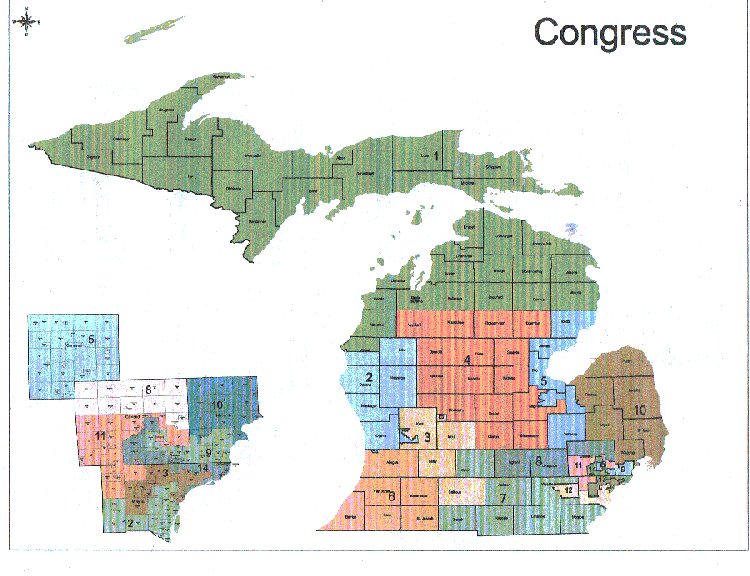
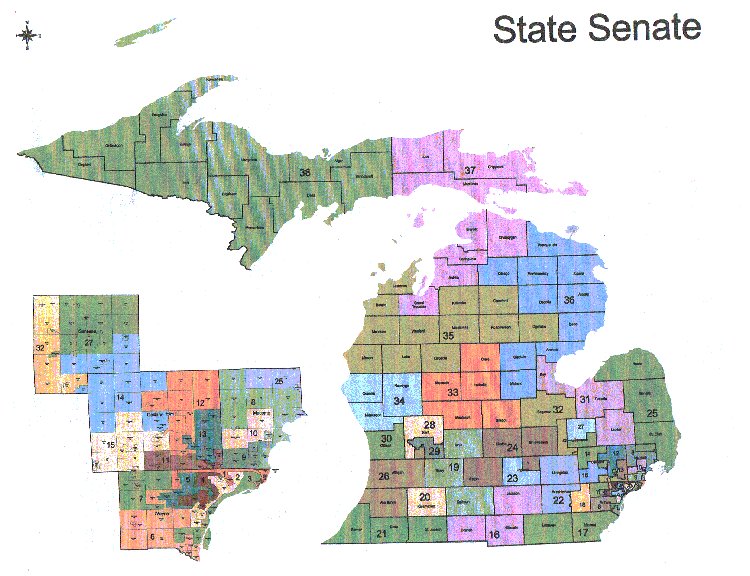
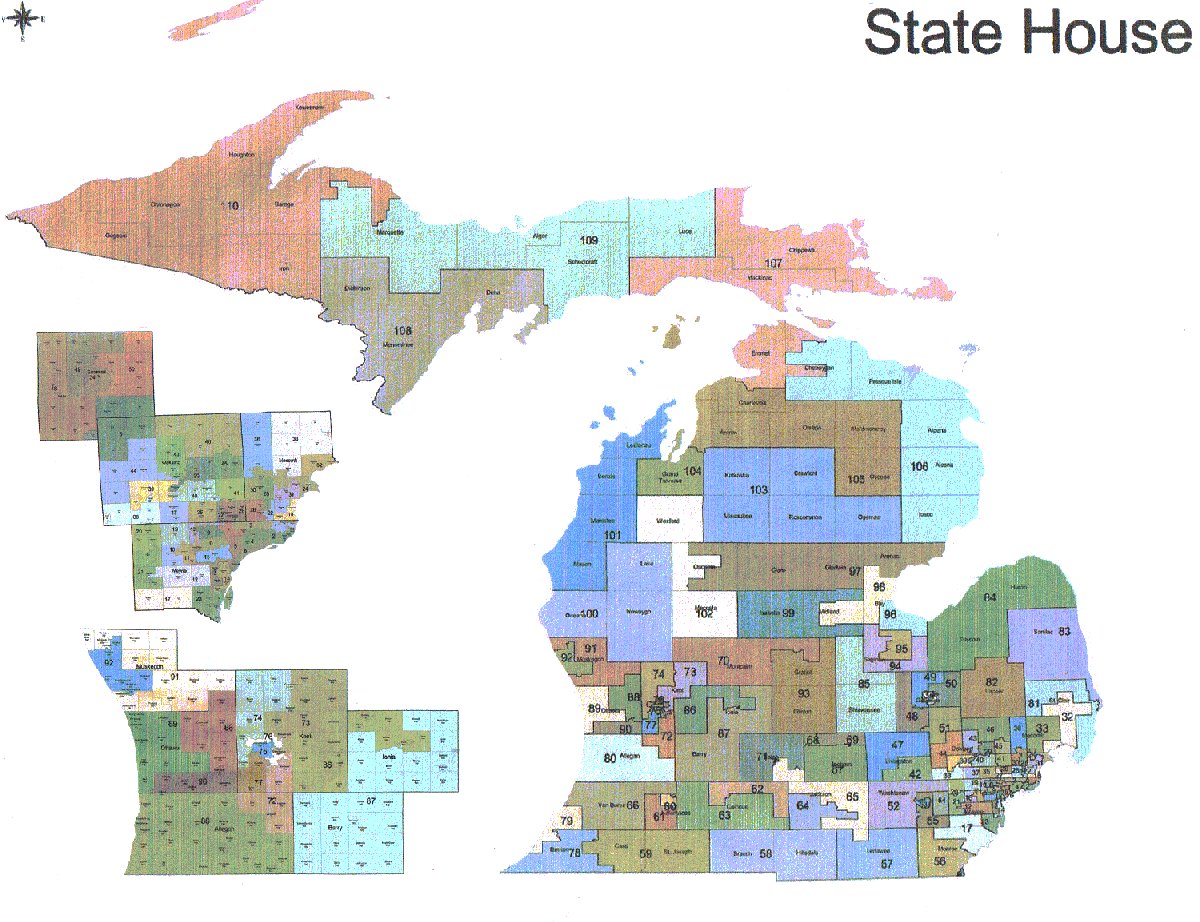
TRUST
FUND BABY
By Russ Harding, 5/4/2011
The Michigan Natural Resources Trust
Fund is funded from oil and gas royalties that have provided millions of dollars
the state has used to purchase large tracts of lands. Those purchases have
provided untold outdoor recreation opportunities for residents and visitors. A
significant downside, however, is that public ownership effectively takes these
lands off tax rolls. Traditionally, the state reimburses local units of
government for the lost revenue using general fund money, even though Article IX
of the state Constitution allows interest and earnings of the Natural Resource
Trust Fund to be used to for these “payments in lieu of taxes” to local
government.
Rep. Joel Johnson, R-Clare, has introduced House Bill 4577, which would direct that PILT money come from interest and earnings of the Natural Resource Trust Fund as provided for in the Constitution. One has to wonder why legislators have not already availed themselves of this opportunity to save money that can be used to help close the state’s budget deficit.
When state officials and lawmakers place more private land in public ownership, there is a cost to the taxpayers for that action. HB 4577 is a good start in addressing the consequences of the use of trust fund dollars to buy state land. This is just a start, however, and more will need to be done.
Permission to reprint this blog post in whole or in part is hereby granted, provided that the author (or authors) and the Mackinac Center for Public Policy are properly cited.
STATE DEBT ALERT! BEWARE
MASSIVE BORROWING DISGUISED AS
"LOTTERY PRIVATIZATION"
By Jack McHugh, April 23, 2011
 In the past few days, politicians in the Republican-controlled Michigan
Legislature have begun murmuring about “lottery privatization.” Don’t be misled,
however – this has nothing to do with saving money by contracting out operation
of the Michigan lottery to a private company.
In the past few days, politicians in the Republican-controlled Michigan
Legislature have begun murmuring about “lottery privatization.” Don’t be misled,
however – this has nothing to do with saving money by contracting out operation
of the Michigan lottery to a private company.
The fact that the talk is coming from appropriations committee members
angsting over spending cuts is suggestive of what’s really being contemplated:
Debt. Hundreds of millions or even billions of dollars of new borrowing that
future Michigan taxpayers will have to repay.
The borrowing would be done by pledging to lenders some or all of the lottery
revenue for years or even decades into the future. In return, the lenders would
write up-front checks that the politicians could start spending right now.
As part of the scheme, a lender would also operate the lottery, just as in
good-faith privatization programs, but that’s just cover. You can tell because,
depending on the size of the loan, rather than flowing into the state Treasury,
some or all of the future lottery revenue would go into the pockets of the
operator to repay the interest and principle on the debt. Depending on the size
of the loan, the amounts would be tens or hundreds of times more than the few
millions a private company would earn each year for just managing the lottery.
The clincher is when the arrangement also involves turning over the operation
for decades into the future. Hardly any legitimate management outsourcing
contracts extend more than five years or so, at the end of which the state can
choose to renew or not depending on the manager’s performance. Because of the
debt owed in these loan-masquerading-as-privatization deals, the state has
essentially no recourse if the lender/operator causes problems.
As for future taxpayers deprived of up to $700 million in annual lottery
revenue that currently supports public schools — too bad: They have no
representation in these borrow-and-spend discussions.
To be sure, the politicians will swear on stacks of Bibles that those big
up-front loan proceeds will go right into an airtight “lockbox,” with ironclad
guarantees to spend the money gradually and only for specified Really Important
Things (specifically, educational things, since the state constitution earmarks
lottery profits to schools). Many lawmakers will even believe it themselves as
they assure taxpayers that this money will never be tapped for any other
purpose. Unless, that is, during some future budget “crisis” a simple majority
of lawmakers plus the governor agree that dipping in is easier than finding more
spending cuts.
There are already quite a few such ‘lockboxes” enshrined in state statutes,
called “restricted funds.” The Legislature never, ever taps these funds to cover
other spending … never more than a few times a year, that is. (See also “How
Fees Fuel Big Government.”)
Handing politicians pools containing hundreds of millions or billions of dollars is never a good idea. When the cost of doing so is massive interest and debt service payments imposed on taxpayers for decades to come, plus the loss of ongoing revenue from a lucrative source like the lottery, it's an even worse one.
Permission to reprint this article in whole or in part is hereby granted, provided that the author (or authors) and the Mackinac Center for Public Policy are properly cited. http://www.mackinac.org.
GOV. SNYDER TO BREAK
MICHIGAN'S MEGA HABIT
By Michael D. LaFaive, 1/28/2011
Although details are not yet
clear, according to early reports Gov. Rick Snyder’s proposed Michigan Business
Tax replacement appears to be good news for advocates of sound economic policy.
Whatever the final details, lowering the tax burden on job providers and making
the system much less complex will surely provide a boost for commerce in the
Great Lakes State.
Arguably of equal importance, press reports are saying the governor’s proposal would also end the Michigan Economic Growth Authority’s selective corporate tax break and subsidy program, and the state film subsidies as well. Research by Mackinac Center analysts shows that, at best, MEGA creates no new net jobs, and it may actually destroy them.
Specifically, Mackinac Center scholars have performed two separate statistical analyses of MEGA, using different methodologies and time periods. A 2005 study found that for every $123,000 in tax credits offered by the program, just one construction job was created, all of which had disappeared after two years.
In 2009, the Center zeroed in on MEGA’s effect on manufacturing jobs, and discovered an apparent link — a negative one. That is, for every $1 million in tax credits actually earned by MEGA companies, 95 manufacturing jobs were lost in the counties where the recipient firms were located.
Two other organizations have performed detailed reviews of MEGA program. One also found it to be a job killer, at least relative to an alternative tax regime of lower overall taxes, and the other found modestly positive job creation, but with overall fiscal effects that were still negative.
If the early reports hold up, Gov. Snyder’s proposal appears to be a bold and fresh approach to tax policy in Michigan. Responding to the news, Mackinac Center President Joseph Lehman posed a regretful question: “Imagine how many of Michigan’s 858,800 lost jobs could have been saved if Gov. Snyder’s predecessors had done what he is doing now?”
Permission to reprint this blog post in whole or in part is hereby granted, provided that the author (or authors) and the Mackinac Center for Public Policy are properly cited. http://www.mackinac.org.
CONSTITUTIONAL CONVENTION WON'T FIX MICHIGAN'S PROBLEMS
By
Joseph G. Lehman, April 13, 2010
On Nov. 2, Michigan voters will face Proposal 1, which will ask whether a
convention should be held to rewrite Michigan's constitution. Although we can
certainly improve that foundational document, most of Michigan's problems
could be solved without rewriting it. Furthermore, there is no guarantee that
a constitutional convention would fix, or even address, whatever problems
might prompt voters to call the convention in the first place.
Proposal 1 will be on the ballot because the current constitution, passed in 1963, requires the question to appear automatically every 16 years, starting in 1978. That year, 77 percent of voters rejected the constitutional convention and 72 percent did likewise in 1994. Recent polling indicates voters may be more open to the idea this year, but they disapprove by more than 2-to-1 when told the cost could be as much as $45 million.
The fundamental purpose of the state constitution is to limit government’s ability to infringe on people’s rights.
Nevertheless, a few convention proponents have organized around specific reform ideas. Examples include lengthening legislative term limits, converting to a part-time Legislature, modifying selection of judges, altering the budget process, expanding water regulation, increasing taxation and more.
Others who have long sought specific changes in Michigan law are considering supporting a convention for the sake of their single issue. Some in the highly energized Tea Party movement wonder if a constitutional convention might let them effectively open the hood of state government and fix what's broken at a time when the state seems unable to cope with its alarming economic decline.
The problem is, that's not the way it would likely work. A constitutional convention is not like handing your car to a certified mechanic; it's more like giving it to 148 trained and untrained mechanics and letting them do anything a majority of them can agree to, including replacing your car with something much worse. After a lot of time, trouble and expense, you and fellow voters collectively choose between the mechanics' handiwork and exactly what you started with.
The passage of Proposal 1 would set a process in motion. Two elections — a partisan primary and a general — would be held by May 2011 to elect the 148 convention delegates, one from each state House and Senate district. They would convene by October, select their own officers and create their own rules. They'd meet in Lansing and could continue through July 2012. Whatever they produced would go to voters for approval within 90 days. If it passed by a simple majority, the new constitution would take effect.
Nothing about this process would address our problems any better than the current legislative system. Our most serious economic problems involve chronic overspending in the face of weakening state revenue, which is worsened by rising levels of taxation and regulation that drive people and businesses from the state.
If our current lawmakers can't fix that, it's not because the constitution prevents them from doing so. More likely it's because voters haven't yet held individual lawmakers responsible for reckless spending (although this may be changing). If voters aren't yet holding legislators accountable for spending, it's not clear how they would hold convention delegates accountable for potentially bigger decisions. The fundamental purpose of the state constitution is to limit government's ability to infringe on people's rights. Where constitutional changes are needed, the voter initiative process is a better alternative than a convention, which could be unlimited in scope and cost millions of taxpayer dollars.
Neither is there a convincing reason to believe convention delegates would be more capable than current legislators. Delegate elections would be highly partisan and influenced by the same special interests that dominate regular elections.
The prospect of rewriting a constitution could attract some truly exceptional, public-service minded candidates, but it would probably attract even more of those who would typically run for the Legislature, along with term-limited former lawmakers. It might especially draw highly charged, single-issue candidates whose priorities could make the convention agenda read like the contents of Pandora's box.
Michigan has serious problems, but they should be fixed without a constitutional convention. The problem with Michigan government isn't so much what's under the hood, it's what we're letting the driver get away with. If your teenage driver is irresponsible, no mechanic can change that. Instead, you need better control and accountability of the driver.
Joseph G. Lehman is president of the Mackinac Center for Public Policy, a research and educational institute headquartered in Midland, Mich. Permission to reprint in whole or in part is hereby granted, provided that the author and the Center are properly cited. http://www.mackinac.org
MICHIGAN TAXPAYERS HAVE
ALREADY MADE COMPROMISES
By James M. Hohman | June 7, 2010
The Michigan Legislature recently passed reforms that slightly lower the cost
of employing state and public school workers by requiring modest employee
contributions for future retiree benefits. The reforms may be cited by
legislators who want to enact a service tax, describing it as a "grand bargain"
wherein both taxpayers and spending interests give a little and get a little.
Unfortunately, the "grand bargain" is a lopsided compromise that will further
burden taxpayers.
Since 2002, Michigan residents have seen four different tax increases: Hikes in income and business tax rates in 2007, and cigarette tax hikes in 2002 and 2004. These are in addition to other revenue enhancements, such as adding "driver responsibility fees" to traffic tickets and selling off future tobacco settlement revenues. Legislators have also reneged on promised phase-downs and phase-outs of income and business taxes. In return, the state received balanced budgets and not a whole lot else.
To the taxpayers, the only issue is the amount they are required to contribute. The state’s current policies make them pay more each year. The cost of government employees, however, keeps increasing. In fiscal 2002, state government spent $3.9 billion in wages and benefits for 60,000 employees. In fiscal 2008, the last year for which data is available, that cost had grown to $4.7 billion despite employing 9,300 fewer full-time equivalent employees.
On average, Michigan spends $93,039 per FTE state employee, up from $65,176 in 2002. State fiscal strains resulted in cuts to other areas of the budget, including university appropriations and local government revenue sharing, even as taxes were raised. But the level of pay and benefits of Michigan's government work force has only increased.
Few state employees receive a $93,039 salary, though. Insurance benefits and retirement costs require 30.5 cents of every dollar in state compensation, and they have grown substantially. Since fiscal 2002, the state's payments for retirement have nearly doubled (state retirement includes generous health benefits), while payments for health insurance have increased by 48 percent. Protecting the wages and benefits received by the state government work force has clearly been a priority for policymakers.
Public school budgets have been even more sheltered than have the state's employees from Michigan's decade-long economic downturn. From 2002 to 2008, cumulative revenues to school districts increased by 2.3 percent, adjusting for inflation. That may not sound like much, but at the same time, total private-sector earnings in Michigan — every private-sector paycheck, employer-paid benefit and dollar earned by a private business — fell 11.5 percent, adjusted for inflation. Public school enrollment over this time fell 3.4 percent. School spending has been detached from declines in both the student population and the economy.
If state and local governments (including school districts) were to bring the fringe benefits received by public-sector employees in line with those of the private sector, our calculations show the savings would equal $5.7 billion annually. This is more than enough to repeal all of the recent state tax hikes, eliminate the Michigan Business Tax and substantially lower any other state tax.
The differences between the compensation for Michigan's government employee and its private-sector taxpayers are unsustainable. Reform is critical. Policymakers are beginning to address the problem, but the current proposals fix only a fraction of the problem.
The savings from the proposals to require employee contributions to state pension systems are difficult to project. At best, the bills would save $400 million annually, which is substantial, but a far cry from the $5.7 billion gap now in place. At worst, the bills may actually cost taxpayers more through provisions that multiply pension benefits and mandate other retiree benefits.
There is constant talk in Lansing about the structure of public-employee benefits: what insurance coverage to offer, whether to pool benefits among various levels of government and whether government workers should be in a "defined-contribution" or a "defined-benefit" retirement system. But to the taxpayers, the only issue is the amount they are required to contribute. The state's current policies make them pay more each year.
Lately, those costs of compensation have increased without any votes from Lansing and with no public discussion. Public-employee expenses are treated as just another cost that taxpayers must bear. But taxpayers have given up much over the past eight years to shore up a broken system. Any public policy "bargain" appealing to "fairness" needs to address the unsustainable growth of public compensation. Addressing these costs would make a service tax unnecessary.
James M. Hohman is a fiscal policy analyst at the Mackinac Center for Public Policy, a research and educational institute headquartered in Midland, Mich. Permission to reprint in whole or in part is hereby granted, provided that the author and the Center are properly cited. www.mackinac.org
MICHIGAN DEPT. OF ED.
MISCALCULATES AVERAGE TEACHER SALARY
Department corrects its error; revised figures available
By Michael Van Beek, June 2, 2010
The Michigan Department of Education improperly calculated the average public school teacher salary in the state for the last six years, reporting figures significantly lower than what is correct. Corrected figures for the past two years were recently released.
The teacher salary averages are published in MDE's "Bulletin 1014" report, which divides the total amount paid in salary to all teachers in the state by the number of teachers. The department, however, had included some charter school teachers in the second figure without adding their pay to the total salary amount. The math error produced a deflated average teacher salary from 2004 to 2009.
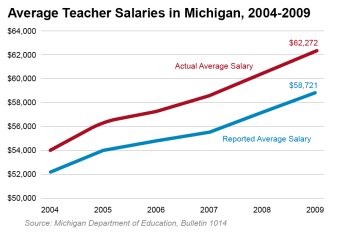 In 2004 the difference
between the average salary reported by the MDE ($52,161) and the correct figure
($54,088) was $1,927, or 3.7 percent. The most recent 2009 report understates
the correct salary amount by $3,551, or 6.1 percent.
In 2004 the difference
between the average salary reported by the MDE ($52,161) and the correct figure
($54,088) was $1,927, or 3.7 percent. The most recent 2009 report understates
the correct salary amount by $3,551, or 6.1 percent.
Charter school teachers generally earn salaries that are considerably lower than those in conventional schools. When they are not included in the calculations the average salary for teachers in conventional districts is $62,556.
The MDE has issued a revised version of the 2009 report that correctly states that the average teacher salary for all teachers that year (conventional and charter) was $62,272, or $3,551 more than the $58,721 originally reported. The 2008 report has also been corrected.
The figures are important because they may be used to inform important policy decisions. For example, the Legislature recently debated a modest school employee pension reform proposed by Gov. Jennifer Granholm, and pensions are based on a teacher's final salary.
Michigan teachers command the highest salaries in the nation when taking into account state per capita personal income.
Reprinted by permission from Michigan Capitol Confidential, a publication of the Mackinac Center, www.mackinac.org.
MICHIGAN'S COSTLY TAB FOR 'CAP-AND-TRADE'
By Tom Gantert, March 18, 2010
Rep. Henry Waxman, D-Calif.Cap-and-trade
legislation will hit Michigan hard by 2030 if passed, costing the state as many
as 91,000 jobs while raising residential energy costs as much as 60 percent and
cutting a family's disposable income by as much as $1,400 a year, according to a
new study.
The study was done by the American Council for Capital Formation, a Washington-based public policy research think tank. It analyzed the impact of the Waxman-Markey HR 2545 bill. That bill contains the "cap-and-trade" language. Cap-and-trade puts a cap on emissions — and energy consumption. Sources either lower their emissions, with the ability to trade any excess allowance not used, or they can exceed the cap and purchase more credits to cover that over usage.
"It's really all pain and no gain as far as our study shows," said Margo Thorning, one of the study's two authors and the senior vice president and chief economist of the ACCF.
The ACCF did a baseline study on Michigan without a cap-and-trade bill, and then compared that to what would happen if the climate legislation were passed.
The study's findings:
Michigan will have between 66,600 and 90,800 fewer jobs by 2030 if cap-and-trade legislation is passed. The job losses will be from lower industrial output due to higher energy prices, the high cost of complying with required emission cuts and greater competition from overseas manufacturers with lower energy costs.
Michigan's energy costs will go up by 2030. Gasoline prices will increase by 20 to 26 percent, electricity prices will increase up to 60 percent and natural gas prices will increase up to 79 percent.
Disposable income for families will be reduced between $883 and $1,435 per year by 2030.
Thorning is coming to Lansing on April 29 to give a more in-depth presentation on the study.
According to the study, cap-and-trade will slow Michigan's economic growth because the state's energy users will have to subsidize more expensive energy sources such as wind and solar power to quickly meet federal mandates.
Thorning said the negative impact economically will not result in any clear environmental benefit because larger developing countries aren't on the same cap-and-trade energy diet.
"The environment doesn't benefit unless China and India take on targets, and they haven't taken on targets," Thorning said. "Our small change will be swamped by the emerging countries who are growing and dependent upon fossil fuels."
The study is available at